
Missed sales opportunities, wasted ad spend, and watching competitors outrank your listings—this is the reality for many Amazon sellers. The problem is not Amazon SEO itself. The problem is execution. Most sellers either focus only on keywords or only on ads, ignoring the fact that Amazon ranking is driven by a combination of relevance, conversion rate (CVR), and sales velocity.
A structured Amazon SEO checklist helps you align all these factors into a system that improves ranking, increases CTR, and drives consistent organic sales. In 2026, winning on Amazon requires not just optimization—but data-driven and conversion-focused optimization.
But here’s the truth after working with 250+ brands at Ecom Ranker:
Amazon SEO is not complicated—it’s just often executed poorly.
With a structured Amazon SEO checklist, you can:
- Rank higher in search results
- Increase click-through rate (CTR)
- Improve conversion rates
- Drive consistent organic sales
In this guide, we break down a complete, actionable Amazon SEO checklist designed for 2026—built on real data, algorithm insights, and proven strategies.
For advanced help, explore ourAmazon SEO services
What is Amazon SEO?
Amazon SEO is the process of optimizing your product listings to rank higher in Amazon search results and increase organic sales. Unlike Google SEO, Amazon’s algorithm prioritizes:
- Sales performance
- Conversion rate
- Keyword relevance
This means your listing must not only attract traffic but also convert it efficiently. A strong Amazon SEO strategy for brands and private label sellers focuses on both visibility and performance.
Ranking formula simplified:
Ranking = Relevance + Sales Velocity + Conversion Rate
Amazon SEO Checklist Template
Using a checklist ensures consistency and execution.
At Ecom Ranker, we recommend combining SEO with CRO (conversion rate optimization) for maximum results.
Learn more in our Amazon growth strategy guide
Step-by-Step Amazon SEO Checklist
A successful Amazon listing is built on multiple ranking signals:
- Keyword relevance
- Sales velocity
- Conversion rate
- Customer satisfaction
Let’s break down each component in depth.
1. Keyword Research for Amazon Listings
Keyword research is the most important step because it determines where your product appears and who sees it.
However, advanced sellers go beyond basic keyword research and focus on buyer intent keywords.
Instead of targeting generic terms like “shampoo”, high-performing listings target specific queries like “organic baby shampoo for sensitive skin”. These keywords have lower competition and higher conversion rates, making them essential for Amazon SEO for private label.
Using tools like Helium 10 and Jungle Scout allows you to analyze search volume, competitor keywords, and trends. But the real advantage comes from identifying keyword gaps—keywords your competitors rank for but you don’t.
More relevant keywords = more visibility = more organic sales
Keyword research is the foundation of Amazon SEO.
It determines:
- Where your product appears
- Who sees it
- How well it converts
Master keyword strategy with our Amazon keyword research services
Focus on Buyer Intent Keywords
Not all keywords are equal.
High-performing listings target buyer intent keywords, not just traffic keywords.
Example:
- Weak: shampoo
- Strong: organic baby shampoo for sensitive skin
These keywords:
- Have lower competition
- Attract ready-to-buy customers
- Improve conversion rates
Use Amazon-Specific Tools
Data-driven decisions outperform guesswork.
Top tools:
Use them for:
- Search volume analysis
- Competitor keyword tracking
- Trend insights
We integrate these tools in our Amazon SEO optimization process

Competitor Analysis (Underrated Goldmine)
Your competitors are already showing you what works.
Steps:
- Identify top-ranking listings
- Extract keywords
- Find gaps
Learn more in our Amazon competitor analysis guide
Expert Insight:
If competitors rank and you don’t—it’s usually a keyword gap or conversion issue.
2. Product Title Optimization
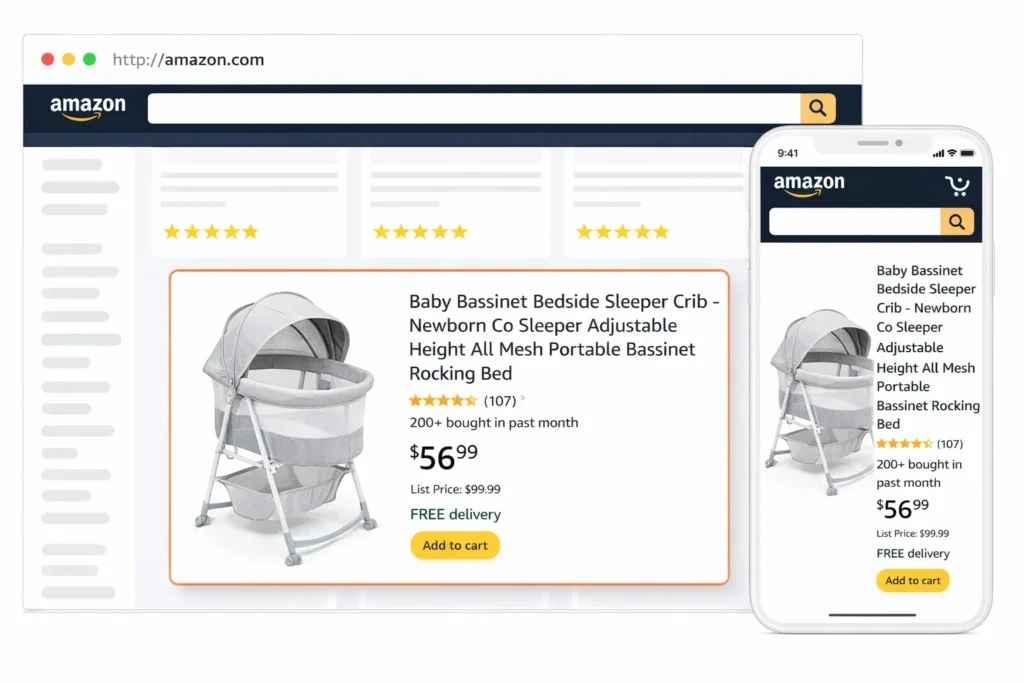
Your title is one of the strongest ranking and CTR factors. It should include your primary keyword while remaining clear and readable.
A high-performing title follows this structure:
Brand + Product Type + Key Features + Benefit
Avoid keyword stuffing, as it reduces readability and can harm conversion rates. Amazon prioritizes listings that convert, not just those with keywords.
A well-optimized title improves both:
- Click-through rate (CTR)
- Conversion rate (CVR)
Higher CTR + CVR = better ranking
Your title directly impacts:
- Rankings
- CTR
- Conversions
Optimize titles with ourAmazon listing optimization service
Key Elements of a High-Converting Title
- Primary keyword (front-loaded)
- Product type
- Key features
- Unique selling points
Structure:
Brand + Product + Features + Benefits
Balance SEO and Readability
Avoid:
Keyword stuffing
Robotic titles
Focus on:
Clarity
Natural flow
Customer understanding
Pro Insight:
Amazon ranks listings that convert—not just those with keywords.
3. Backend Search Terms Optimization
Backend keywords allow you to rank for additional search terms without affecting front-end content.
To optimize backend terms:
- Use synonyms and variations
- Avoid repetition
- Fill maximum character space
Many sellers ignore this section, but it plays a crucial role in improving discoverability and expanding keyword coverage.Backend keywords boost discoverability without affecting readability.
Best Practices
- Use full character space
- Add synonyms & variations
- Avoid repetition
Common Mistakes
- Using irrelevant keywords
- Adding restricted terms
- Keyword stuffing
Stay compliant with our Amazon account management services
4. Bullet Points and Product Description
Bullet points are where you convince customers to buy. Instead of listing features, focus on benefits and problem-solving.
A strong bullet point structure includes:
- Problem → Solution → Benefit
For example, instead of saying “stainless steel bottle”, say:
“Durable stainless steel prevents rust and keeps your drink fresh for longer.”
This improves Amazon conversion rate optimization, which directly impacts ranking.
This is where conversion happens.
Bullet Points Optimization
Focus on:
- Benefits over features
- Problem-solving
- Clear structure
Example:
Built for Durability – High-quality stainless steel prevents rust
Product Description Strategy
Use:
- Storytelling
- Emotional triggers
- Clear formatting
5. Product Images and A+ Content
Visuals directly impact:
- Conversion rate
- Buyer trust
- Sales velocity
Image Optimization
Images are one of the biggest factors affecting both CTR and CVR.
High-performing listings use:
- High-resolution images
- Lifestyle visuals
- Infographics
Your main image determines whether users click, while additional images influence conversion.
Better images = more clicks + more sales
- High resolution
- Multiple angles
- Lifestyle images
A+ Content Strategy
The product description and A+ content are essential for building trust and increasing conversion rates.
A strong description uses:
- Storytelling
- Emotional triggers
- Clear formatting
A+ content enhances engagement and helps differentiate your brand from competitors. It is especially important for Amazon SEO strategy for brands.
Better content = higher CVR = higher ranking
A+ Content improves:
- Engagement
- Conversion rates
- Brand trust
Explore our Amazon A+ content services
6. Customer Reviews and Ratings
Customer reviews directly impact both ranking and conversions.
Products with higher ratings and more reviews tend to rank better because they signal trust and quality.
To improve reviews:
- Deliver a great product experience
- Use Amazon’s “Request a Review” feature
- Respond to negative feedback professionally
Strong reviews = higher CVR = better ranking
Reviews influence both:
- Ranking
- Buying decisions
How to Get More Reviews
- Use “Request a Review”
- Follow-up emails
- Deliver great product experience
Handle Negative Reviews
- Respond professionally
- Fix issues
- Improve product
Build review strategy with Amazon brand growth services
Sales Velocity
Sales velocity is one of the most important ranking signals. The more consistently your product sells, the higher it ranks.
PPC plays a role here by driving initial traffic and sales, which helps boost ranking. Over time, SEO takes over as organic sales increase.
Sales velocity fuels Amazon TACoS optimization
Common Amazon SEO Mistakes to Avoid
Many Amazon sellers struggle to rank not because the market is too competitive, but because of avoidable mistakes in execution. These mistakes directly impact Amazon SEO performance, click-through rate (CTR), conversion rate (CVR), and ultimately TACoS optimization. When these core factors are weak, even high ad spend cannot sustain growth.
Understanding and fixing these issues is essential for building a strong Amazon SEO strategy for brands and private label sellers.
Keyword Stuffing
Keyword stuffing is one of the most common mistakes in Amazon listing optimization. Sellers often try to include as many keywords as possible in titles, bullet points, and descriptions, believing it will improve ranking. However, this approach harms readability and reduces customer trust.
Amazon’s algorithm prioritizes listings that convert, not just those filled with keywords. When your content looks unnatural or repetitive, customers are less likely to engage, leading to lower CTR and CVR.
Solution:
Focus on keyword relevance and natural placement. Use primary keywords in the title, secondary keywords in bullet points, and long-tail keywords in backend search terms. Maintain a clear and readable structure that appeals to customers.
Poor Images (CTR & Conversion Killer)
Images are the first thing customers notice, and they play a major role in both CTR and conversion rates. Low-quality images, unclear product visuals, or lack of lifestyle context can significantly reduce engagement.
A weak main image lowers your CTR because users skip your listing in search results. Even if they click, poor secondary images reduce trust and decrease conversion rates.
Solution:
Use high-resolution images with clean backgrounds, multiple angles, and lifestyle visuals. Add infographics that highlight key features and benefits. Optimized images improve both Amazon CTR and CVR, which are critical ranking factors.
Weak Product Descriptions
Many sellers treat product descriptions as an afterthought, focusing only on keywords instead of persuasion. Weak descriptions fail to communicate value, leaving customers unconvinced.
Amazon’s algorithm tracks conversion behavior. If your listing receives traffic but does not convert, your ranking will drop over time. This makes Amazon conversion rate optimization (CRO) a key part of SEO.
Solution:
Write descriptions that focus on benefits, storytelling, and problem-solving. Use clear formatting, emotional triggers, and structured content to guide the customer toward purchase. Strong content improves engagement and increases sales.
Ignoring Backend Search Terms
Backend search terms are often overlooked, but they play a crucial role in expanding keyword coverage. Ignoring this section limits your ability to rank for additional search queries.
Many sellers either leave backend fields incomplete or misuse them by repeating keywords already used in the front-end content. This reduces their effectiveness.
Solution:
Use backend search terms to include synonyms, alternate spellings, and long-tail keywords. Avoid repetition and irrelevant terms. Proper backend optimization strengthens your Amazon SEO for private label and brand listings.
The Real Impact of These Mistakes
These mistakes collectively reduce:
- CTR → fewer clicks from search results
- CVR → lower conversion rates
- Sales velocity → weaker ranking signals
As a result, your listing struggles to rank organically and becomes more dependent on PPC, increasing TACoS.
How to Fix These Issues
To fix these problems, you need a structured approach:
- Optimize keyword placement without stuffing
- Upgrade images to improve CTR and trust
- Rewrite descriptions for conversion
- Fully utilize backend search terms
A professional audit helps identify hidden gaps and opportunities. This is where Amazon SEO audit services play a critical role in improving performance and unlocking growth.
Build a Ranking System, Not Just Listings
Amazon SEO is not a one-time task. It is a continuous process of optimization and testing.
Winning in 2026 requires:
- Data-driven keyword strategy
- Conversion-focused content
- Continuous testing
- Strong branding
At Ecom Ranker, we help brands:
- Improve rankings
- Increase conversions
- Scale profitably
Explore our full Amazon growth services
Frequently Asked Questions
Can you do SEO on Amazon?
Yes, Amazon SEO focuses on optimizing listings for visibility and conversions.
How do I rank higher on Amazon?
Use keyword optimization, improve CVR, and increase sales velocity.
How long does Amazon SEO take?
Typically 4–8 weeks depending on competition.
Does SEO reduce TACoS?
Yes, by increasing organic sales and reducing ad dependency.