
When shoppers browse Amazon, they rarely read the product title first.
They look at the product image.
In a marketplace with millions of products, the image becomes the first impression that determines whether a customer clicks your listing or scrolls past it.
This is why Amazon product image optimization is one of the most powerful yet overlooked strategies for improving product performance.
After working with Amazon brands for more than a decade, one thing has become clear:
Better product images increase both click-through rate and conversion rate dramatically.
Many sellers spend thousands of dollars on advertising, but if the product images are weak, customers simply won’t buy.
Optimizing product images helps you:
- Increase search click-through rate
- Improve conversion rate
- Build brand trust
- Reduce product returns
- Improve organic rankings
If you want to improve your listing performance, it’s also helpful to understand how Amazon conversion rate optimization works because images play a major role in turning visitors into buyers.
In this complete guide, we’ll explore how to optimize Amazon product images for maximum visibility, engagement, and conversions.
Why Amazon Product Images Matter for SEO and Sales
Amazon is a visual shopping platform.
Customers scroll through search results quickly and rely heavily on images to decide which product to click.
This means product images directly affect two important metrics:
Click-Through Rate (CTR)
Your main image determines whether customers click your product.
A stronger main image increases traffic.
Conversion Rate
Once customers land on the listing, additional images help them understand the product and make purchase decisions.
Higher conversion rates send strong signals to the Amazon ranking algorithm, which can help your product rank higher in search results.
In simple terms:
Better images → More clicks → Higher conversions → Better rankings.
Amazon Product Image Guidelines
Before optimizing your images, you must follow Amazon’s official image requirements.
Amazon has strict rules about how product images should appear on the platform.
Main Image Requirements
The main image must:
- Have a pure white background
- Show only the product being sold
- Fill at least 85% of the frame
- Be sharp and clear
- Not contain text or graphics
These guidelines ensure consistency across Amazon’s marketplace.
Recommended Image Size
Amazon requires a minimum resolution of 1000 x 1000 pixels.
However, professional sellers typically use 2000 x 2000 pixels.
Higher resolution images allow zoom functionality, which improves customer experience.
The Ideal Amazon Image Sequence
Amazon allows up to 9 product images per listing.
Instead of randomly uploading images, the best-performing listings follow a strategic image sequence.
A common high-converting structure includes:
- Main product image
- Product lifestyle image
- Key feature infographic
- Product benefit infographic
- Product size and dimensions
- Comparison chart
- Usage demonstration
- Brand story image
- Product video thumbnail
This creates a visual journey that guides customers through the buying process.
How to Optimize the Main Product Image
The main product image is the most important image on your listing.
It determines whether customers click your product in search results.
Main Image Optimization Tips
Use:
- Bright lighting
- High contrast
- Clear product angles
- Professional photography
Avoid clutter or unnecessary objects.
The goal is to make the product stand out clearly in search results.
Use Lifestyle Images to Increase Conversions
Lifestyle images show the product in real-life situations.
Instead of simply displaying a product, lifestyle images help customers imagine owning it.
For example:
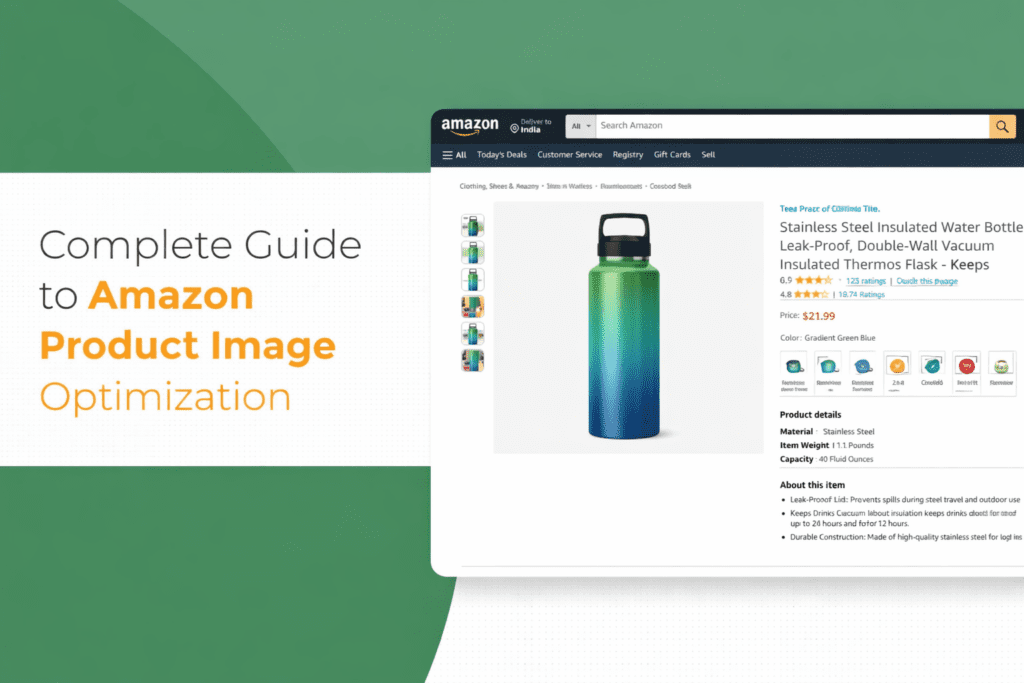
A water bottle listing might show someone using the bottle during a workout or outdoor activity.
Lifestyle images create emotional connections with shoppers and increase purchase confidence.
Use Infographics to Explain Product Features
Infographics combine visuals with short explanations.
They help customers quickly understand product features.
Examples of infographic content include:
- Material quality
- Key product benefits
- Technical specifications
- Unique selling points
These visuals make complex information easier to digest.
Highlight Product Size and Dimensions
One of the biggest reasons for product returns on Amazon is size misunderstanding.
Customers often cannot judge product dimensions accurately from images.
Always include an image that clearly shows size.
Examples include:
- Product next to a person
- Product next to common objects
- Measurement diagrams
This helps customers make informed purchasing decisions.
Use Comparison Charts
Comparison charts help customers evaluate different product options.
If your brand sells multiple products, comparison charts are especially useful.
Example comparison table:
| Product | Size | Material | Best Use |
|---|---|---|---|
| Bottle A | 20oz | Steel | Gym |
| Bottle B | 32oz | Steel | Outdoor |
Comparison charts increase both customer confidence and average order value.
The Psychology Behind High-Converting Product Images
Effective product images appeal to customer psychology.
Three important factors influence buying decisions.
Trust
Professional images signal high product quality.
Customers are more likely to buy from listings that look trustworthy.
Clarity
Customers must understand the product immediately.
Clear images eliminate confusion.
Desire
Lifestyle images help customers imagine the product improving their life.
This emotional connection increases conversions.
Mobile Optimization for Product Images
More than 60% of Amazon shoppers browse on mobile devices.
Images must look good on smaller screens.
Mobile optimization tips include:
- Use large readable text
- Avoid tiny font sizes
- Keep visuals simple
If images are cluttered or text is too small, mobile shoppers will ignore them.
Advanced Amazon Image Optimization Strategies
Experienced Amazon sellers use advanced strategies to maximize results.
A/B Testing Product Images
Amazon allows sellers to run Manage Your Experiments tests.
You can test different images to determine which ones perform best.
Examples include testing:
- Main image variations
- Lifestyle images
- Infographic styles
Testing helps identify which images produce the highest conversion rates.
Use Product Videos
Videos dramatically increase customer engagement.
Product videos can demonstrate:
- How the product works
- Key product features
- Real-world usage scenarios
Video content helps answer customer questions quickly.
Maintain Strong Brand Identity
Brand consistency builds recognition and trust.
Strong branding includes:
- Consistent color schemes
- Logo placement
- Similar visual styles across listings
Consistent branding helps customers remember your products.
Optimize Images for Advertising
If you’re running ads, the main product image becomes even more important.
Ads appear in crowded search results.
Better images improve click-through rate and advertising performance.
To learn how advertising works with listing optimization, you can explore strategies in the Amazon PPC strategy guide.
How Product Images Support New Product Launches
When launching a new product, optimized images are critical.
New listings have no reviews or sales history.
Images must do most of the work convincing customers to buy.
For sellers preparing to launch products, the complete Amazon product launch strategy guide explains how listing elements influence early sales.
Common Amazon Product Image Mistakes
Many sellers make simple mistakes that hurt conversions.
Low-Resolution Images
Blurry images reduce trust.
Always use high-resolution photography.
Overcrowded Images
Too many elements distract from the product.
Keep images clean and focused.
Misleading Visuals
Never exaggerate product features.
Misleading images lead to negative reviews.
Ignoring Customer Questions
Reviews often reveal what customers don’t understand about the product.
Use images to answer those questions.
Amazon Product Image Optimization Checklist
Before uploading your listing images, confirm the following:
✔ High-resolution images
✔ White background main image
✔ Lifestyle images included
✔ Infographic feature explanations
✔ Product dimensions shown
✔ Mobile-friendly design
✔ Brand consistency maintained
Following this checklist ensures a professional product listing.
How Optimized Images Improve Amazon Rankings
While images do not directly affect keyword indexing, they influence ranking indirectly.
Optimized images improve:
- Click-through rate
- Conversion rate
- Customer satisfaction
These signals help Amazon’s algorithm identify high-quality listings.
Higher conversions can ultimately lead to stronger rankings.
Amazon Product Image Optimization FAQs
How many images should an Amazon listing have?
Most successful listings use 7–9 images.
What size should Amazon images be?
Recommended image size is 2000 x 2000 pixels.
Can Amazon images include text?
Yes, infographic images can include text, but the main image cannot.
Do images affect Amazon SEO?
Images affect conversion rate, which indirectly improves rankings.
Final Thoughts
Amazon product image optimization is one of the most effective ways to improve listing performance.
While many sellers focus on keywords and advertising, images remain the primary factor influencing customer decisions.
Investing in high-quality product images can dramatically improve:
- Click-through rate
- Conversion rate
- Advertising performance
- Organic rankings
When optimized properly, product images transform a basic listing into a high-converting product page that drives consistent sales.