
Product images are one of the most powerful conversion tools on Amazon. In a marketplace where customers cannot physically touch or inspect a product, visuals become the primary way shoppers evaluate quality, understand features, and build trust with a brand.
Over the past decade of working with Amazon brands and optimizing thousands of listings, one trend has remained consistent: better product images directly increase conversion rates and sales performance.
Amazon itself confirms that listings with optimized visuals and enhanced content can experience conversion improvements of up to 10–20%.
That’s why understanding the latest Amazon product image size requirements for 2026 is essential for any seller who wants to remain competitive.
In this guide, we will cover:
• Amazon product image size requirements
• Detail page (DP) image guidelines
• Main image rules
• Recommended image formats
• Best practices for higher conversions
• Common mistakes sellers should avoid
• How A+ Content works with product images
If you are serious about improving product visibility and sales on Amazon, mastering product images is just as important as mastering Amazon SEO ranking strategies, which we explain in our guide on Amazon SEO optimization techniques .

What Are Amazon DP Images?
DP images, or Detail Page Images, are the product visuals displayed on an Amazon product listing.
These images represent your product on the listing page and help customers understand what they are buying.
DP images include:
• the main product image
• secondary product images
• lifestyle images
• infographic images
• product demonstration visuals
Together, these images create the visual experience customers see when visiting your listing.
From years of analyzing Amazon conversion data, it’s clear that customers rely heavily on product images to answer questions like:
• What does the product look like?
• How large is it?
• What features does it have?
• How is it used?
Because of this, DP images have a direct influence on purchasing decisions.
Brands that combine optimized images with strong keyword targeting often see improved organic rankings. For example, combining optimized visuals with strategies like Amazon backend keyword optimization can significantly improve listing visibility, which we explain in our Amazon backend keyword strategy guide .
Why Product Image Quality Matters on Amazon
Before discussing technical image requirements, it’s important to understand why visuals are so important.
First impressions drive clicks
When shoppers browse Amazon search results, they usually see only three things:
• product title
• price
• main product image
Among these, the image is often the first thing that captures attention.
A clean, professional image can dramatically increase your click-through rate.
Images build customer trust
Customers rely on visuals to determine product quality.
Blurry or poorly designed images can immediately reduce trust and cause shoppers to skip your listing.
High-quality images, on the other hand, signal professionalism and reliability.
Images answer customer questions
A strong image gallery can answer many questions customers might otherwise ask.
For example:
• showing product size comparisons
• demonstrating usage
• highlighting product materials
• explaining key features
When customers clearly understand a product, they are more likely to buy.
What Is the Amazon Main Image?
The main image is the most important visual in your listing.
It appears in:
• Amazon search results
• category pages
• product listings
Because it acts as your product’s thumbnail across the marketplace, Amazon enforces strict guidelines for main images.
Amazon Main Image Requirements
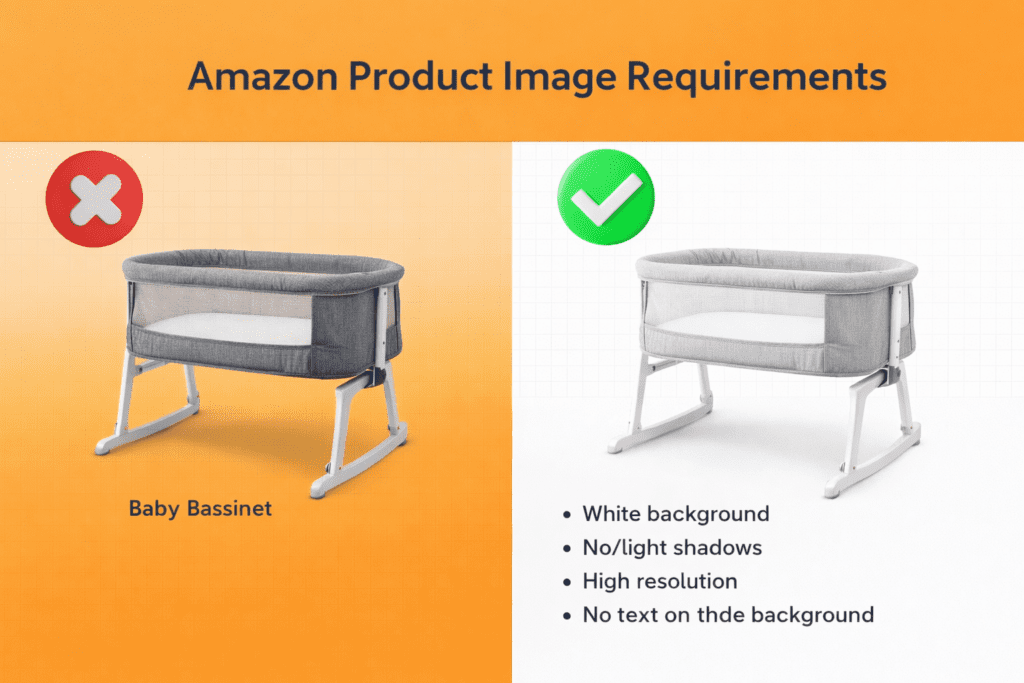
• The background must be pure white (RGB 255,255,255)
• The product must occupy at least 85% of the frame
• No logos, text, or graphics allowed
• No additional objects unless included with the product
• The product must accurately represent what is being sold
These rules ensure consistency across the marketplace and allow customers to easily compare products.
If your listing violates these requirements, Amazon may suppress the image or the entire listing.
Amazon Product Image Size Requirements (2026)
Understanding Amazon’s technical image requirements is essential for maintaining compliant listings.
Minimum image size
1000 x 1000 pixels
This is the minimum required size to activate Amazon’s zoom feature.
The zoom function allows shoppers to inspect product details closely, which can significantly increase buyer confidence.
Recommended image size
2000 x 2000 pixels or larger
Professional Amazon sellers usually upload images that are at least 2000 pixels on the longest side.
This ensures optimal display quality and better zoom functionality.
Maximum image size
10,000 pixels on the longest side
Images larger than this limit will be rejected by Amazon.
Supported image formats
Amazon accepts several image file formats:
• JPEG (.jpg) — recommended
• PNG (.png)
• TIFF (.tif)
• GIF (.gif)
Among these, JPEG is typically preferred because it balances image quality with smaller file size.
Amazon Image Aspect Ratio
Amazon does not strictly enforce one aspect ratio for secondary images, but many successful sellers use the 3:4 ratio.
This format allows the product to appear larger and more visually appealing on both desktop and mobile devices.
Additional Image Guidelines
Amazon allows sellers to upload multiple images per listing.
Most categories allow:
• up to 9 images
• product videos
These additional images provide an opportunity to showcase product benefits.
For example, sellers often include:
• lifestyle images
• close-up feature images
• product comparison charts
• packaging photos
• product dimension diagrams
When designing these images, it is helpful to combine strong visuals with optimized listing copy. If you are looking to improve listing structure as well, our Amazon listing optimization guide explains how product images and listing content work together .
Best Practices for Amazon Product Images
Meeting Amazon’s minimum image requirements is only the starting point.
To maximize sales performance, sellers should follow several best practices.
Use High-Resolution Images
Low-resolution images appear blurry when customers zoom in.
Professional Amazon listings typically use images between 2000–3000 pixels.
Clear images allow shoppers to inspect product details and build trust.
Show the Product Clearly
Your product should occupy at least 85% of the image frame.
Avoid unnecessary empty space.
Large, clear product visuals improve visibility on mobile devices.
Use Lifestyle Images
Lifestyle images demonstrate how the product fits into a customer’s life.
Examples include:
• showing the product being used
• placing the product in realistic environments
• demonstrating practical scenarios
Lifestyle visuals help customers imagine themselves using the product.
Add Infographic Images
Infographic images combine visuals with short text descriptions.
These images highlight key features such as:
• product dimensions
• materials
• benefits
• package contents
Infographics help communicate important information quickly.
Maintain Brand Consistency
Your image gallery should follow a consistent style.
This includes:
• similar lighting
• similar backgrounds
• consistent color tones
Strong branding builds customer trust and recognition.
How Product Images Improve Conversion Rates
From analyzing thousands of Amazon listings over the past decade, we’ve consistently seen a strong relationship between image quality and conversion rate.
Listings with optimized images often experience:
Higher click-through rates
Strong main images attract more clicks from search results.
Higher conversion rates
When customers clearly understand the product, they feel more confident purchasing.
Lower return rates
Accurate images prevent misunderstandings about size, color, or features.
Common Amazon Image Mistakes
Even experienced sellers sometimes make mistakes when uploading product images.
Here are the most common problems.
Incorrect image size
Images smaller than 1000 pixels prevent zoom functionality.
This significantly reduces product trust.
Non-white backgrounds
Amazon requires a pure white background for main images.
Colored backgrounds may cause listing suppression.
Watermarks or logos
Text overlays, logos, and watermarks are not allowed in main images.
Misleading visuals
Images must accurately represent the product.
Misleading images often result in negative reviews and high return rates.
How to Upload Images on Amazon
Uploading images in Seller Central is simple.
Follow these steps:
- Log into Seller Central
- Navigate to Inventory → Manage Inventory
- Select your product listing
- Click Edit
- Upload images in the Images tab
- Save and update the listing
Images typically appear live within a few hours.
Using A+ Content with Product Images
Amazon’s A+ Content feature allows brand-registered sellers to create enhanced product descriptions.
Instead of plain text, A+ Content includes:
• large images
• comparison charts
• feature explanations
• brand storytelling
Listings that use A+ Content often see conversion improvements.
Sellers who want help implementing A+ Content and advanced listing design can explore our Amazon listing optimization services .
Premium A+ Content (A++ Content)
Premium A+ Content provides additional visual modules.
These include:
• interactive hotspots
• video modules
• enhanced comparison charts
According to Amazon, Premium A+ Content can increase sales by up to 20%.
Optimizing Images for Amazon SEO
Although images themselves do not directly influence keyword rankings, they support overall SEO performance.
Best practices include:
• using descriptive file names
• adding alt-text descriptions
• aligning visuals with keyword-optimized listings
Strong SEO combined with high-quality visuals can dramatically increase product visibility.
Brands looking to improve both SEO and advertising performance often benefit from professional Amazon PPC management services .
Final Thoughts
Amazon product images are far more than just visuals.
They are one of the most important drivers of:
• customer trust
• click-through rates
• conversion rates
By following Amazon’s product image size requirements and implementing strong visual strategies, sellers can significantly improve listing performance.
For brands looking to scale their marketplace growth, combining optimized images with advanced strategies like Amazon SEO services can provide a powerful competitive advantage .
At EcomRanker, we help brands improve every aspect of their Amazon presence—from product images to advertising strategies and listing optimization.
Frequently Asked Questions
What size should Amazon product images be?
Amazon requires a minimum image size of 1000 x 1000 pixels, but the recommended size is 2000 x 2000 pixels or larger.
Why does Amazon require a white background?
A white background ensures consistency across product listings and allows customers to easily compare products.
How many images can I upload on Amazon?
Most Amazon categories allow up to 9 images including videos.
Do product images affect Amazon ranking?
While images do not directly affect keyword ranking, they influence click-through rate and conversion rate, which are key ranking signals.