
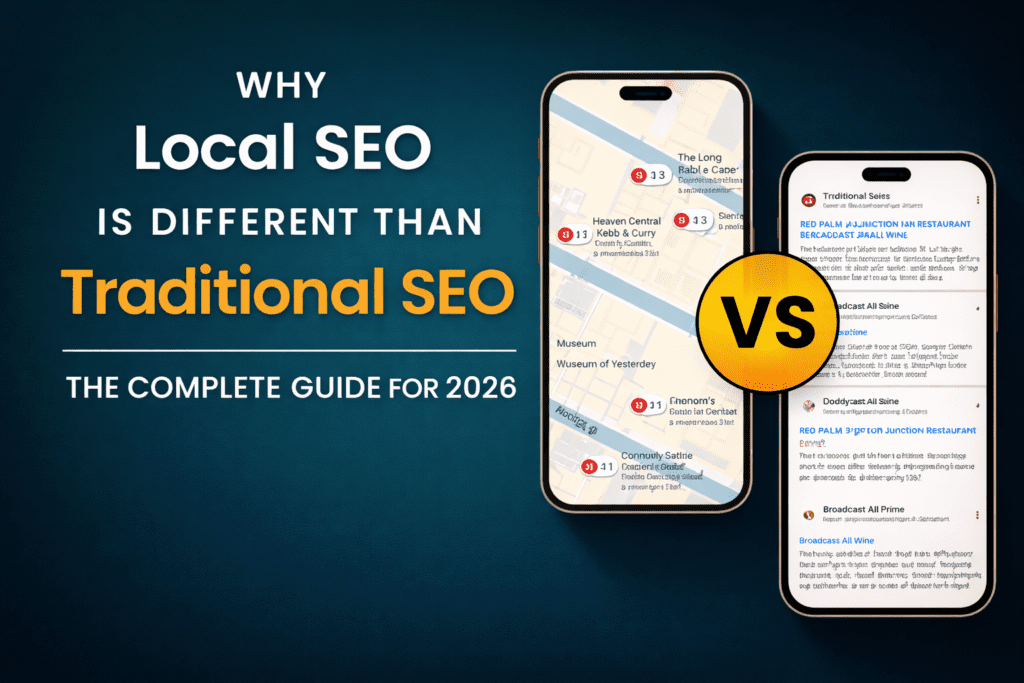
Search engine optimization has evolved far beyond simply ranking a website for broad keywords. Today, businesses must understand that Local SEO and Traditional SEO serve different purposes, target different audiences, and require distinct strategies. While traditional SEO focuses on improving visibility on a national or global scale, local SEO is designed to help businesses appear in geographically relevant searches, such as “coffee shop near me” or “best plumber in London.”
If you own a business that serves a specific area, understanding the difference between local SEO vs traditional SEO can dramatically improve your online visibility, lead generation, and conversion rates.
In this comprehensive guide, we’ll explain why local SEO is different than traditional SEO, how each works, and why businesses need the right strategy to compete in modern search results.
What Is Traditional SEO?
Traditional SEO refers to the process of optimizing a website to rank higher in search engine results for broad, non-location-specific keywords. It is typically used by businesses that operate nationally, internationally, or online-only.
Traditional SEO Focuses On:
- Ranking for industry-related keywords regardless of location
- Increasing organic website traffic from broad audiences
- Building domain authority through backlinks
- Creating content to target informational and commercial search intent
- Competing in standard organic search results
Example Traditional SEO Keywords:
- Best CRM software
- How to lose weight
- Digital marketing strategies
- Buy office furniture online
Traditional SEO is ideal for:
- SaaS companies
- E-commerce stores
- National brands
- Online educators
- Affiliate websites
What Is Local SEO?
Local SEO is the process of optimizing your online presence to rank for location-based searches in search engines, especially Google.
It helps businesses appear in:
- Google Map Pack / Local Pack
- Google Maps results
- “Near me” searches
- Location-specific organic search results
Example Local SEO Keywords:
- Dentist in Manchester
- Best pizza near me
- Emergency plumber Birmingham
- SEO agency in London
Local SEO is essential for:
- Brick-and-mortar stores
- Service-area businesses
- Local agencies
- Restaurants
- Medical clinics
- Contractors
Why Local SEO Is Different Than Traditional SEO
Although both strategies aim to improve search visibility, the ranking factors and optimization methods differ significantly.
1. Local SEO Targets Geographic Intent
The most significant difference is search intent.
Traditional SEO targets users searching for general information or products.
Local SEO targets users searching for businesses in a specific geographic area.
Examples:
- Traditional Search: “Best digital marketing tools”
- Local Search: “Digital marketing agency in New York”
Google understands local intent and delivers location-based results accordingly.
Why It Matters:
Local SEO helps businesses connect with high-intent users who are ready to visit, call, or purchase nearby.
2. Google Business Profile Plays a Major Role in Local SEO
Unlike traditional SEO, Google Business Profile (GBP) is a major ranking factor for local SEO.
Your GBP listing affects visibility in:
- Google Maps
- Local 3-Pack
- Mobile “near me” searches
GBP Optimization Includes:
- Accurate business name
- Correct address and phone number (NAP)
- Business categories
- Photos and videos
- Reviews
- Service areas
- Business hours
Traditional SEO does not rely on Google Business Profile.
3. Local SEO Relies Heavily on Proximity
Traditional SEO rankings are mostly based on:
- Relevance
- Authority
- Content quality
- Backlinks
Local SEO adds a major factor:
Proximity
Google considers how close the business is to the searcher.
For example:
Two businesses with similar SEO may rank differently depending on the user’s location.
This makes local SEO more dynamic and personalized than traditional SEO.
4. Online Reviews Impact Local Rankings
Reviews are far more influential in local SEO.
Google uses:
- Review quantity
- Review quality
- Review recency
- Keyword relevance in reviews
Why Reviews Matter:
- Build trust
- Improve click-through rates
- Influence local rankings
- Increase conversions
Traditional SEO rankings are less directly affected by customer reviews.
5. Local Citations Are Critical for Local SEO
Local SEO depends on citation consistency.
A citation is any online mention of your business’s:
- Name
- Address
- Phone Number
Examples include:
- Yelp
- Bing Places
- Apple Maps
- Local directories
- Industry directories
Consistent citations strengthen local trust signals.
Traditional SEO usually does not depend on citation management.
6. Local SEO Uses Location-Specific Landing Pages
Local businesses often create pages for:
- Each city served
- Each service + location combination
- Multi-location branches
Examples:
- /plumbing-services-london
- /roof-repair-manchester
- /seo-agency-birmingham
Traditional SEO generally targets broader topic clusters rather than location pages.
7. Local Link Building Is More Community Focused
Traditional SEO backlink strategies often seek:
- High-authority national publications
- Industry blogs
- Broad digital PR
Local SEO values:
- Local news websites
- Chamber of commerce links
- Local business partnerships
- Community sponsorships
- Regional blogs
Local relevance matters more than pure authority.
8. Mobile Search Dominates Local SEO
Most local searches happen on mobile devices.
Examples:
- “Restaurant near me”
- “Emergency locksmith nearby”
- “Pharmacy open now”
Therefore local SEO requires:
- Mobile-friendly design
- Fast loading pages
- Click-to-call buttons
- Embedded maps
- Easy navigation
Traditional SEO values mobile optimization too, but local SEO depends on it even more.
9. Conversion Intent Is Higher in Local SEO
Local searchers are usually closer to making a purchase.
Statistics Often Show:
- Many local searches result in same-day visits
- “Near me” searches indicate strong buying intent
Traditional SEO may target users earlier in the buyer journey.
Traditional SEO vs Local SEO Comparison Table
| Factor | Traditional SEO | Local SEO |
|---|---|---|
| Target Audience | Broad/National | Nearby/Regional |
| Search Intent | Informational/Commercial | Immediate/Local Purchase |
| Key Ranking Factors | Content, Links, Authority | GBP, Reviews, Proximity, Citations |
| Google Maps Presence | No | Yes |
| Location Pages | Rare | Essential |
| Reviews Impact | Moderate | High |
| Citation Building | Minimal | Critical |
Which SEO Strategy Does Your Business Need?
You Need Traditional SEO If:
- You sell products nationally/internationally
- You run an online-only business
- Your audience is not location-dependent
You Need Local SEO If:
- You serve customers in a defined geographic area
- You have a physical location
- You operate as a local service provider
Many Businesses Need Both
Some businesses benefit from combining both:
- A national brand with local branches
- An e-commerce company with physical stores
- A franchise business
Benefits of Local SEO for Businesses
Local SEO has become one of the most powerful digital marketing strategies for businesses that serve customers within a specific geographic area. Unlike broader search engine optimization campaigns that target national or global audiences, local SEO focuses on attracting nearby customers who are actively searching for products or services in their area. Because these users often have immediate purchase intent, local SEO can generate highly qualified traffic and deliver a stronger return on investment than many traditional marketing channels. Below are the key benefits of local SEO for businesses explained in detail.
Increased Visibility in Google Maps and Local Search Results
One of the biggest advantages of local SEO is improved visibility in Google Maps, the Google Local Pack, and location-based search results. When users search for terms such as “plumber near me,” “best dentist in London,” or “coffee shop nearby,” Google prioritizes local business listings that are relevant, optimized, and geographically close to the searcher.
Appearing in these prominent local placements gives your business significantly more exposure than standard organic listings because map results often appear above traditional website rankings. This means customers can discover your business before they even scroll down the page. For many local businesses, visibility in the Google Map Pack can generate a substantial percentage of total leads and customer enquiries.
Businesses that invest in local SEO improve their chances of ranking in:
- Google Maps results
- Google Local 3-Pack listings
- “Near me” searches
- Mobile location-based searches
- Voice search local queries
Greater visibility in these areas means your business is seen by more potential customers exactly when they are searching for what you offer.
More Phone Calls and Customer Enquiries
Local SEO helps drive more direct customer actions, including phone calls, contact form submissions, booking requests, and quote enquiries. Users searching for local businesses are often in the decision-making stage of the buyer journey and are ready to take immediate action.
When your business appears in local search results with a well-optimized Google Business Profile, users can contact you instantly through:
- Click-to-call buttons
- Contact links
- Website visit buttons
- Appointment booking integrations
- Direction request options
Because local search users have stronger commercial intent than general search traffic, the leads generated through local SEO tend to be more qualified and conversion-ready. A business that ranks well locally can consistently generate enquiries without paying for every click like with paid advertising.
Higher Foot Traffic to Physical Locations
For brick-and-mortar businesses, local SEO can significantly increase in-store visits by helping nearby customers discover your location when searching online. Consumers frequently use Google Search and Google Maps to find nearby stores, restaurants, clinics, and service providers before deciding where to visit.
By ranking prominently in local search results, your business becomes more accessible to people who are actively looking for nearby solutions. Features such as map listings, directions, operating hours, photos, and reviews help users choose your business over competitors.
Industries that particularly benefit from increased foot traffic through local SEO include:
- Restaurants and cafés
- Retail shops
- Medical clinics
- Salons and spas
- Gyms and fitness centers
- Automotive businesses
For these businesses, improved local visibility directly translates into more walk-in customers and higher sales.
Better Trust and Credibility Through Customer Reviews
Online reviews are one of the strongest trust signals in local SEO. Consumers often rely heavily on reviews when choosing between nearby businesses, especially when comparing service providers with similar offerings.
A strong review profile helps build credibility by showing prospective customers that others have had positive experiences with your business. Google also uses review signals as part of its local ranking algorithm, meaning reviews can improve both trust and rankings simultaneously.
Benefits of positive reviews include:
- Higher click-through rates from search results
- Improved conversion rates
- Greater customer confidence
- Enhanced brand reputation
- Better local search rankings
Responding professionally to reviews—both positive and negative—can further strengthen trust and demonstrate strong customer service.
Increased Conversions From High-Intent Local Buyers
Local SEO attracts users who are often much closer to making a purchase compared to traditional organic traffic. Someone searching “emergency electrician near me” or “best pizza in Manchester” typically has immediate intent and is actively seeking a nearby provider.
Because of this, local SEO traffic often converts at a higher rate than broader SEO traffic. Instead of attracting general visitors who may simply be researching, local SEO connects your business with users who are ready to:
- Make a purchase
- Book an appointment
- Request a quote
- Call for immediate assistance
- Visit your location
This makes local SEO one of the most efficient lead-generation channels for service-based and location-dependent businesses.
Competitive Advantage Over Nearby Businesses
Many local businesses still neglect local SEO or optimize it poorly. This creates a major opportunity for businesses that invest in it strategically.
A well-executed local SEO strategy can help your business outrank nearby competitors in:
- Google Maps
- Local Pack results
- Local organic rankings
- “Near me” searches
Even in competitive industries, strong optimization of your Google Business Profile, website, reviews, citations, and local content can provide a meaningful edge over competitors who are not investing properly in local search visibility.
Local SEO allows smaller businesses to compete effectively with larger competitors by focusing on geographic relevance rather than national authority alone.
Long-Term Cost-Effective Marketing ROI
Unlike paid advertising, where visibility stops as soon as you stop spending, local SEO can provide long-term ongoing visibility and lead generation once rankings are established.
Although local SEO requires time and consistent effort, it often delivers:
- Lower long-term customer acquisition costs
- Sustainable lead generation
- Ongoing visibility without per-click charges
- Better marketing ROI over time
For many businesses, local SEO becomes a core driver of leads after rankings stabilize.
Improved Brand Awareness in Your Local Market
Even when users do not convert immediately, appearing consistently in local search results increases awareness and familiarity with your brand. Repeated exposure in Google Maps and local listings helps build recognition within your service area.
Over time, this can position your business as the go-to provider in your local market.
Final Thoughts: Local SEO Requires a Different Strategy
Local SEO is not simply traditional SEO with a city name added to keywords. It is a distinct search optimization discipline built around proximity, local relevance, business listings, reviews, and geographic intent.
Businesses that treat local SEO like standard SEO often miss critical ranking opportunities.
To dominate local search results, you need a strategy specifically designed for:
- Google Business Profile optimization
- Citation building
- Review generation
- Local landing pages
- Geo-targeted keyword research
- Community-based link acquisition
Frequently Asked Questions About Local SEO vs Traditional SEO
Adding a strong FAQ section can improve topical depth, target long-tail search queries, and help your content rank for featured snippets. Below is an expanded, SEO-friendly FAQ section with detailed answers you can add to your blog post.
Is Local SEO Easier Than Traditional SEO?
Not necessarily. While local SEO often targets a smaller geographic market than traditional SEO, it comes with its own unique challenges. Businesses must optimize for factors that traditional SEO does not heavily rely on, including Google Business Profile management, customer reviews, citation consistency, proximity to searchers, and Google Maps optimization. In competitive local markets, ranking in the Google Map Pack can be just as difficult as ranking organically for national keywords.
Can Local SEO Help Online Businesses?
Local SEO generally benefits businesses that serve customers in a defined geographic area. If your online business operates nationally or globally without targeting specific locations, traditional SEO is usually more relevant. However, online businesses with physical locations, local service areas, or region-specific operations can benefit significantly from local SEO alongside broader SEO efforts.
How Long Does Local SEO Take to Show Results?
Local SEO typically takes 3 to 6 months to show meaningful results, though timelines vary depending on your market, competition, website authority, and current optimization level. Businesses in highly competitive industries or large cities may take longer to achieve strong rankings, while those in less competitive local markets may see results faster.
What Is the Difference Between Local SEO and Organic SEO?
Local SEO focuses on improving visibility for geographically targeted searches and Google Maps rankings, while organic SEO (traditional SEO) focuses on ranking in standard search results regardless of location. Local SEO includes optimization factors such as proximity, reviews, citations, and Google Business Profile, whereas organic SEO relies more heavily on content quality, backlinks, technical SEO, and domain authority.
Does Every Business Need Local SEO?
No. Local SEO is most beneficial for businesses that serve customers in a specific geographic area, such as local service providers, physical stores, medical clinics, and restaurants. Businesses that operate exclusively online without geographic targeting may not need local SEO.
Can You Do Local SEO Without a Website?
Technically yes, a business can appear in Google Maps through a Google Business Profile without a website. However, having an optimized website significantly improves your ability to rank competitively in local search results and gives customers more information about your services, credibility, and expertise.
Why Are Reviews Important for Local SEO?
Reviews help improve both rankings and conversions. Google uses review signals—including quantity, quality, recency, and relevance—as part of its local ranking algorithm. Positive reviews also build trust with potential customers and increase click-through rates from search results.
How Many Reviews Do You Need for Local SEO?
There is no exact number of reviews required, as it depends on your competitors and market. Generally, businesses should aim to consistently generate authentic reviews over time rather than focus on a specific number. In competitive industries, having a stronger review profile than nearby competitors can improve rankings and conversion rates.
What Are Local Citations in SEO?
Local citations are online mentions of your business’s name, address, and phone number (NAP) on directories, websites, and business listings. Common citation sources include Yelp, Bing Places, Apple Maps, Facebook, and industry-specific directories. Consistent citations help search engines verify your business’s legitimacy.
Does Google Business Profile Affect SEO Rankings?
Yes. Google Business Profile is one of the most important ranking factors for local SEO. A fully optimized and active GBP can improve visibility in Google Maps, Local Pack results, and local search rankings.
What Is the Google Local Pack?
The Google Local Pack (also called the Map Pack or Local 3-Pack) is the boxed map section that appears in search results showing three local business listings related to a user’s query. Ranking in the Local Pack can drive significant visibility, calls, and traffic for local businesses.
Can You Rank in Multiple Cities With Local SEO?
Yes, businesses serving multiple areas can rank in different cities by creating optimized location-specific landing pages and building local relevance signals for each target area. However, simply duplicating pages with city names changed is not effective and can hurt rankings.
Conclusion
Understanding why local SEO is different than traditional SEO is essential for businesses that want to attract the right audience and maximize search visibility.
Traditional SEO helps you compete broadly.
Local SEO helps you dominate your area.
Choosing the right SEO strategy—or combining both—can significantly impact your growth, traffic, and revenue, and Ecom Ranker can help you implement the approach best suited to your business goals.