
Amazon advertising is essential for growth, but many sellers face the same frustrating challenge: ad spend keeps rising while profitability remains flat or declines. If your advertising costs are increasing but your margins are shrinking, your TACoS is likely too high.
Understanding how to reduce TACoS on Amazon is one of the most important aspects of building a profitable and scalable Amazon business. While many sellers focus heavily on ACoS or ROAS, experienced Amazon operators know that TACoS provides a much clearer picture of long-term business health because it measures advertising spend against your total Amazon revenue, not just ad-attributed sales.
A high TACoS often signals overdependence on paid traffic, weak organic rankings, poor conversion performance, or inefficient advertising strategy. A lower TACoS generally reflects stronger organic sales, healthier margins, and a more sustainable Amazon growth model.
In this complete guide, we’ll break down exactly what TACoS is, why it matters, what causes high TACoS, and the most effective strategies to reduce TACoS while continuing to grow your Amazon sales profitably.
What Is TACoS on Amazon?
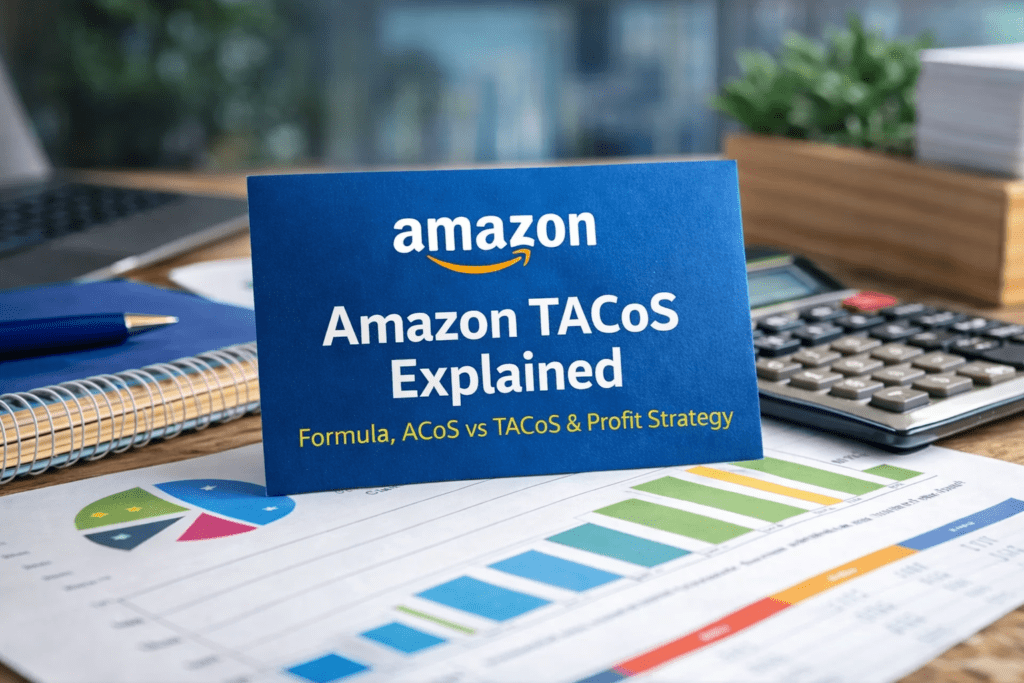
TACoS stands for Total Advertising Cost of Sales. It measures the percentage of your total Amazon revenue spent on advertising.
TACoS Formula
TACoS = (Total Ad Spend ÷ Total Revenue) × 100
Unlike ACoS, which compares ad spend only to ad-attributed revenue, TACoS includes both paid and organic sales. This gives sellers a much more holistic understanding of how dependent their business is on advertising.
For example, if you spend £5,000 on ads and generate £50,000 in total Amazon revenue, your TACoS is 10%.
This means that 10% of all revenue generated is being reinvested into advertising.
Why TACoS Matters More Than ACoS
Many sellers make the mistake of focusing only on ACoS because it is easier to understand at the campaign level. However, ACoS can be misleading when viewed in isolation.
A product may have a low ACoS while still being overly dependent on paid traffic if organic sales remain weak. Conversely, a higher ACoS may be acceptable if the campaign is helping build organic ranking and total revenue growth.
TACoS provides a broader perspective by measuring advertising efficiency relative to your entire business. It helps sellers determine whether advertising is supporting long-term growth or simply masking deeper inefficiencies.
A declining TACoS generally indicates:
- Organic sales are increasing
- Ad efficiency is improving
- Ranking momentum is building
- Brand awareness is strengthening
- Overall business profitability is improving
What Is a Good TACoS on Amazon?
There is no universal “perfect” TACoS because acceptable ranges vary by category, margin structure, and product lifecycle.
Typical TACoS Benchmarks
| Product Stage | Typical TACoS Range |
|---|---|
| Product Launch | 20–40%+ |
| Growth Phase | 10–25% |
| Mature Product | 5–15% |
A “good” TACoS is one that supports profitable growth based on your margins and strategic goals.
What Causes High TACoS on Amazon?
High TACoS is usually a symptom of broader account inefficiencies rather than simply excessive ad spend.
Common causes include:
- Poor organic keyword rankings
- Weak listing conversion rate
- Inefficient PPC structure
- Wasted spend on irrelevant keywords
- Overbidding
- Poor pricing competitiveness
- Weak reviews/social proof
- Heavy dependence on paid traffic
- Low average order value
Reducing TACoS requires fixing the underlying drivers of inefficiency.
How to Reduce TACoS on Amazon
Increase Organic Rankings to Reduce Paid Traffic Dependency
The most effective long-term way to reduce TACoS is to generate more organic sales. Every organic sale reduces your dependency on advertising and improves TACoS automatically.
To improve organic rankings:
- Optimize listings for buyer-intent keywords
- Improve conversion rate
- Increase sales velocity
- Build review count and rating
- Maintain inventory consistency
- Use PPC strategically to rank for target keywords
Strong organic rankings create a compounding effect that lowers TACoS over time.
Improve Listing Conversion Rate
A poor conversion rate means you must spend more on ads to generate the same number of sales. Improving conversion allows you to generate more revenue from the same amount of traffic.
Focus on:
- Better main image
- Stronger lifestyle/secondary images
- Improved bullet points
- Clearer value proposition
- Enhanced A+ Content
- Video where applicable
- Better pricing/offer positioning
- Review/social proof optimization
Even modest conversion improvements can have major TACoS impact.
Eliminate Wasted Ad Spend
Wasted ad spend is one of the fastest ways to inflate TACoS.
Common sources include:
- Irrelevant search terms
- Low-converting keywords
- Broad match misuse
- Poor campaign structure
- Unoptimized bids
- Underperforming placements
Reduce wasted spend by:
- Adding negative keywords
- Auditing search terms weekly
- Lowering bids on inefficient traffic
- Pausing poor performers
Focus Spend on High-Converting Keywords
Not all keywords generate equal profitability.
Shift budget toward:
- High-intent buyer keywords
- Proven converting exact-match terms
- High-ROAS keywords
- Branded/defensive terms
Budget concentration improves efficiency and lowers TACoS.
Build Better PPC Campaign Structure
Campaign structure significantly impacts optimization ability.
Best practices include:
- Separate campaigns by match type
- Segment branded/non-branded
- Isolate top-performing keywords
- Create ranking vs profit campaigns
- Organize by product or category
A clean structure allows more precise optimization.
Improve Pricing Strategy
Pricing influences conversion, profitability, and ranking.
Pricing too high hurts conversion.
Pricing too low hurts margin.
Optimize pricing through:
- Competitor analysis
- Price testing
- Promotional strategy
- Coupon/discount testing
Increase Average Order Value (AOV)
Higher revenue per order lowers TACoS even if ad spend remains constant.
Ways to increase AOV:
- Product bundles
- Multipacks
- Cross-sells
- Brand Store upsells
- Virtual bundles
Drive External Traffic
External traffic increases total revenue and can improve TACoS.
Useful traffic sources:
- Google SEO
- Email marketing
- Influencers
- Social media
- Affiliate traffic
Amazon often rewards strong external traffic with ranking benefits.
Build Repeat Purchase and Brand Loyalty
Repeat customers reduce reliance on ads.
Improve retention through:
- Product quality
- Brand consistency
- Product ecosystem expansion
- Subscribe & Save
- Excellent customer experience
How TACoS Changes Through the Product Lifecycle
TACoS expectations should vary based on product maturity.
New launches often require aggressive advertising, producing high TACoS temporarily. As the product gains reviews, ranking, and sales history, TACoS should gradually decline.
Mature products with strong organic presence generally sustain lower TACoS.
Why Cutting Ad Spend Alone Is Not the Solution
Many sellers attempt to reduce TACoS simply by lowering budgets. This often backfires.
Reducing spend too aggressively can:
- Hurt visibility
- Reduce sales velocity
- Lower organic ranking
- Shrink total revenue
The goal is not lower spend—it is higher efficiency.
Advanced TACoS Optimization Strategies
Reducing TACoS at a basic level often involves improving listings, cutting wasted spend, and refining bids. However, sellers who want to achieve consistently strong profitability and scalable growth must move beyond foundational optimization and implement more advanced strategic frameworks. The most successful Amazon brands treat TACoS management as a holistic business strategy rather than a simple PPC metric. These advanced optimization strategies help mature sellers improve efficiency while continuing to scale.
Use PPC Data to Improve SEO
One of the most effective advanced TACoS strategies is using PPC performance data to strengthen your organic SEO strategy. Amazon PPC campaigns provide real-time insight into which search terms actually convert, making them one of the best sources of keyword intelligence available to sellers. Rather than relying solely on third-party keyword tools, experienced sellers analyze PPC search term reports to identify proven buyer-intent keywords that generate profitable conversions.
Once high-performing search terms are identified, they can be strategically integrated into product titles, bullet points, backend search terms, A+ Content, and other listing elements to improve organic relevance and ranking potential. This creates a compounding effect: PPC helps uncover winning keywords, and SEO optimization helps the product rank organically for those terms over time. As organic ranking improves, reliance on paid traffic decreases, which lowers TACoS naturally.
Segment Ranking vs Profit Campaigns
Many sellers struggle with TACoS because they manage all campaigns with the same objective, even though not every campaign should be optimized for immediate profitability. Advanced Amazon advertisers separate PPC campaigns based on strategic purpose—typically dividing them into ranking campaigns and profit campaigns.
Ranking campaigns are designed to aggressively push visibility and sales velocity for important strategic keywords, even if they operate at a higher ACoS temporarily. These campaigns are intended to improve organic ranking and long-term marketplace position. Profit campaigns, by contrast, focus on maintaining efficient sales and strong ROAS from already-performing keywords or established products.
Separating campaigns this way gives sellers much better control over performance expectations and optimization decisions. It prevents high-investment ranking campaigns from distorting profitability metrics while ensuring efficiency-focused campaigns remain disciplined. This structured approach enables more strategic TACoS management across the account.
Track TACoS by Product Lifecycle
A major mistake sellers make is applying the same TACoS expectations to every product regardless of its maturity stage. In reality, acceptable TACoS levels vary significantly depending on where a product is in its lifecycle. New launches often require much higher TACoS because sellers intentionally invest heavily in advertising to build awareness, generate sales velocity, and rank organically. Mature products with established rankings and reviews should generally operate at much lower TACoS.
Tracking TACoS by product lifecycle allows sellers to set more realistic and strategic performance benchmarks. Rather than viewing all high TACoS as a problem, sellers can evaluate whether TACoS is appropriate for the product’s current growth phase. This prevents premature optimization decisions that may harm long-term growth. A product in launch mode should be evaluated differently than a mature best-seller focused on maximizing profitability.
Lifecycle-based TACoS management creates a more strategic and nuanced advertising approach that supports both growth and efficiency.
Common Mistakes That Increase TACoS
Many Amazon sellers struggle to reduce TACoS not because their products are unprofitable, but because they make strategic and operational mistakes that quietly increase advertising dependency and reduce efficiency over time. Understanding these common mistakes can help sellers identify where their Amazon advertising and overall marketplace strategy may be underperforming.
Focusing Only on ACoS
One of the most common mistakes sellers make is optimizing solely around ACoS while ignoring TACoS and broader business performance metrics. Although ACoS is useful for evaluating the efficiency of individual campaigns, it does not provide visibility into how dependent your business is on advertising overall. A seller may achieve a low ACoS while still relying heavily on paid traffic if organic sales remain weak. This creates a misleading sense of efficiency. Successful Amazon sellers use ACoS for campaign-level optimization but rely on TACoS to evaluate the overall health and sustainability of their advertising strategy.
Ignoring Organic Ranking
Weak organic rankings are one of the biggest contributors to persistently high TACoS. If your product does not rank well organically for important buyer-intent keywords, you will remain heavily dependent on paid traffic to generate sales. This forces you to keep spending aggressively on PPC just to maintain visibility. Many sellers focus entirely on ad management while neglecting the organic ranking side of Amazon growth. In reality, sustainable TACoS reduction comes from improving organic keyword positions so your products generate more unpaid traffic over time.
Poor Listing Optimization
A weak product listing can significantly inflate TACoS because it lowers conversion rate and forces you to spend more money acquiring traffic to achieve the same number of sales. Even highly targeted PPC campaigns will struggle if the listing fails to persuade shoppers to convert. Poor imagery, weak bullet points, unclear value propositions, unoptimized A+ Content, and low trust signals all reduce conversion efficiency. Strong listing optimization improves conversion rate, allowing sellers to generate more revenue from the same traffic volume and lowering TACoS naturally.
Overbidding Aggressively
Many sellers assume that higher bids automatically lead to better performance, but aggressive bidding without profitability controls can quickly destroy margins and inflate TACoS. Overbidding often results in paying excessive cost-per-click for traffic that may not convert profitably. This is especially dangerous in competitive categories where bid inflation is common. Effective Amazon PPC management requires balancing visibility with profitability and adjusting bids based on conversion data, margin thresholds, and campaign objectives rather than blindly chasing impressions or top-of-search placement.
Weak Keyword Targeting
Targeting the wrong keywords is another major cause of poor TACoS performance. If campaigns target broad, irrelevant, or low-intent search terms, sellers end up paying for traffic that rarely converts. This wastes budget, reduces campaign efficiency, and inflates TACoS unnecessarily. Strong keyword targeting requires focusing on buyer-intent search terms, analyzing search term reports regularly, identifying profitable keywords, and using negative keywords to eliminate poor-performing traffic. Better targeting leads to higher conversion rates, lower wasted spend, and stronger advertising efficiency.
Final Thoughts
Reducing TACoS on Amazon is not about blindly cutting ad spend—it is about building a more efficient and less ad-dependent business.
The strongest Amazon sellers lower TACoS by improving organic ranking, increasing listing conversion, eliminating wasted ad spend, refining PPC strategy, and strengthening total revenue from both paid and unpaid channels.
A lower TACoS reflects a healthier, more scalable Amazon business.
The ultimate goal is not just cheaper advertising—it is sustainable profitability and long-term marketplace growth.
FAQs About Reducing TACoS on Amazon
What Is a Good TACoS on Amazon?
A good TACoS depends heavily on your product margins, category competitiveness, lifecycle stage, and growth strategy. Mature products with strong organic rankings often operate in the 5–15% range, while newer products or aggressively scaled products may run significantly higher. Rather than chasing arbitrary benchmarks, sellers should evaluate TACoS relative to profitability and business goals. A “good” TACoS is one that supports sustainable growth while maintaining acceptable margins.
How Quickly Can You Reduce TACoS on Amazon?
Some TACoS improvements can happen relatively quickly through PPC optimization, bid adjustments, and waste reduction. However, the most meaningful long-term TACoS improvements usually come from increasing organic sales, which can take weeks or months depending on category competition and listing strength. Sellers should view TACoS optimization as an ongoing strategic process rather than a quick fix.
Should TACoS Always Decrease Over Time?
For mature products, TACoS often decreases gradually as organic ranking improves and paid traffic dependency declines. However, TACoS may increase temporarily during product launches, promotions, inventory pushes, seasonal campaigns, or aggressive scaling phases. Short-term TACoS increases are not necessarily bad if they support broader strategic growth objectives.
Can You Reduce TACoS Without Lowering Sales?
Yes, and this should be the primary goal. The best TACoS optimization strategies improve efficiency while maintaining or increasing total sales. This is achieved by improving conversion rate, eliminating wasted spend, increasing organic sales, strengthening keyword targeting, and improving listing performance. Reducing TACoS by cutting revenue is not true optimization.
Is Lower TACoS Always Better?
Not necessarily. Extremely low TACoS may indicate underinvestment in growth or missed opportunities to capture more market share. Sometimes spending more on advertising strategically can increase overall profit even if TACoS rises slightly. TACoS should always be evaluated in context of total revenue, margin, and growth strategy.
Why Is My TACoS Increasing Even Though My ACoS Is Good?
This usually means your business is still heavily reliant on advertising despite efficient campaigns. A good ACoS does not guarantee strong TACoS if organic sales remain weak. In this situation, the issue is often insufficient organic ranking, weak brand presence, or poor listing conversion rather than PPC inefficiency.
What Is More Important: TACoS or ACoS?
Both metrics matter, but TACoS is generally more valuable for evaluating long-term business health because it reflects total business efficiency. ACoS is useful for campaign-level optimization, while TACoS helps assess broader profitability and dependence on advertising.
What’s the difference between “ranking campaigns” and “profit campaigns” in Amazon PPC?
Ranking campaigns are deliberately run at a higher ACoS to aggressively push visibility and sales velocity for strategically important keywords, with the goal of building organic ranking and long-term marketplace position rather than immediate profitability. Profit campaigns, by contrast, focus on maintaining efficient ROAS from already-proven keywords and established products. Separating campaigns this way prevents high-investment ranking efforts from distorting your overall profitability metrics, and gives you much more precise control over which parts of your account should be optimized for growth versus which should be optimized for margin.
Does increasing average order value (AOV) actually help reduce TACoS?
Yes — since TACoS measures ad spend against total revenue, increasing revenue per order lowers TACoS even if your ad spend stays exactly the same. Tactics like product bundles, multipacks, cross-sells, and Brand Store upsells all raise the revenue side of the TACoS formula without requiring any additional advertising investment, making AOV growth one of the more overlooked levers for TACoS reduction compared to the usual focus on cutting wasted spend.