
Selling on Amazon today is far more sophisticated than it was a few years ago. The platform has evolved into a highly structured marketplace where product authenticity, traceability, and brand ownership are essential. One question we receive frequently from new and experienced sellers alike is:
“Do I need a GS1 certificate to sell on Amazon?”
At EcomRanker, we’ve worked with hundreds of Amazon sellers over the past decade, and this question comes up again and again. While the short answer is not always, the real answer is more nuanced.
Understanding GS1 barcodes, GTINs, UPCs, and Amazon’s verification process is crucial if you want to avoid listing issues, maintain control over your brand, and scale your business successfully.
In this in-depth guide, we’ll explain everything you need to know about GS1 certificates, Amazon barcode requirements, GTIN exemptions, and why GS1 codes matter for long-term success on Amazon.
Why Barcodes Matter More Than You Think
When you look at a product on a retail shelf, the barcode printed on the packaging might seem insignificant.
But in reality, that barcode is one of the most important elements in the entire retail ecosystem.
A barcode is not just a set of black lines.
It represents a unique product identification system that allows retailers, marketplaces, warehouses, and logistics companies to track products through every stage of the supply chain.
Underneath the barcode are the numbers that actually matter.
These numbers represent identifiers such as:
- UPC (Universal Product Code)
- EAN (European Article Number)
- GTIN (Global Trade Item Number)
These identifiers allow systems like Amazon to instantly recognise a product, its brand, and its specifications.
Without these identifiers, the supply chain becomes much harder to manage.
What Is GS1?
GS1 stands for Global Standards 1, a non-profit global organisation responsible for creating and maintaining barcode standards used by retailers worldwide.
GS1 developed the system that allows businesses to generate globally recognised identifiers for their products.
When a company registers with GS1, it receives a GS1 Company Prefix, which becomes part of every barcode created for that business.
This prefix connects the product directly to the company that owns it.
In simple terms:
GS1 provides globally trusted product identification.
Major retailers and marketplaces rely on this system to ensure product authenticity and accurate catalog information.
What Is a GS1 Certificate?
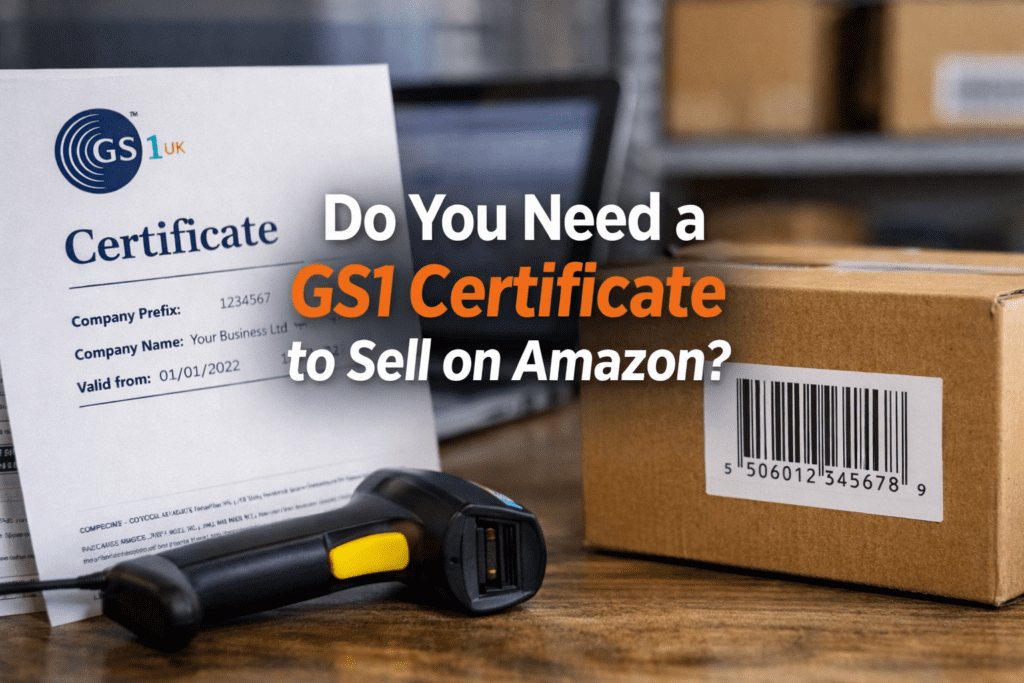
A GS1 Certificate is proof that your company owns the barcode prefix used in your product codes.
This certificate confirms that:
- Your business is registered with GS1
- You are the legal license holder of the barcode prefix
- The GTINs created using that prefix belong to your company
For Amazon sellers, this matters because Amazon increasingly verifies product identifiers against the GS1 database.
If your barcode is not registered with GS1 under your company name, Amazon may consider it invalid.
Amazon’s Increasing Focus on Product Authenticity
Amazon has made significant changes in recent years to protect buyers from counterfeit products and inaccurate listings.
One of the key ways they do this is by validating UPC and EAN codes through the GS1 database.
Amazon has publicly stated:
Amazon verifies the authenticity of product UPCs by checking the GS1 database.
If the brand name in your Amazon listing does not match the brand registered with GS1, Amazon may reject the listing.
This means that purchasing cheap UPC codes from third-party sellers can lead to serious problems.
Can You Sell on Amazon Without a GS1 Barcode?
Technically, yes.
Amazon does allow certain products to be listed without GS1 barcodes through a process called GTIN exemption.
However, this option is limited and not always ideal.
GTIN exemptions are usually granted for:
- Private label products without barcodes
- Handmade products
- Generic products without a brand
- Bundled items
Even when exemptions are available, they often come with restrictions.
For example, sellers may experience difficulty:
- Updating listings
- Protecting their brand
- Managing product variations
- Creating new listings quickly
This is why many experienced sellers eventually move to GS1 codes anyway.
Why Amazon Recommends GS1 Barcodes
Amazon recommends that sellers obtain barcodes directly from GS1 for several reasons.
1. Product Authenticity
GS1 codes ensure that each product has a unique identifier connected to a legitimate business.
This helps Amazon maintain trust in its marketplace.
2. Brand Ownership
If your barcode prefix belongs to your company, Amazon recognises you as the brand owner.
This makes it easier to:
- Control listings
- Update product details
- Resolve disputes
3. Listing Approval
Amazon’s automated systems often verify GTIN information against the GS1 database.
If the barcode does not match, listing creation may fail.
4. Long-Term Business Stability
Many sellers who initially buy cheap UPC codes later discover that those codes are already linked to another company.
This can lead to major listing problems later.
How GS1 Codes Work
GS1 codes combine multiple pieces of information into a single identifier.
These include:
- Company prefix
- Product identifier
- Check digit
Together they form a Global Trade Item Number (GTIN).
Each GTIN uniquely identifies a product anywhere in the world.
This allows retailers and logistics systems to instantly recognise the product.
Benefits of GS1 Barcodes for Amazon Sellers
Using GS1 barcodes provides several major advantages.
1. Global Recognition
GS1 barcodes are accepted by major retailers worldwide.
This allows sellers to expand beyond Amazon into other retail channels.
2. Better Supply Chain Tracking
Products can be scanned and tracked across warehouses, shipping networks, and retailers.
This improves inventory accuracy and logistics efficiency.
3. Improved Search Engine Visibility
Search engines use GTIN numbers to identify products across multiple listings.
This helps platforms like Google Shopping aggregate product information.
4. Brand Protection
GS1 registration allows you to claim ownership of product identifiers associated with your brand.
This helps prevent listing hijacking.
5. Marketplace Compliance
Many online marketplaces now require GS1 barcodes.
Using GS1 helps ensure compliance across platforms.
How Much Do GS1 Codes Cost?
The cost of GS1 membership depends on several factors:
- Country
- Company turnover
- Number of products
For example, in the UK:
Small businesses can join GS1 for approximately £50 per year plus VAT.
Larger companies with thousands of products may pay significantly more.
Membership includes:
- Access to GS1 barcode numbers
- Company prefix registration
- GS1 certificate
- Access to the GS1 management portal
What Happens If You Buy Cheap UPC Codes?
Some websites sell UPC codes for a few pounds or dollars.
These codes may work temporarily, but they often cause problems later.
Common issues include:
- UPC already registered to another company
- Listing ownership conflicts
- Amazon rejecting the GTIN
- Brand registry complications
Because these codes are not registered under your business name, you technically do not own them.
This makes it difficult to control your product listings.
Should You Replace Non-GS1 Barcodes?
If you previously purchased barcodes from a third-party reseller, it may be worth replacing them with GS1 codes.
Although this requires updating product listings, it helps ensure long-term stability.
Many experienced sellers eventually migrate to GS1 once their brand grows.
How to Get a GS1 Certificate
Obtaining a GS1 certificate is straightforward.
The typical process involves:
- Registering with GS1 in your country
- Selecting a membership plan
- Receiving your company prefix
- Assigning GTIN numbers to your products
Once registered, you can access your GS1 certificate through the member portal.
When You Might Not Need GS1
There are situations where GS1 may not be necessary.
These include:
- Amazon Handmade sellers
- Custom products made to order
- Private label products using GTIN exemption
- Certain bundled items
However, even in these cases, having GS1 codes can simplify operations.
Why Serious Amazon Sellers Eventually Choose GS1
From our experience at EcomRanker, most growing brands eventually adopt GS1.
It provides a level of professionalism and control that becomes essential as a business scales.
Without GS1:
- Listing control can become difficult
- Brand protection is weaker
- Amazon support cases are harder to resolve
With GS1, your products become part of a globally recognised identification system.
Final Thoughts
While it is technically possible to sell on Amazon without GS1 barcodes, doing so often limits your ability to scale your brand.
GS1 codes provide:
- Authentic product identification
- Stronger brand ownership
- Marketplace compliance
- Better supply chain transparency
For sellers serious about building a long-term brand on Amazon, GS1 barcodes are not just helpful — they are often essential.
At EcomRanker, we always recommend that sellers invest in proper product identification early in their journey.
It saves time, prevents listing issues, and protects your brand as your business grows.
FAQs
Do I need a GS1 certificate to sell on Amazon?
Not always. Some products qualify for GTIN exemption. However, GS1 barcodes are strongly recommended for brand control and listing stability.
Can I use cheap UPC codes from third-party websites?
You can, but it is risky. These codes may not be registered to your business and could cause listing issues later.
What is the difference between UPC, EAN and GTIN?
GTIN is the umbrella term for product identifiers. UPC and EAN are specific formats of GTIN used in different regions.
Does Amazon verify UPC codes?
Yes. Amazon checks many UPC codes against the GS1 database to confirm authenticity.
How long does it take to receive GS1 barcodes?
Most sellers receive their GS1 prefix and access to barcode numbers within a few days of registration.
Can I change my barcode later?
Yes, but changing barcodes after listing products can be complicated. It’s best to start with GS1 from the beginning.