
Amazon advertising has evolved significantly over the past few years, and in 2026, sellers face more competition than ever before. With millions of products competing for visibility, relying solely on organic rankings is no longer enough to achieve sustainable growth. Brands that consistently dominate Amazon search results are investing heavily in paid advertising to increase visibility, attract high-intent shoppers, and drive more sales. Among Amazon’s advertising solutions, Amazon Sponsored Products and Amazon Sponsored Brands remain the two most powerful and widely used ad formats. While both operate on a pay-per-click (PPC) model, they serve different marketing objectives and play unique roles within an Amazon advertising strategy.
Many sellers often wonder whether they should invest more heavily in Sponsored Products or Sponsored Brands. The answer depends on their business goals, product portfolio, brand maturity, and advertising budget. Understanding how these advertising formats work and where they fit within the customer journey is essential for maximizing return on investment. Businesses working with professional Amazon PPC Management services often use both ad formats together to create a comprehensive advertising strategy that drives both immediate sales and long-term brand growth.
What Are Amazon Sponsored Products?
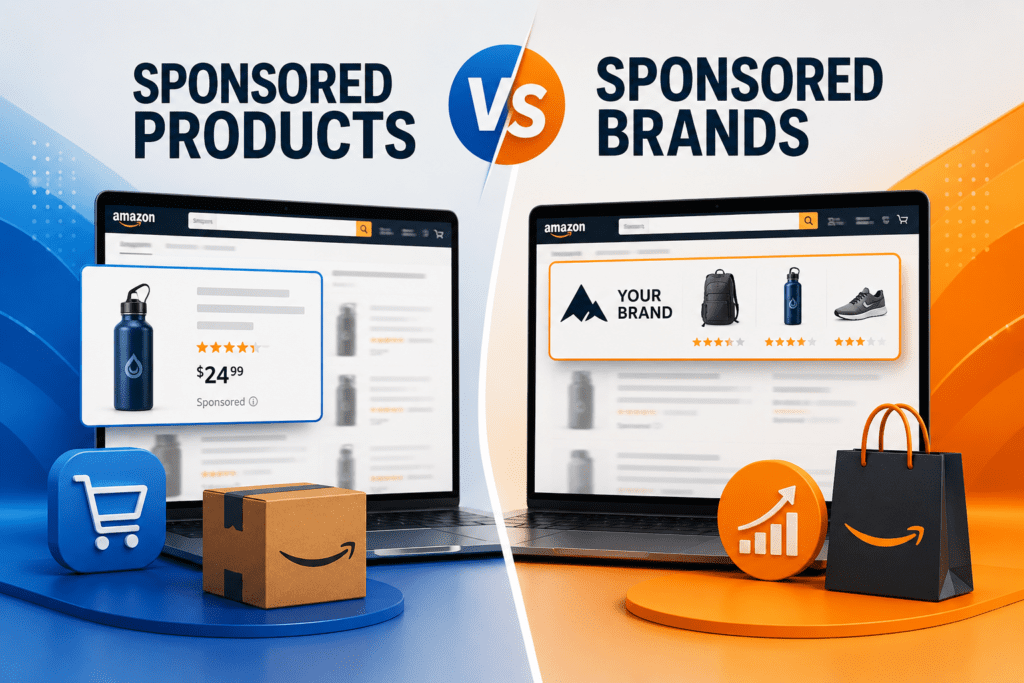
Amazon Sponsored Products are advertisements that promote individual product listings directly within Amazon’s shopping experience. These ads appear throughout search results and on product detail pages, making them one of the most visible and conversion-focused advertising formats available to sellers. Sponsored Products are designed to increase product visibility by placing listings in front of shoppers actively searching for related products.
When a customer enters a search query on Amazon, Sponsored Product ads compete in an auction based on relevance and bidding strategy. If the ad wins placement, it appears alongside organic search results with a small “Sponsored” label. Because these ads direct customers straight to a product detail page, they are highly effective at generating sales. This makes Sponsored Products particularly valuable for sellers looking to improve keyword rankings, increase product visibility, and accelerate sales velocity.
One of the biggest advantages of Sponsored Products is their accessibility. Both established brands and new sellers can launch campaigns quickly and begin generating traffic almost immediately. Many businesses use Sponsored Products as the foundation of their Amazon Advertising Services strategy because they provide measurable results and clear performance data.
What Are Amazon Sponsored Brands?
Amazon Sponsored Brands are a premium advertising format designed to showcase a brand rather than a single product. These ads typically feature a custom headline, brand logo, and multiple products within a single advertisement. Sponsored Brand ads frequently appear at the top of Amazon search results, giving them one of the most prominent placements available on the platform.
Unlike Sponsored Products, which focus primarily on driving immediate purchases, Sponsored Brands are designed to increase brand awareness and encourage shoppers to explore a broader product range. When customers click on a Sponsored Brand ad, they can be directed to an Amazon Storefront, a curated landing page, or a collection of products. This allows advertisers to tell a more complete brand story and create a stronger connection with potential customers.
For businesses that have invested in Amazon Store Optimization and brand-building initiatives, Sponsored Brands provide an excellent opportunity to showcase their unique value proposition. As consumers become increasingly brand-conscious, Sponsored Brands play a crucial role in establishing credibility and differentiating products from competitors.
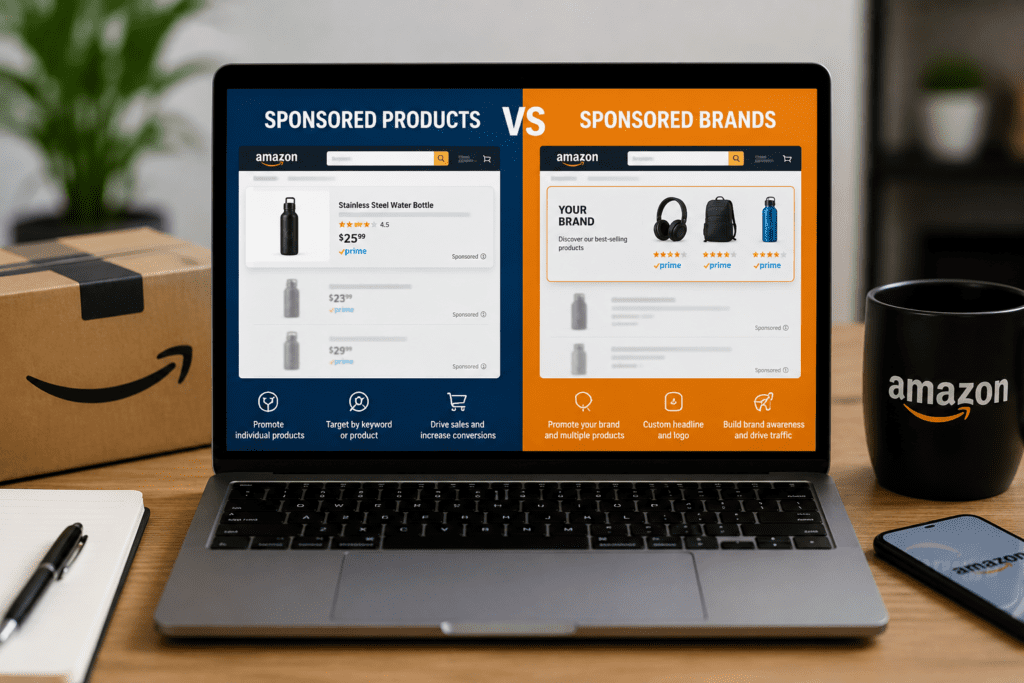
Amazon Sponsored Products vs Amazon Sponsored Brands
| Feature | Amazon Sponsored Products | Amazon Sponsored Brands |
|---|---|---|
| Primary Goal | Drive immediate sales for individual products | Build brand awareness and showcase multiple products |
| Best For | Product launches, sales growth, ranking improvement | Brand building, customer acquisition, Storefront traffic |
| Ad Format | Single product advertisement | Brand logo, custom headline, and multiple products |
| Placement | Search results and product detail pages | Top of search results, product pages, Amazon Store placements |
| Visibility | High visibility across Amazon shopping results | Premium visibility at the top of search results |
| Brand Registry Required | No | Yes |
| Amazon Storefront Support | No | Yes |
| Custom Headline | No | Yes |
| Brand Logo Display | No | Yes |
| Video Ads Available | No | Yes (Sponsored Brand Video) |
| Automatic Targeting | Yes | No |
| Manual Keyword Targeting | Yes | Yes |
| Product (ASIN) Targeting | Yes | No |
| Category Targeting | Yes | No |
| Negative Keywords | Yes | Limited |
| Competitor Targeting | Strong | Limited |
| Click-Through Rate (CTR) | Typically higher due to multiple placements | Strong for branded searches |
| Conversion Rate | Usually higher | Usually lower but supports assisted conversions |
| Cost Per Click (CPC) | Lower | Higher |
| Budget Requirement | Suitable for small and large budgets | Works best with moderate to larger budgets |
| Creative Customization | Very limited | Extensive customization options |
| Customer Journey Stage | Bottom-funnel (ready-to-buy shoppers) | Mid to top-funnel (research and discovery) |
| Organic Ranking Impact | Strong direct impact through sales velocity | Indirect impact through brand searches |
| Performance Measurement | Sales-focused metrics | Sales + branding metrics |
| Campaign Setup Complexity | Easy | Moderate |
| Supports Multiple Products in One Ad | No | Yes |
| Best for New Sellers | Excellent | Limited until brand presence is established |
| Best for Established Brands | Good | Excellent |
| Short-Term ROI | Higher | Moderate |
| Long-Term Brand Growth | Limited | Excellent |
The Core Difference Between Sponsored Products and Sponsored Brands
Although both advertising formats use Amazon’s PPC model, their objectives differ significantly. Sponsored Products focus on generating direct sales by promoting individual listings to shoppers with high purchase intent. The goal is to capture customers who are ready to buy and convert them as quickly as possible.
Sponsored Brands, on the other hand, focus on brand visibility and customer engagement. Rather than promoting a single product, they introduce shoppers to a brand and encourage them to explore multiple products. This approach helps businesses build awareness, increase brand recall, and develop long-term customer relationships.
In simple terms, Sponsored Products are performance-driven advertising campaigns, while Sponsored Brands combine performance marketing with branding. The most successful Amazon advertisers understand that both formats serve different purposes and should be used together rather than viewed as competing options.
Ad Placement and Visibility
Placement plays a significant role in determining advertising performance. Sponsored Products appear in multiple locations across Amazon, including the top, middle, and bottom sections of search results as well as product detail pages. These placements allow sellers to reach shoppers at various stages of the buying journey. Because Sponsored Products blend naturally into search results, they often generate strong click-through and conversion rates.
Sponsored Brands typically occupy premium positions at the top of search results, where they attract maximum visibility. Their larger format, custom branding elements, and prominent placement make them highly effective for capturing shopper attention before competitors. In many cases, Sponsored Brands create the first impression a customer has of a brand during a product search.
Businesses focused on expanding market share often prioritize Sponsored Brands because of their ability to dominate search results and increase overall brand exposure. Many Amazon Marketing Strategy experts consider Sponsored Brands an essential component of long-term brand growth.
Targeting Capabilities
One of the reasons Sponsored Products remain so popular is their extensive targeting flexibility. Advertisers can use keyword targeting, automatic targeting, product targeting, category targeting, and negative keywords to refine campaign performance. This level of control allows sellers to reach highly specific audiences while minimizing wasted advertising spend.
Sponsored Brands primarily rely on keyword targeting and audience-based targeting. While they do not offer the same level of product targeting flexibility as Sponsored Products, they excel at reaching shoppers during the discovery phase of the buying process. Sponsored Brand Video campaigns have become especially effective in recent years because they combine visual engagement with keyword targeting.
For advertisers seeking maximum targeting precision, Sponsored Products generally provide more options. However, Sponsored Brands offer unique advantages when the goal is building awareness and engaging potential customers.
Creative Customization and Branding Opportunities
Perhaps the most significant difference between these ad formats is the level of creative customization available. Sponsored Products closely resemble standard product listings, meaning advertisers have limited control over the ad’s appearance beyond optimizing product images, titles, and pricing.
Sponsored Brands provide substantially more creative flexibility. Advertisers can incorporate custom headlines, brand logos, lifestyle imagery, and video content to create more engaging advertisements. This allows brands to communicate their identity, values, and product benefits more effectively.
Brands that have invested in Amazon A+ Content often see even greater benefits from Sponsored Brands because the customer experience remains consistent from advertisement to product page. This consistency can significantly improve conversion rates and customer trust.
Cost Per Click and Return on Investment
Advertising costs continue to rise across Amazon as competition increases. Sponsored Brands generally have higher average cost-per-click rates because they compete for premium placements at the top of search results. Sponsored Products, while still competitive, are often more cost-efficient for generating direct sales.
However, evaluating these ad formats solely based on CPC can be misleading. Sponsored Brands frequently generate benefits that extend beyond immediate sales, including increased brand searches, higher Storefront traffic, stronger customer loyalty, and improved repeat purchase rates. These long-term benefits often justify the additional investment.ads
Many businesses allocate a larger portion of their budget to Sponsored Products initially and gradually increase Sponsored Brand spending as their brand grows and their product catalog expands.
When Should You Use Sponsored Products?
Sponsored Products are particularly effective when launching new products, increasing sales velocity, improving keyword rankings, or operating with a limited advertising budget. Because these ads target customers with strong buying intent, they often deliver the fastest return on investment.
New sellers entering competitive categories frequently rely on Sponsored Products to gain visibility and establish initial sales momentum. These campaigns also provide valuable search term data that can be used to optimize broader advertising strategies.
When Should You Use Sponsored Brands?
Sponsored Brands are most effective for businesses with multiple products and a clear brand identity. They help increase awareness, promote product collections, and encourage customers to explore a broader range of offerings. Companies that have invested in an Amazon Storefront can use Sponsored Brands to drive traffic directly to curated shopping experiences.
For brands focused on long-term growth rather than immediate sales alone, Sponsored Brands offer powerful opportunities to build recognition and strengthen customer relationships.
Which Advertising Format Performs Better in 2026?
There is no universal winner between Sponsored Products and Sponsored Brands because they serve different purposes. Sponsored Products remain the strongest option for driving immediate sales and improving organic rankings. Sponsored Brands excel at building brand awareness, increasing customer engagement, and supporting long-term growth.
The highest-performing Amazon sellers rarely choose one over the other. Instead, they create integrated advertising strategies that use Sponsored Products to capture purchase-ready shoppers while leveraging Sponsored Brands to build awareness and strengthen brand presence.
By combining these ad formats with Amazon SEO Services, Amazon Listing Optimization, and advanced Amazon PPC Management, businesses can create a full-funnel advertising system that drives sustainable growth and maximizes profitability.
Amazon Sponsored Products vs Amazon Sponsored Brands: Which Should You Choose?
| If Your Goal Is… | Choose |
|---|---|
| Generate immediate sales | Sponsored Products |
| Launch a new product | Sponsored Products |
| Improve organic rankings | Sponsored Products |
| Target competitor listings | Sponsored Products |
| Build brand awareness | Sponsored Brands |
| Promote multiple products | Sponsored Brands |
| Drive traffic to an Amazon Store | Sponsored Brands |
| Increase branded searches | Sponsored Brands |
| Create a full-funnel advertising strategy | Use Both Together |
| Scale an established brand | Use Both Together |
Conclusion
In 2026, Amazon advertising success depends on understanding how different ad formats contribute to the customer journey. Sponsored Products and Sponsored Brands are not competitors; they are complementary tools that help businesses achieve different objectives. Sponsored Products generate direct sales and improve visibility for individual products, while Sponsored Brands build awareness, showcase product portfolios, and strengthen overall brand recognition.
Brands that strategically invest in both advertising formats are better positioned to increase market share, improve customer acquisition, and achieve long-term success on Amazon. Rather than asking which format is better, sellers should focus on how to combine both effectively within a comprehensive advertising strategy that supports their business goals.
Frequently Asked Questions About Amazon Sponsored Products vs Amazon Sponsored Brands
1. What is the main difference between Amazon Sponsored Products and Amazon Sponsored Brands?
The primary difference between Amazon Sponsored Products and Amazon Sponsored Brands lies in their advertising objectives. Sponsored Products are designed to promote individual product listings and drive direct sales. These ads appear throughout Amazon search results and product detail pages, helping shoppers discover a specific product and encouraging immediate purchases.
Sponsored Brands, on the other hand, focus on building brand awareness and showcasing multiple products simultaneously. These ads include a brand logo, custom headline, and several featured products, making them ideal for introducing customers to a brand rather than a single listing. While Sponsored Products are conversion-focused, Sponsored Brands support both customer acquisition and long-term brand growth.
2. Which advertising format generates more sales: Sponsored Products or Sponsored Brands?
In most cases, Sponsored Products generate more direct sales because they target shoppers who are already searching for specific products and are often ready to buy. Since these ads direct customers straight to a product detail page, the purchase journey is shorter and conversion rates tend to be higher.
Sponsored Brands may not always generate as many immediate sales, but they contribute significantly to brand awareness, repeat purchases, and customer lifetime value. Many successful Amazon sellers use Sponsored Products to drive conversions while using Sponsored Brands to build brand recognition and support future sales.
3. Are Sponsored Products better for new Amazon sellers?
Yes, Sponsored Products are generally the best starting point for new Amazon sellers. They are easier to set up, require less creative work, and focus directly on generating sales. New sellers can use Sponsored Products to gain visibility, collect keyword data, improve organic rankings, and build initial sales history.
Because Amazon’s algorithm favors products with strong sales performance, Sponsored Product campaigns can help accelerate product ranking improvements and establish momentum in competitive categories.
4. Do I need Amazon Brand Registry to run Sponsored Brands?
Yes. To run Sponsored Brand campaigns, sellers must be enrolled in Amazon Brand Registry. Amazon requires advertisers to own a registered trademark and have an approved brand presence on the platform before gaining access to Sponsored Brands.
Sponsored Products do not require Brand Registry. Any eligible professional seller with active listings can create Sponsored Product campaigns, making them more accessible to newer businesses.
5. Which ad type has a lower cost-per-click (CPC)?
Sponsored Products generally have lower CPCs compared to Sponsored Brands. Because Sponsored Brand ads compete for premium placements at the top of search results, advertisers often need to bid more aggressively to secure visibility.
However, CPC alone should not determine your advertising strategy. Sponsored Brands often provide additional value through brand exposure, Storefront visits, and increased customer engagement that may not be immediately reflected in direct sales metrics.
6. Can I use both Sponsored Products and Sponsored Brands together?
Absolutely. In fact, using both advertising formats together is considered one of the most effective Amazon PPC strategies in 2026.
Sponsored Products help capture high-intent shoppers who are ready to purchase, while Sponsored Brands help build awareness and introduce customers to your broader product portfolio. When combined, these campaigns create a full-funnel advertising strategy that reaches customers at multiple stages of the buying journey.
Many top-performing brands allocate budget to both campaign types because they complement each other rather than compete with one another.
7. Which ad format is better for product launches?
Sponsored Products are typically the preferred choice for launching new products. They provide immediate visibility, drive initial traffic, and help generate the sales velocity necessary to improve organic rankings.
However, brands with multiple products may also benefit from Sponsored Brands during a launch. Sponsored Brand campaigns can introduce the new product alongside established products, leveraging existing brand trust to increase conversion rates.
For maximum impact, many advertisers launch both campaign types simultaneously.
8. What targeting options are available for Sponsored Products?
Sponsored Products offer several targeting methods, including keyword targeting, automatic targeting, product targeting, category targeting, and negative targeting.
Keyword targeting allows advertisers to bid on specific search terms. Product targeting enables ads to appear on competitor listings or related product pages. Category targeting helps reach shoppers browsing entire product categories. Negative keywords and negative product targeting help eliminate irrelevant traffic and reduce wasted ad spend.
These extensive targeting capabilities make Sponsored Products one of the most flexible advertising solutions on Amazon.
9. Can Sponsored Brands target competitor products?
Not directly in the same way as Sponsored Products. Sponsored Brands primarily use keyword targeting rather than ASIN-level product targeting. While you can bid on keywords associated with competitor products, you cannot directly target competitor ASINs using Sponsored Brands.
If competitor targeting is a major part of your strategy, Sponsored Products offer greater flexibility and precision.
10. Are Sponsored Brand Video ads worth using in 2026?
Yes, Sponsored Brand Video campaigns continue to be among the highest-performing Amazon advertising formats. Video ads automatically play within search results, helping brands attract attention and communicate product benefits more effectively than static images.
Because many sellers still underutilize video advertising, Sponsored Brand Video campaigns often achieve strong click-through rates and lower advertising costs compared to traditional Sponsored Brand placements.
For brands looking to stand out in crowded marketplaces, video campaigns are becoming increasingly important.
11. How much should I budget for Sponsored Products and Sponsored Brands?
Budget requirements vary depending on product category, competition level, and advertising goals. Many new sellers begin with a larger allocation toward Sponsored Products because they generate more immediate sales and provide valuable performance data.
As the brand grows, advertisers often increase investment in Sponsored Brands to strengthen awareness and support long-term customer acquisition. A common strategy is allocating approximately 70% of the budget to Sponsored Products and 30% to Sponsored Brands, although the ideal ratio varies by business.
Regular performance monitoring and optimization are essential for determining the most effective budget distribution.
12. Which ad format provides better ROI?
Sponsored Products often deliver higher short-term ROI because they focus on converting high-intent shoppers into buyers. Their direct-response nature makes it easier to measure immediate profitability.
Sponsored Brands frequently provide stronger long-term ROI by increasing brand awareness, driving Storefront traffic, generating repeat purchases, and improving customer retention. While these benefits may not always appear in direct attribution reports, they contribute significantly to overall business growth.
The best approach is to evaluate both immediate returns and long-term brand impact when measuring advertising success.
13. Can Sponsored Brands help increase organic sales?
Yes. Sponsored Brands can indirectly improve organic sales by increasing brand visibility and encouraging more shoppers to search specifically for your brand. As brand searches increase, Amazon may recognize stronger customer demand and improve the visibility of your products in organic search results.
Additionally, customers exposed to Sponsored Brand campaigns often return later through organic searches, creating sales that may not be directly attributed to advertising but still result from increased brand awareness.
14. What are the biggest mistakes sellers make with Sponsored Products and Sponsored Brands?
One common mistake is relying exclusively on one advertising format. Many sellers focus only on Sponsored Products because they generate immediate sales while neglecting the long-term benefits of brand building through Sponsored Brands.
Another mistake is failing to optimize campaigns regularly. Successful advertising requires continuous keyword analysis, bid adjustments, search term optimization, negative targeting implementation, and creative testing.
Many sellers also overlook the importance of listing optimization. Even the best advertising campaigns will struggle if product listings have poor images, weak copy, or insufficient reviews.
15. Which Amazon ad format should most sellers prioritize in 2026?
For most sellers, Sponsored Products should remain the foundation of their Amazon advertising strategy because they generate direct sales, improve rankings, and provide valuable keyword insights.
However, brands that want to build long-term market share should not ignore Sponsored Brands. As Amazon becomes increasingly competitive, branding plays a larger role in purchasing decisions.
The most successful Amazon businesses in 2026 are not choosing between Sponsored Products and Sponsored Brands. Instead, they strategically combine both formats to maximize visibility, conversions, and long-term growth.