

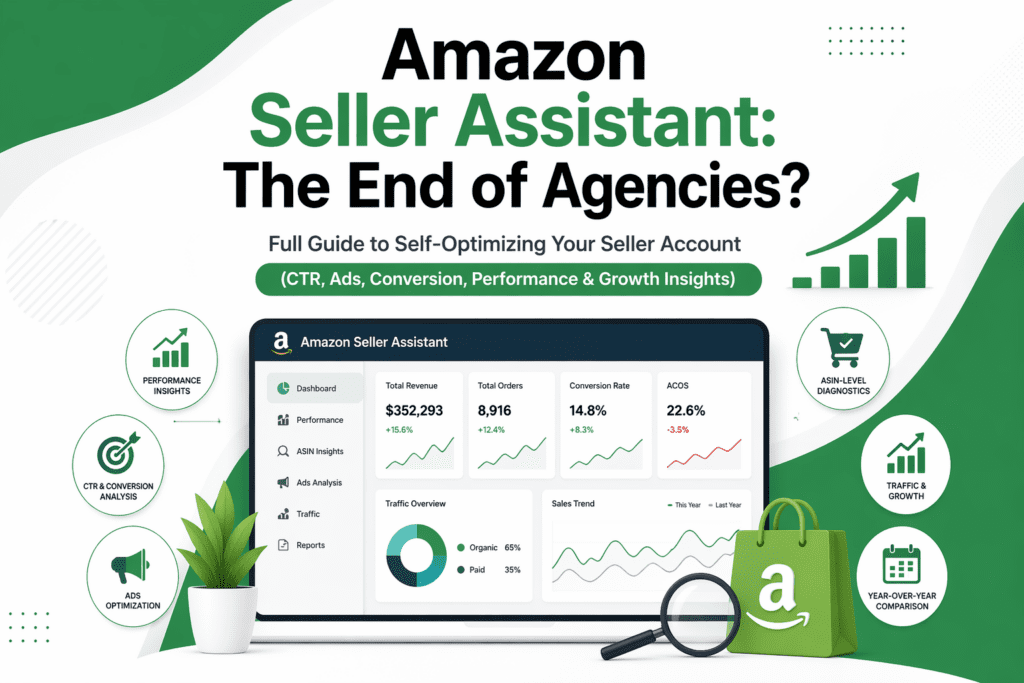
From Data Overload to Decision Clarity
Selling on Amazon has never been a lack-of-data problem. In fact, the real challenge has always been the opposite — an overwhelming abundance of fragmented data without clear direction. Sellers have historically relied on multiple dashboards inside Seller Central, from Business Reports to Advertising Console, Brand Analytics, and inventory insights. While these tools provide numbers, they rarely provide answers.
A seller could see declining sales, fluctuating conversion rates, or rising ad spend, yet still remain uncertain about the root cause. Was the issue traffic? Was it listing quality? Were ads underperforming, or was competition simply stronger? This gap between data visibility and decision-making clarity created a dependency on agencies, consultants, and third-party tools that interpret and act on that data.
Amazon Seller Assistant fundamentally changes this dynamic. It transforms raw metrics into actionable intelligence, allowing sellers to not only understand what is happening in their account but also why it is happening and what to do next. This marks a major shift from reactive selling to proactive optimization.
You can now:
- See account-level performance summaries
- Identify exact problem areas
- Analyze CTR, conversion rate, traffic, ads, ASIN-level performance
- Compare YoY (year-over-year) trends
- Understand why sales are dropping
- Take data-driven action instantly
What is Amazon Seller Assistant? A New Intelligence Layer
Amazon Seller Assistant is best understood not as just another feature, but as an intelligence layer built into Seller Central. It aggregates signals from multiple sources — including traffic data, conversion metrics, advertising performance, and ASIN-level insights — and converts them into meaningful interpretations.
Instead of manually analyzing disconnected reports, sellers are now presented with a unified view of performance. This includes summaries of revenue trends, identification of performance drops, and clear indicators of inefficiencies across listings and campaigns. What once required hours of analysis or external expertise can now be understood in minutes.
This evolution represents Amazon’s broader movement toward an AI-first ecosystem, where sellers are guided by insights rather than forced to interpret raw numbers.
Instead of manually analyzing:
- Business Reports
- Advertising Console
- Brand Analytics
- Inventory reports
Core Capabilities
Account Performance Summary: The New Command Center
One of the most impactful aspects of Seller Assistant is the account-level performance summary. Previously, understanding overall business health required navigating through multiple sections of Seller Central and mentally connecting the dots between them. Now, sellers can view a consolidated overview that highlights revenue trends, traffic fluctuations, conversion changes, and Buy Box stability.
This summary acts as a diagnostic dashboard. Instead of simply showing that sales have declined, it reveals the underlying drivers behind that decline. For example, a drop in revenue might be directly linked to reduced traffic rather than conversion issues. This level of clarity prevents sellers from making incorrect assumptions, such as unnecessarily adjusting pricing or creatives when the real issue lies in visibility.
By centralizing performance indicators, Seller Assistant effectively becomes the seller’s daily decision-making hub, reducing time spent on analysis and increasing time spent on execution.
ASIN-Level Diagnostics: Precision Over Guesswork
Amazon businesses often consist of multiple products, and identifying which ASIN is responsible for performance changes has traditionally been a complex task. Seller Assistant simplifies this by offering detailed ASIN-level diagnostics that highlight exactly where issues or opportunities exist.
Instead of guessing which product is underperforming, sellers can now see clear indicators tied to individual listings. More importantly, the tool goes beyond identification and provides context. It distinguishes whether an issue stems from low click-through rate, poor conversion, declining traffic, or inefficient advertising.
This precision allows sellers to move from broad, account-wide adjustments to targeted optimization strategies. Rather than making sweeping changes across all listings, they can focus on specific products and apply the right fixes, whether that involves improving visuals, adjusting pricing, or refining keyword targeting.
CTR Insights: The Gateway to Visibility
Click-through rate (CTR) is one of the most critical yet often misunderstood metrics in Amazon selling. It determines whether shoppers choose to engage with a listing in the first place. A product may rank well or receive impressions, but without strong CTR, those impressions do not translate into traffic.
Seller Assistant highlights CTR performance at the ASIN level and identifies listings that are underperforming in this area. This is particularly valuable because CTR issues are often rooted in creative and positioning elements rather than technical factors.
A weak main image, an unclear title, or a pricing mismatch can all reduce the likelihood of a click. By identifying these weaknesses, sellers are guided toward improving their listing presentation. This is where services such as Amazon product image optimization and Amazon SEO expert services still play a significant role, as improving CTR requires a combination of design, psychology, and keyword strategy.
Ultimately, CTR serves as the first gate in the conversion funnel. Without it, even the best listings will struggle to generate sales.
Conversion Rate Analysis: Turning Traffic into Revenue
While CTR brings shoppers to a listing, conversion rate determines whether those visitors become customers. Seller Assistant provides detailed insights into conversion performance, helping sellers understand why a product may not be converting effectively.
Low conversion rates are often the result of trust and presentation issues. Poor reviews, lack of compelling A+ content, low-quality images, or uncompetitive pricing can all discourage purchases. Seller Assistant surfaces these potential causes, allowing sellers to address them directly.
This is particularly important because many sellers mistakenly focus on increasing traffic when the real issue lies in conversion. Driving more visitors to a poorly optimized listing only amplifies inefficiencies. By identifying conversion bottlenecks, sellers can prioritize improvements that directly impact revenue.
Optimizing conversion often involves enhancing storytelling, improving visual content, and building trust through social proof. This is where Amazon conversion rate optimization services remain highly valuable, as they focus on refining the elements that influence buying decisions.
Ads Performance Breakdown: From Spending to Strategy
Advertising on Amazon is both an opportunity and a risk. While it can drive significant growth, it can also lead to wasted spend if not managed effectively. Seller Assistant provides a clearer view of advertising performance by breaking down key metrics such as ACOS, ROAS, and keyword efficiency.
Rather than simply presenting numbers, the tool helps sellers understand which campaigns are profitable and which are draining resources. It highlights inefficiencies, such as keywords that generate clicks but no conversions or campaigns that exceed acceptable cost thresholds.
This level of insight allows sellers to transition from reactive adjustments to strategic optimization. They can refine targeting, adjust bids, and reallocate budgets with confidence. While this reduces reliance on external PPC management for basic optimization, advanced scaling and campaign structuring still benefit from expert intervention.
Traffic Analysis: Understanding the Source of Growth
Traffic is the foundation of any Amazon business, and understanding its composition is essential for sustainable growth. Seller Assistant provides a breakdown of traffic sources, distinguishing between organic and paid traffic while also highlighting keyword-driven performance.
This insight is crucial when diagnosing performance changes. A drop in sales may be linked to declining organic rankings, reduced ad visibility, or shifts in keyword relevance. By identifying the source of traffic loss, sellers can take targeted actions to restore visibility.
Traffic analysis also supports growth strategies. By understanding which keywords and channels drive the most valuable traffic, sellers can focus their efforts on expanding those areas. This aligns closely with Amazon SEO optimization and PPC strategies, where the goal is to increase both visibility and relevance.
Year-over-Year Insights: From Reaction to Planning
One of the most strategic features of Seller Assistant is its ability to provide year-over-year comparisons. This allows sellers to analyze performance trends over time and identify patterns related to seasonality and market dynamics.
Instead of reacting to short-term fluctuations, sellers can make informed decisions based on historical data. For example, if a product consistently performs well during a specific season, sellers can prepare by increasing inventory, optimizing listings in advance, and allocating additional advertising budget.
This shift from reactive management to proactive planning is a key advantage, enabling sellers to stay ahead of demand rather than responding to it.
Industry Impact: Redefining the Role of Agencies
The introduction of Seller Assistant inevitably raises the question of whether agencies will become obsolete. The reality is more nuanced. While the tool empowers sellers to handle many aspects of performance analysis and basic optimization, it does not eliminate the need for expertise.
Sellers can now independently diagnose issues, monitor metrics, and implement foundational improvements. However, advanced strategies such as brand positioning, creative differentiation, and large-scale growth planning still require specialized knowledge.
In essence, Seller Assistant shifts the role of agencies from data interpreters to strategic partners. It reduces dependency on basic services while increasing the importance of high-level expertise.
How Sellers Can Use This Tool: From Insight to Execution
Amazon Seller Assistant is only as powerful as the way it is used. While it delivers clear insights, the real advantage comes from turning those insights into structured, data-driven actions. Instead of randomly optimizing listings or increasing ad budgets, sellers can now follow a logical workflow that begins with identifying the problem, moves into diagnosing the root cause, and ends with precise execution at the ASIN level.
Step 1: Identify the Revenue Drop
The first step in using Seller Assistant effectively is to start with the most important question: “Why are my sales down?” This question seems simple, but historically it has been one of the hardest to answer accurately. Sellers often react to declining revenue without understanding whether the issue stems from traffic, conversion, or advertising performance.
Seller Assistant eliminates this ambiguity by breaking down revenue changes into clear contributing factors. It shows whether the drop is driven by a decrease in traffic, a decline in conversion rate, or inefficiencies in advertising. For example, if traffic has decreased, it indicates a visibility issue — potentially caused by lost keyword rankings, increased competition, or reduced ad impressions. If conversion has dropped while traffic remains stable, the problem lies within the listing itself, such as weak content, poor reviews, or pricing misalignment.
In cases where advertising is the issue, Seller Assistant highlights inefficiencies such as rising costs, declining returns, or reduced campaign performance. This structured breakdown allows sellers to move away from guesswork and immediately focus on the area that requires attention. Instead of making broad, unfocused changes, they can prioritize the exact factor impacting revenue.
Step 2: Diagnose the Root Cause
Once the primary issue is identified, the next step is to go deeper and diagnose the root cause. This is where Seller Assistant provides the most value, as it connects surface-level problems with underlying reasons.
Case 1: Low CTR (Click-Through Rate)
When Seller Assistant indicates low CTR, it is signaling a visibility and attractiveness problem. This means shoppers are seeing the product in search results but are choosing not to click on it. The causes are almost always related to how the product is presented.
A weak main image is one of the most common issues. If the image does not stand out, clearly communicate the product, or match customer expectations, it will fail to capture attention. Similarly, an unoptimized title that lacks clarity, relevance, or keyword alignment can reduce click appeal. Pricing can also play a role — if the product appears overpriced compared to competitors, shoppers may skip it entirely.
Fixing CTR requires a combination of creative and strategic improvements. Redesigning the main image to make it more visually compelling, refining the title to improve clarity and keyword targeting, and ensuring competitive pricing are key steps. This is where high-converting Amazon product image optimization services and SEO-focused listing strategies become critical, as they directly influence how customers perceive the product in search results.
Case 2: Low Conversion Rate
If CTR is strong but sales are still low, the issue shifts from attraction to persuasion. A low conversion rate indicates that customers are clicking on the product but not completing the purchase. This is often a result of weak trust signals or poor listing quality.
Seller Assistant helps highlight these weaknesses by pointing toward factors such as poor reviews, lack of compelling A+ content, insufficient product detail, or low-quality images. Customers on Amazon make quick decisions, and if a listing fails to build confidence or clearly communicate value, they will move on to competitors.
Improving conversion requires strengthening every element of the listing experience. High-quality images that demonstrate product usage, detailed and benefit-driven copy, enhanced A+ content, and strong social proof all contribute to higher conversion rates. Pricing strategy also plays a role, as perceived value must align with cost.
This is where Amazon listing conversion optimization services provide significant value, as they focus on refining the elements that directly influence buyer decisions. Seller Assistant identifies the problem, but executing high-level conversion improvements requires a deep understanding of customer behavior and marketplace dynamics.
Case 3: Ads Waste and Inefficiency
When Seller Assistant highlights advertising inefficiencies, it is pointing to wasted budget and missed opportunities. This often occurs when campaigns are generating clicks but not conversions, or when bids are too high relative to the return they generate.
The tool allows sellers to identify exactly where money is being lost. This could be specific keywords that are irrelevant or underperforming, campaigns that are poorly structured, or budgets that are not allocated effectively. Instead of treating advertising as a trial-and-error process, sellers can now approach it with precision.
Fixing ad inefficiency involves several targeted actions. Adding negative keywords helps eliminate irrelevant traffic, while adjusting bids ensures that spending aligns with performance. Campaign restructuring may also be necessary to separate high-performing keywords from low-performing ones, allowing for better control over budget allocation.
While Seller Assistant enables sellers to handle these optimizations independently, advanced scaling strategies — such as expanding into new keyword segments or optimizing campaign structures at scale — still benefit from professional Amazon PPC optimization services.
Step 3: Fix ASIN-Level Issues with Precision
The final step is where real transformation happens. Once the root cause is identified, sellers must apply fixes at the ASIN level. This is a critical shift from traditional approaches, where sellers often made broad changes across their entire account without knowing which products actually needed attention.
Seller Assistant allows sellers to act with precision. Instead of guessing which listing to optimize, they can focus on specific ASINs that are underperforming and apply targeted improvements. This could involve redesigning images for one product, improving A+ content for another, or restructuring ad campaigns for a specific SKU.
This approach not only saves time but also ensures that efforts are directed where they will have the greatest impact. By continuously monitoring performance and applying data-driven adjustments, sellers can create a cycle of ongoing optimization and growth.
Advanced Use Cases: Beyond Basic Optimization
Beyond day-to-day management, Seller Assistant enables more advanced strategies. During product launches, it allows sellers to monitor early performance indicators and make rapid adjustments to maintain momentum. When scaling successful products, it helps identify high-performing ASINs that deserve increased investment.
It also supports competitive analysis by providing context on how a seller’s performance compares to category benchmarks. This insight can reveal opportunities for differentiation and growth.
Additionally, year-over-year data can be used to plan for seasonal demand, ensuring that inventory and marketing efforts are aligned with expected trends.
1. Product Launch Optimization
Track:
- Early CTR
- Conversion velocity
2. Scaling Winning Products
Identify:
- High ROI ASINs
Double down with:
Amazon scaling strategy services
3. Competitor Benchmarking
Analyze:
- Your vs category performance
4. Seasonal Planning
Use YoY data to:
- Prepare inventory
- Adjust pricing
Common Problems Seller Assistant Solves
One of the biggest advantages of Amazon Seller Assistant is its ability to turn vague, frustrating problems into clear, actionable insights. Most sellers don’t struggle because they lack effort — they struggle because they lack clarity. Seller Assistant bridges that gap by identifying exactly where things are going wrong and why. Instead of reacting blindly, sellers can now respond with precision.
Problem 1: “My Sales Dropped Suddenly”
A sudden drop in sales is one of the most stressful situations for any Amazon seller. Without proper insight, it often leads to panic-driven decisions such as lowering prices, increasing ad spend, or making unnecessary listing changes. The real issue, however, is that sales drops are rarely random — they are almost always the result of a specific underlying factor.
Seller Assistant helps break this down by identifying whether the decline is caused by reduced traffic, falling rankings, or advertising inefficiencies. For instance, if traffic has dropped significantly, it may indicate that your product has lost keyword rankings or visibility due to increased competition or algorithm changes. On the other hand, if traffic remains stable but sales are down, the issue is likely related to conversion rather than visibility.
In cases where ads are involved, Seller Assistant can reveal whether your campaigns have stopped delivering impressions, lost keyword positions, or become too expensive to sustain. This level of clarity allows sellers to avoid guesswork and focus directly on the root cause. Instead of reacting emotionally, they can take structured action — whether that means improving SEO, optimizing listings, or restructuring ad campaigns.
Problem 2: “My Ads Are Not Profitable”
Advertising is often one of the largest expenses in an Amazon business, and when it stops being profitable, it can quickly erode margins. Many sellers face this issue but struggle to identify exactly where the problem lies. They may see rising ACOS or declining ROAS, but those metrics alone do not explain what needs to be fixed.
Seller Assistant provides a deeper level of visibility by pinpointing which campaigns, ad groups, or keywords are underperforming. It highlights areas where money is being wasted — such as keywords that generate clicks without conversions or campaigns that consume budget without delivering meaningful returns. This transforms advertising from a black box into a transparent system.
With this insight, sellers can make precise adjustments. They can eliminate waste by adding negative keywords, reallocate budgets to high-performing campaigns, and refine bidding strategies to improve efficiency. Instead of increasing ad spend in hopes of better results, they can focus on improving the quality of spend, which is what ultimately drives profitability.
While Seller Assistant empowers sellers to manage basic ad optimization independently, scaling campaigns to a highly profitable level still requires strategic expertise. This is where advanced Amazon PPC optimization and management services continue to add value, especially for competitive niches.
Problem 3: “My Product Is Not Converting”
Low conversion is one of the most misunderstood challenges in Amazon selling. Many sellers assume that if their product is not selling, the problem must be traffic. In reality, a large number of listings receive sufficient traffic but fail to convert visitors into buyers. This results in wasted ad spend, poor ranking signals, and stagnating growth.
Seller Assistant helps uncover the real reasons behind low conversion rates by analyzing listing performance and identifying potential weaknesses. These weaknesses often relate to trust and presentation rather than visibility. For example, a product with weak reviews, unclear benefits, poor-quality images, or unconvincing A+ content will struggle to convert, regardless of how much traffic it receives.
By surfacing these issues, Seller Assistant enables sellers to focus on improving the elements that directly influence purchasing decisions. Enhancing product images, refining copy, adding social proof, and aligning pricing with perceived value can significantly increase conversion rates. This not only boosts sales but also improves organic ranking, as Amazon’s algorithm favors listings that convert well.
Conversion optimization is where the difference between average and top-performing sellers becomes most visible. While Seller Assistant identifies the problem, executing high-level improvements often requires a deeper understanding of customer psychology, branding, and content strategy — which is why professional Amazon conversion rate optimization services remain highly relevant.
The Future of Amazon Selling: Toward Automation
Seller Assistant is a clear indication of Amazon’s direction toward automation and predictive intelligence. As the platform evolves, sellers can expect more advanced features, such as automated recommendations, dynamic pricing adjustments, and AI-driven campaign management.
This shift will further reduce manual effort and increase the importance of strategic thinking. Sellers who adapt to this environment will be better positioned to compete in an increasingly data-driven marketplace.
Conclusion: A Shift in Power, Not a Complete Replacement
Amazon Seller Assistant represents a significant shift in how sellers interact with data. It provides clarity, speed, and control, enabling more informed decisions and reducing reliance on external analysis.
However, tools alone do not guarantee success. Execution, creativity, and strategic thinking remain critical factors that differentiate top-performing brands from the rest.
The true impact of Seller Assistant lies in its ability to level the playing field. It gives every seller access to insights that were once limited to experts. What sellers do with those insights will ultimately determine their success.