
Amazon has officially launched its first commercial drone delivery service in the United Kingdom, introducing autonomous aerial deliveries for customers in Darlington, County Durham. The pilot programme represents one of the company’s most significant logistics expansions in Europe and is part of Amazon’s long-running “Prime Air” initiative aimed at transforming last-mile delivery through advanced drone technology.
The launch makes Darlington the first UK town to receive live commercial drone deliveries from Amazon and one of only a few locations globally where the company has begun real-world autonomous parcel operations outside the United States.
Amazon’s Prime Air Vision Comes to the UK
Amazon has been developing drone delivery technology for more than a decade. The company first revealed its Prime Air concept in 2013, promising rapid aerial deliveries capable of transporting small parcels directly to customers’ homes in under an hour.
Since then, Amazon has invested heavily in autonomous aviation systems, navigation software, obstacle detection technology, and aviation safety compliance. While earlier tests took place in the United States and limited UK demonstrations occurred years ago, the Darlington programme is the company’s first fully operational commercial rollout in Britain.
The new service is designed to improve delivery efficiency, reduce dependency on road transport, and accelerate shipping times for lightweight everyday products.
How the Drone Delivery System Operates
The pilot programme currently operates from Amazon’s fulfilment centre near Darlington. Customers located within approximately a 7.5-mile radius of the facility are eligible for participation in the early testing phase.
When customers place an order on Amazon, eligible products display a drone delivery option during checkout. Once confirmed, warehouse staff prepare the parcel and load it into an autonomous Prime Air drone.
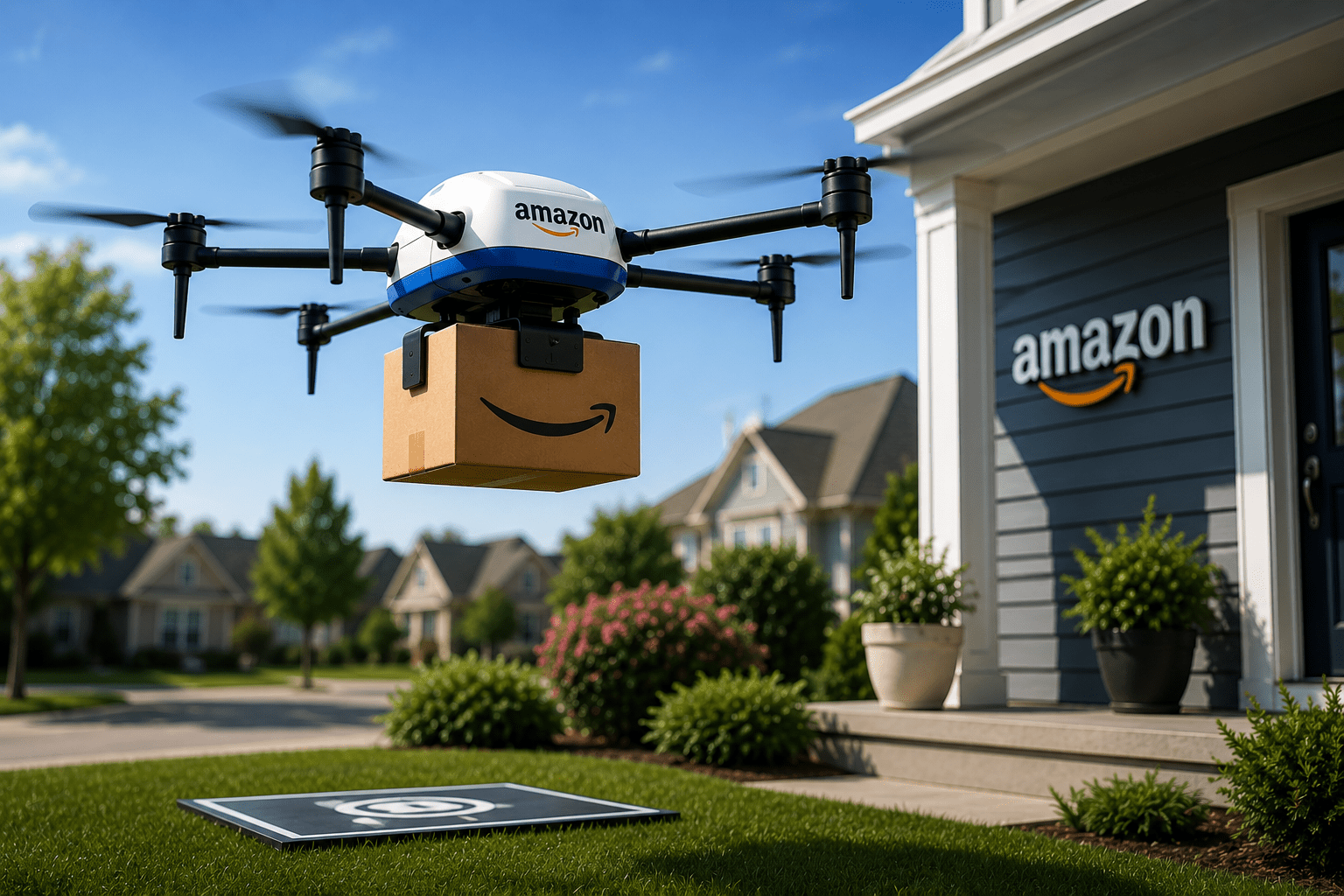
The drone then follows a pre-programmed flight path using advanced navigation systems and real-time environmental monitoring technology. Upon arriving at the destination, the aircraft carefully lowers the package into a designated delivery zone before automatically returning to the fulfilment centre.
Amazon says the process is designed to minimize delivery time while maintaining strict operational safety standards.
What Products Can Be Delivered by Drone?
The current drone delivery system focuses on small and lightweight products weighing under approximately 5 pounds (2.2 kilograms). According to Amazon, the majority of everyday household purchases fall within this weight category.
Eligible products include:
- Phone chargers and electronic accessories
- Batteries and cables
- Beauty and healthcare products
- Kitchen accessories
- Small household essentials
- Pet supplies
- Emergency everyday items
Amazon believes drone delivery will be especially useful for urgent same-day purchases where customers need products within hours rather than waiting for standard shipping windows.
The Technology Behind Amazon’s MK30 Drone
The Darlington operation uses Amazon’s latest-generation MK30 delivery drone, which has been specifically designed for safer and quieter urban and suburban operations.
The MK30 drone features:
- Advanced “detect and avoid” systems
- Real-time terrain mapping
- Automated route correction
- Weather monitoring sensors
- Multiple backup safety systems
- Precision landing and delivery capability
- Reduced noise output compared to previous models
The aircraft uses onboard artificial intelligence and computer vision technology to identify obstacles during flight, including trees, power lines, buildings, animals, and other aircraft.
Amazon states that the drones are capable of operating safely even in areas with moderate environmental complexity and changing weather conditions.
Regulatory Approval and UK Aviation Oversight
Launching commercial drone deliveries in the UK required extensive approval from the Civil Aviation Authority (CAA), local councils, and aviation regulators.
Amazon worked with regulators for several years to develop operational frameworks covering:
- Flight safety
- Airspace management
- Privacy regulations
- Emergency procedures
- Noise control
- Autonomous aircraft reliability
The company conducted multiple test flights before commercial approval was granted for the Darlington pilot programme.
UK aviation authorities will continue monitoring the operation closely during the trial phase before considering broader expansion into additional cities and regions.
Why Amazon Chose Darlington
Darlington was selected because of its combination of suburban residential areas, controlled airspace conditions, and proximity to Amazon’s existing logistics infrastructure.
Smaller towns are considered ideal environments for early drone deployment because they typically experience:
- Lower air traffic congestion
- Fewer skyscrapers and urban obstacles
- Easier route management
- More predictable delivery zones
- Reduced operational complexity
Industry analysts say successful operations in Darlington could eventually pave the way for drone delivery expansion into larger UK cities over the next several years.
Environmental and Logistics Impact
Amazon argues that drone deliveries could significantly reduce delivery van traffic and improve environmental sustainability for last-mile logistics.
Potential benefits include:
Faster Deliveries
Customers may receive eligible products within one to two hours after ordering.
Reduced Road Congestion
Fewer delivery vehicles on roads could help reduce traffic pressure in residential areas.
Lower Carbon Emissions
Electric-powered drones may lower emissions for lightweight deliveries compared to fuel-powered vans.
Improved Delivery Efficiency
Autonomous systems can operate continuously with minimal manual intervention.
However, experts also note that the long-term environmental impact will depend on battery production, charging infrastructure, drone manufacturing, and overall operational scale.
Concerns and Public Debate
Despite excitement around the technology, drone delivery expansion has also raised concerns among regulators and residents.
Some of the key concerns include:
- Privacy issues from low-flying aircraft
- Noise pollution in residential neighborhoods
- Airspace congestion
- Safety risks during equipment failure
- Weather-related operational challenges
- Cybersecurity and system reliability
Amazon says the MK30 drones were specifically engineered to operate more quietly than previous models and include multiple fail-safe systems to prevent accidents.
Competition in the Drone Delivery Industry
Amazon is not the only company investing in drone logistics.
Several major global firms are developing similar systems, including:
- Google-owned Wing
- Walmart
- UPS Flight Forward
- Zipline
- DHL
The global drone delivery market is expected to grow rapidly over the next decade as companies race to improve logistics speed and reduce delivery costs.
Industry analysts estimate that autonomous aerial delivery could become a multi-billion-dollar sector worldwide by the early 2030s.
Amazon’s Long-Term Expansion Plans
Amazon has confirmed that the Darlington programme is only the beginning of its broader UK drone delivery ambitions.
The company plans to gather operational data from the pilot before deciding on larger-scale deployments across Britain and Europe. Future expansion could include:
- Increased delivery range
- Larger drone fleets
- Faster dispatch systems
- Integration with same-day Prime delivery
- Expanded product categories
Amazon executives believe autonomous delivery technology will eventually become a normal part of e-commerce logistics.
A Major Step Toward the Future of Retail
The launch of Amazon’s UK drone delivery programme marks a significant moment in the evolution of online shopping and logistics technology.
What once appeared futuristic is now becoming a commercial reality. By combining artificial intelligence, autonomous aviation, and rapid logistics systems, Amazon is attempting to redefine how products move from warehouses to consumers.
While the Darlington rollout remains a limited pilot programme, it represents an important test for the future of autonomous delivery not only in the UK, but globally.
As regulators, residents, and businesses closely monitor the project, the success or failure of this initiative could shape the next generation of retail logistics for years to come.