
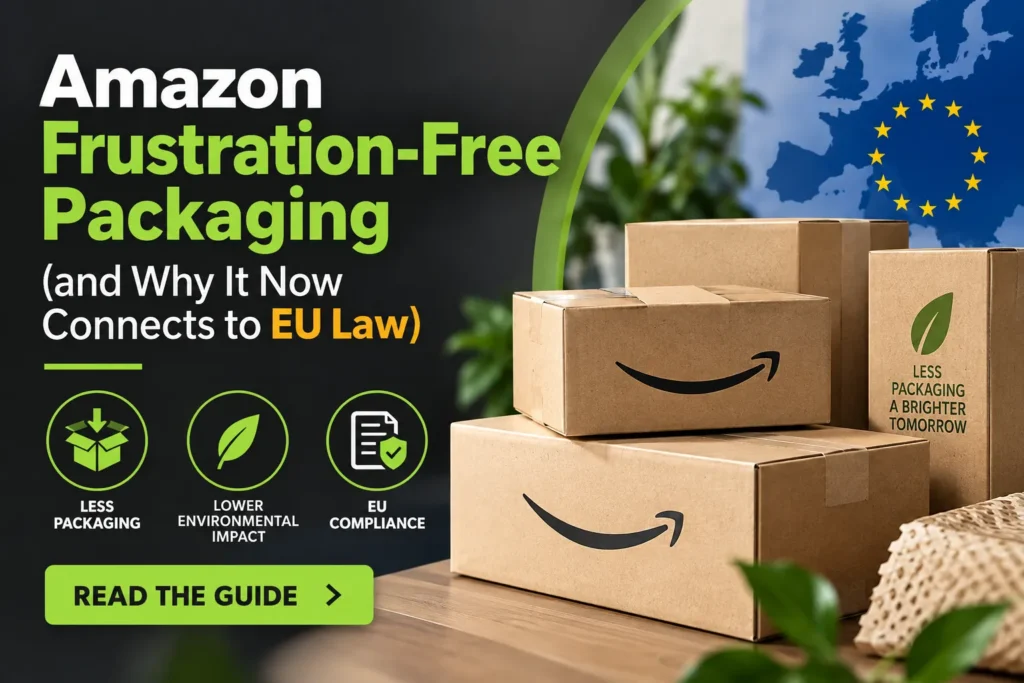
Frustration-Free Packaging (FFP) has always been an Amazon program — minimal, recyclable packaging that ships without extra boxes. Since August 12, 2026, it’s also become relevant to something bigger: the EU’s new Packaging and Packaging Waste Regulation ties legal compliance fees directly to a packaging recyclability rating, and FFP-certified packaging generally lands in the favorable tier. This isn’t a coincidence worth ignoring if you sell into Europe.
Key Takeaways
- FFP is a three-tier certification program (FFP, SIOC, PFP) requiring recyclable, minimal, easy-to-open packaging that passes ISTA shipping-simulation testing.
- Products get certified through a formal process: design submission, ISTA testing (self-administered, Amazon lab, or third-party lab depending on weight/fragility), and final badge approval.
- As of August 12, 2026, the EU’s Packaging and Packaging Waste Regulation (PPWR) requires EPR registration and fees in every EU country you sell in — and fees are increasingly tied to a recyclability rating system where better packaging design means lower fees.
- This connects directly to FFP: packaging built to meet Amazon’s recyclability and minimal-materials standards tends to score favorably under the EU’s recyclability assessment, meaning FFP certification can reduce EU compliance costs, not just Amazon packaging costs.
- FFP isn’t right for every product — fragile or high-value items risk increased damage and perceived-value concerns, and alternative programs exist for products that don’t qualify.
What Frustration-Free Packaging Actually Is
FFP is Amazon’s program for shipping products in minimal, recyclable packaging — using the manufacturer’s original packaging as the shipping container wherever possible, eliminating extra boxes, foam, and plastic wrap. It reduces material and shipping costs for sellers, cuts waste, and gives customers a simpler unboxing experience without excess filler.
The Three Certification Tiers
| Tier | Name | Key Requirement |
| Tier 1 | Frustration-Free Packaging (FFP) | 100% recyclable, no plastic/foam/wire ties, opens in under 2 minutes without tools, box utilization score of 30%+ (fragile) or 50%+ (non-fragile) |
| Tier 2 | Ships in Own Container (SIOC) | Fully sealed, durable packaging shipping without additional Amazon boxes, similar box utilization thresholds |
| Tier 3 | Prep-Free Packaging (PFP) | For larger/heavier items; ships in vendor packaging without requiring Amazon to add prep materials |
Each tier is progressively suited to different product profiles — Tier 1 is the most demanding and the most environmentally rigorous, while Tier 3 accommodates products the first two tiers can’t practically serve.
Product Eligibility
Not every product qualifies for FFP, and Amazon evaluates eligibility against durability, size, and handling requirements rather than applying the program uniformly across the catalog.
Generally eligible categories, with examples:
- Toys and Games — board games, action figures, building sets
- Home and Kitchen — small appliances, cookware, cleaning supplies
- Electronics — headphones, chargers, small gadgets
- Personal Care Items — grooming kits, hair dryers, skincare devices
Generally non-eligible categories, with examples:
- Large Furniture — sofas, bed frames, wardrobes
- Fragile Items — glassware, delicate decor, ceramic dishes
- Hazardous Materials — certain chemicals, batteries, flammable items
These eligibility boundaries exist to protect both the customer experience and product integrity — a category excluded from FFP is usually excluded because minimal packaging genuinely can’t protect that type of product reliably in transit, not as an arbitrary restriction.
The Box Utilization Score: How It’s Actually Calculated
The box utilization score is the specific metric Amazon uses to judge whether packaging is appropriately sized for its contents, and it’s worth understanding rather than treating as a black box. In simplified terms, it’s calculated as the volume of the product divided by the volume of the packaging, expressed as a percentage — a higher score means less wasted space and material relative to the product itself. Fragile items are held to a lower threshold (30%+) since they legitimately need more protective space around them, while non-fragile items are expected to reach a tighter fit (50%+), since there’s less justification for excess space when the product doesn’t need cushioning. Sellers preparing for FFP certification should calculate this score during packaging design, not after submission, since a design that falls short of the threshold will be rejected and require a redesign cycle regardless of how well it performs on other criteria.
The Certification Process, Step by Step
Step 1: Packaging Design Submission
Sellers begin by submitting packaging designs to Amazon for review, ensuring the design aligns with the specific tier being pursued — FFP, SIOC, or PFP each carry distinct requirements, so the design needs to be built against the correct target from the outset rather than adjusted after initial rejection.
Step 2: ISTA Testing
Amazon requires packaging to pass testing based on International Safe Transit Association (ISTA) standards, simulating real-world shipping stress: drops, vibration, and compression. Tier 1 and Tier 2 packaging typically undergo the ISTA 6-Amazon.com test — products under 50 lbs use the standard Type A version, covering vibration, shock, and atmospheric conditioning, while oversized packages (over 50 lbs or with dimensions exceeding 108 inches) require more extensive Type B through F testing tailored to larger items. Tier 3 (PFP) uses the ISTA 6-Amazon.com Over-Boxing test specifically, since PFP packaging needs to demonstrate it can handle additional protective outer packaging if Amazon determines it’s needed.
Step 3: Certification Pathway
Sellers have three routes to ISTA certification depending on product type: a self-administered Vendor Drop Test for non-fragile products under 50 lbs; Amazon’s own Packaging Lab, which evaluates fragile items under 50 lbs directly against ISTA 6A standards; or a certified third-party lab for items over 50 lbs or more fragile products, with many labs accessible through Amazon’s Packaging Support and Supplier Network (APASS) to simplify finding a qualified tester.
Step 4: Final Approval and FFP Badge
Once packaging passes the required ISTA tests and meets all standards for the target tier, Amazon grants certification and the FFP badge appears directly on the product listing — a visible signal to shoppers that the item ships in eco-friendly, tested packaging.
The Connection Most Guides Miss: EU Packaging Law
What Changed on August 12, 2026
This is genuinely new, and most current FFP content — including thorough, recently-updated guides — doesn’t connect it at all: the EU’s Packaging and Packaging Waste Regulation (PPWR, Regulation EU 2025/40) took effect on August 12, 2026, replacing the older, more fragmented Packaging Directive. It requires anyone placing packaged goods on the EU market — including US-based Amazon sellers whose products simply reach EU customers — to register for Extended Producer Responsibility (EPR) in every EU country where they sell, and pay eco-contribution fees. Critically, these fees are increasingly tied to a recyclability rating system: better-designed, more recyclable packaging generally qualifies for lower fees, while poorly-designed or hard-to-recycle packaging faces escalating surcharges. The UK runs a comparable system, with its own Recyclability Assessment Methodology grading packaging from green to red, and red-rated packaging facing surcharges that escalate over successive years. Amazon itself is enforcing this directly — reportedly blocking a very high share of non-compliant listings in prior enforcement waves, and offering a “Pay on Behalf” service (with its own separate service fee, reportedly around £20 in the UK and roughly €25 per category in several EU countries) for sellers without their own registration.
How FFP Certification Actually Helps Here
Here’s the connection: FFP’s core requirements — fully recyclable materials, minimal excess packaging, no foam or mixed-material components — are largely the same characteristics that score favorably under the EU’s and UK’s recyclability rating systems. A product already certified for FFP has, in effect, already done much of the design work that also reduces EU/UK EPR fee exposure. This doesn’t eliminate the registration requirement or the need to work with an Authorized Representative in each EU country if you don’t have a local entity — that’s a separate legal obligation — but it does mean the packaging investment you make for Amazon’s program has a second, increasingly significant return if you sell into Europe. Given how new and actively evolving this regulation is, confirm current EPR registration requirements and fee structures for your specific countries and categories directly, since this area is changing quickly.
Cost Savings: A Worked Example
Most FFP content mentions “cost savings” generally without a number. Combining Amazon-side and EU-side savings for an illustrative mid-size seller:
| Factor | Estimate |
| Reduced packaging material cost (Amazon-side, per unit) | Modest per-unit savings, compounding across volume |
| Reduced shipping weight/dimensional cost | Additional per-unit savings from a more compact shipped package |
| Potential EPR fee tier improvement (EU/UK, if selling into Europe) | Favorable recyclability rating vs. red/non-compliant rating can mean materially lower per-tonne eco-contribution fees |
The EU-side savings specifically depend heavily on your packaging’s current rating and your sales volume into Europe — sellers with meaningful EU/UK volume and currently poor-rated packaging stand to gain the most from combining an FFP redesign with EPR fee optimization, while US-only sellers should focus purely on the Amazon-side savings.
Benefits and Real Challenges
Enhanced Customer Experience
FFP simplifies unboxing by shipping items in their original packaging without extra fillers, appealing directly to eco-conscious buyers who notice and appreciate reduced waste. The tradeoff is real: less protective material does increase the risk of shipping damage if the underlying packaging isn’t durable enough on its own to compensate for what’s been removed.
Environmental Sustainability
By using recyclable materials and avoiding excess fillers, FFP genuinely reduces packaging waste and aligns with Amazon’s broader sustainability commitments — and, as covered above, increasingly aligns with binding EU and UK packaging law too. This benefit requires the same careful balancing act as customer experience: sustainability gains shouldn’t come at the cost of product protection.
Increased Sales and Visibility
FFP certification can improve Prime shipping eligibility and visibility, and there’s reason to believe Amazon’s algorithm gives some weight to eco-friendly packaging in ranking or placement decisions. This benefit is more pronounced for everyday goods than for high-value items, where minimalist packaging can work against the premium positioning a more elaborate presentation would support.
Cost Savings
Eliminating additional packaging materials and reducing shipping weight lowers costs directly — less material purchased, less weight shipped, lower dimensional fees where applicable. The caveat: FFP requires that the packaging alone, without supplementary protection, hold up during transit, which can mean investing in a sturdier (and sometimes costlier) primary package to safely eliminate the secondary one.
Perceived Value Concerns
Some customers associate minimalist packaging with lower value, and products shipped without an outer box or filler material can create confusion or disappointment for categories where presentation genuinely matters to the buying experience — beauty products and toys are commonly cited examples where this risk is highest.
Higher Risk of Returns
Because FFP products often ship with minimal protection, there’s a real increased risk of items arriving damaged compared to more heavily padded standard packaging, which can drive higher return rates and dissatisfaction among customers who expected pristine, protected delivery.
Potential for Customer Confusion
When standard and frustration-free packaging options exist side by side for similar products, some customers may not fully understand what FFP means or may default to standard packaging on the assumption it offers better protection or perceived value — a conversion-rate risk worth testing for rather than assuming away.
Difficulty Exiting the Program
If a seller determines FFP isn’t the right fit for a specific product after certification, exiting the program can be a lengthy, non-trivial process. This is a strong argument for evaluating the decision carefully upfront — including the eligibility and box-utilization-score realities covered above — rather than certifying first and reconsidering later.
Packaging Durability Requirements
Since FFP relies on the product’s own packaging to protect it in transit, delicate or fragile items may not be practical candidates unless packaged in genuinely robust, higher-quality materials — which can add cost that partially offsets FFP’s savings, particularly for categories sitting near the eligibility boundary.
If Your Product Doesn’t Qualify
FFP isn’t achievable for every product, and that’s fine — alternatives exist:
- Small and Light Program — for lightweight, compact items, reducing fulfillment costs with free-shipping eligibility
- Subscribe and Save — for repurchase-friendly categories, building recurring revenue independent of packaging tier
- FBA Export — for reaching international customers from US fulfillment centers without separate country-by-country operations
How EcomRanker Approaches Packaging Strategy
We treat packaging decisions as a cost and compliance question together, not just an Amazon program to opt into — reviewing FFP eligibility alongside EU/UK EPR exposure for sellers active in those markets, so a packaging redesign serves both goals rather than being planned in isolation.
Selling into the EU or UK and want your packaging reviewed against both FFP eligibility and current EPR exposure? Get in touch for a packaging strategy review.
Frequently Asked Questions
1 . What is Amazon Frustration-Free Packaging?
A certification program requiring minimal, fully recyclable packaging that ships without extra boxes or filler, using the manufacturer’s original packaging wherever possible.
2 . What are the three FFP certification tiers?
FFP (Tier 1, the strictest), SIOC or Ships in Own Container (Tier 2), and PFP or Prep-Free Packaging (Tier 3, for larger/heavier items).
3 . Does FFP certification affect my EU packaging compliance costs?
Potentially yes. Since the EU’s Packaging and Packaging Waste Regulation took effect in August 2026, packaging fees are increasingly tied to a recyclability rating, and FFP-compliant packaging generally shares the characteristics that score favorably under that system.
4 . Do I still need separate EU EPR registration if my packaging is FFP-certified?
Yes. FFP certification doesn’t replace the legal requirement to register for Extended Producer Responsibility in each EU country you sell in — it can help your fee tier, but the registration obligation is separate.
5 . What products don’t qualify for FFP?
Large furniture, fragile glassware and decor, and hazardous materials generally don’t qualify, since FFP’s minimal-packaging approach conflicts with their damage-prevention or safety needs.
6 . How long does FFP certification take?
It varies by product and testing pathway, generally involving design submission, ISTA shipping-simulation testing, and final review before badge approval.
7 . Can I exit the FFP program if it’s not working for my product?
Yes, but the process can be lengthy, so evaluate the decision carefully before committing to certification.
8 . Does FFP hurt perceived product value?
It can for some categories, particularly beauty products or toys where presentation matters to the customer, since minimal packaging is sometimes associated with lower value.
9 . What alternatives exist if my product doesn’t qualify for FFP?
The Small and Light Program, Subscribe and Save, and FBA Export all offer different cost or reach advantages without requiring FFP certification specifically.
10 . Is the EU’s new packaging law relevant to US-only sellers?
No, the EPR/PPWR obligations specifically apply to products reaching EU customers. US-only sellers should still consider FFP for its direct Amazon-side cost and customer experience benefits, without the EU compliance dimension.