
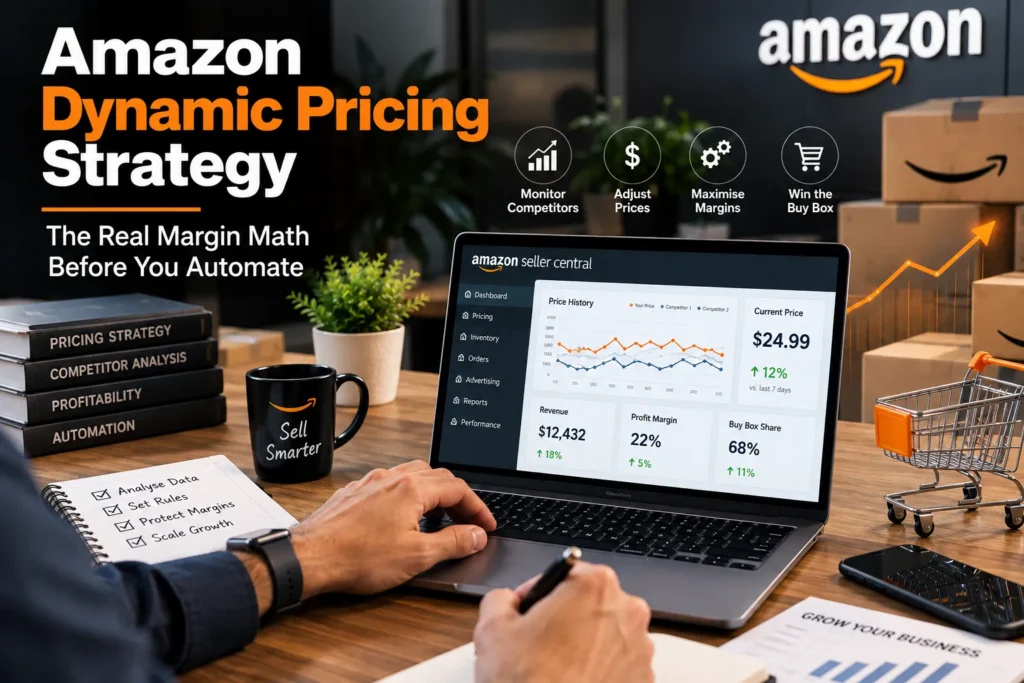
Amazon dynamic pricing automatically adjusts your price based on competition, demand, and inventory — and sellers using competitive-based repricing see an average 23% increase in Buy Box percentage within 30 days. But automated pricing without a profit floor doesn’t just risk a race to the bottom on margin; if it triggers a Minimum Advertised Price violation, that’s a real relationship and account risk, not just a theoretical concern.
Key Takeaways
- Dynamic pricing automatically adjusts your price based on competitor moves, demand signals, inventory levels, and time-based patterns, using Amazon’s free built-in Automate Pricing tool or third-party repricing software.
- The impact is measurable and significant: sellers using competitive-based repricing report an average 23% increase in Buy Box percentage within the first 30 days, and winning the Buy Box itself can lift sales by 300-400%.
- Setting a minimum price threshold is non-negotiable — without one, automated rules can race your price toward zero margin in pursuit of the Buy Box.
- MAP violations are a real account-level risk, not just a manufacturer relationship problem — automated rules that undercut a Minimum Advertised Price agreement can trigger brand complaints that feed into your broader account health standing.
- Price display rules differ outside the US — the UK and EU have specific VAT-inclusive pricing and unit-pricing display requirements that a US-configured pricing tool doesn’t automatically handle.
What Amazon Dynamic Pricing Actually Is
Dynamic pricing adjusts your product’s price in real time based on changing market conditions — competitor pricing, demand signals, inventory levels, and even time of day — rather than sticking to one static price indefinitely. On a platform where the vast majority of shoppers actively compare prices before buying, a stale price is a quiet, ongoing cost: a shopper who’d have bought at your price yesterday scrolls past today if a competitor undercut you overnight and you haven’t noticed.
Dynamic Pricing vs. Repricing — They’re Not Quite the Same Thing
These terms get used interchangeably, but there’s a real distinction worth understanding. Repricing is narrower: it specifically adjusts your price in response to competitor price movements, with the primary goal of winning or keeping the Buy Box. Dynamic pricing is the broader concept, incorporating repricing but also factoring in demand patterns, inventory levels, seasonality, and time-of-day behavior — not just what competitors are doing. In practice, most sellers using Amazon’s Automate Pricing tool or a third-party service are doing some blend of both, but the distinction matters when evaluating software: a pure repricer optimizes narrowly for Buy Box share, while a full dynamic pricing system is optimizing for a broader set of signals simultaneously.

Benefits and Drawbacks of Dynamic Pricing
Benefits:
- Competitive pricing attracts more customers and drives sales volume
- Adjusting to market conditions opens revenue opportunities a static price misses
- Improves Buy Box win rate, which directly affects visibility
- Sales velocity gains from smart pricing can improve organic Best Seller Rank
- Responding quickly to competitor moves protects market position
- Real-time data on customer behavior informs better pricing decisions over time
Drawbacks:
- Continuously lowering price to stay competitive erodes margin if left unchecked
- Frequent visible price changes can undermine customer trust in some categories
- Poorly configured automation can create legally risky pricing patterns
- Automated price drops can violate MAP agreements with manufacturers (see below)
- Frequent price volatility can increase buyer’s remorse and return rates
Setting Up Automate Pricing (Amazon’s Free Tool): Step by Step
- Log in to Seller Central with your seller account credentials.
- Navigate to Pricing → Automate Pricing from the left-hand menu.
- Click “Create a customized pricing rule.”
- Select a rule type from the six options below, based on your actual goal (Buy Box competition, B2B pricing, or inventory clearance).
- Name your rule clearly, especially if you’ll be managing multiple rules across different product groups.
- Configure the rule specifics: select which marketplaces it applies to, choose your pricing action (match, beat, or stay above a competitor), and set minimum and maximum price thresholds — this last step is the guardrail that prevents runaway price drops.
- Apply optional seller filters if you want to compare only against specific seller types (for example, only other FBA offers), keeping the comparison relevant to your actual competitive set.
- Review, save, and monitor. Once live, check performance regularly and adjust thresholds as market conditions shift — this isn’t a “set once and ignore” tool.
| Rule Type | What It Does |
| Competitive Featured Offer | Adjusts your price based on the current Featured Offer (Buy Box) price |
| Competitive Lowest Price | Matches or beats the lowest price across all sellers of the product |
| Competitive External Price | Adjusts when Amazon detects a lower price for your product elsewhere online |
| Business Competitive Featured Offer | Targets B2B pricing to match the Buy Box price in Amazon Business |
| Business Price and Quantity Discounts | Sets automatic volume-based discounts for bulk B2B buyers |
| Based on Sales Units | Drops price once a sales volume threshold is hit within a set timeframe |
The Profit Math Most Guides Skip (Worked Example)
Most dynamic pricing content explains the mechanics thoroughly but stops short of showing what an automated price drop actually does to your bottom line. Here’s a simplified example for a product with a $9 landed cost:
| Scenario | Price | Referral Fee (15%) | Net Profit/Unit | Units Sold | Total Profit |
| Static price, losing Buy Box | $24.99 | $3.75 | $12.24 | 40/month (low, no Buy Box) | $489.60 |
| Repriced to win Buy Box | $21.99 | $3.30 | $9.69 | 150/month (Buy Box win) | $1,453.50 |
| Repriced too aggressively (no floor) | $16.99 | $2.55 | $4.44 | 180/month | $799.20 |
This is the core argument for setting a real minimum price threshold rather than letting a rule chase the Buy Box unconditionally: the middle scenario captures most of the volume benefit while preserving healthy per-unit margin, while the third scenario shows more units sold but meaningfully less total profit than the middle scenario — a result that looks like a win on a sales dashboard but is actually a worse outcome. Model this kind of comparison for your own product before setting thresholds, rather than assuming “more Buy Box time” automatically means “more profit.”
MAP Violations: A Real Account Risk, Not Just a Manufacturer Problem
Most dynamic pricing content mentions Minimum Advertised Price (MAP) violations as a brief caution — a manufacturer relationship issue to be aware of. That undersells the actual risk. If your automated pricing rule undercuts a MAP agreement you’re bound by, the brand owner can file a complaint with Amazon, and depending on severity and pattern, this can feed into broader account health scrutiny beyond just damaging your relationship with that specific supplier. If you sell products under any MAP agreement, build your minimum price threshold at or above your MAP price, not just above your cost floor — an automated rule optimized purely for cost-plus margin can still violate a contractual pricing floor you agreed to separately. This is a detail worth checking explicitly rather than assuming your cost-based minimum automatically respects every MAP agreement you’re party to.
Does Dynamic Pricing Work the Same Way in the UK and EU?
Largely yes on the mechanics, but price display requirements differ in ways a US-configured strategy doesn’t automatically account for:
| Market | Price Display Requirement |
| US | Price typically displayed exclusive of sales tax, calculated at checkout |
| UK | Prices to consumers must be displayed inclusive of VAT |
| EU | VAT-inclusive display required; unit pricing (price per standard unit of measure) required for many product categories |
If your dynamic pricing rules are configured based on a US mental model of “the price,” and you’re also selling on Amazon.co.uk or EU marketplaces, confirm your displayed price already reflects the required VAT-inclusive format for that marketplace — an automated rule optimizing toward a competitor’s displayed price needs to be comparing like-for-like (VAT-inclusive to VAT-inclusive), not accidentally comparing a US-style pre-tax figure against a UK VAT-inclusive one.
Best Practices for Pricing Without Racing to the Bottom
- Always set a minimum price threshold reflecting your true cost floor, including Amazon fees — never leave a rule uncapped.
- Make small, testable changes rather than large swings — a $0.50–$1.00 adjustment reveals conversion impact without shocking demand.
- Monitor competitor pricing regularly, not just react through automation — understanding why a competitor moved (a promotion, a stockout, a clearance) informs whether matching them is actually the right call.
- Adjust based on sales velocity, not just price position — a temporary, deliberate price drop can break a sales slump and restore organic ranking momentum, which a purely reactive rule might not capture.
- Plan deep discounts strategically around major events (Prime Day, Black Friday) rather than reactively, since a well-timed aggressive discount can drive a ranking boost that outlasts the event itself.
- Use review count as pricing leverage — a well-reviewed, trusted listing can support testing a slightly higher price without hurting conversion the way an unproven listing would.
- Don’t leave pricing static for months at a time even outside of active campaigns — review at least monthly, since competitive and demand conditions shift continuously.
- Consider pack-size and bundle adjustments as an alternative or complement to price changes — a larger multi-pack can improve unit economics without a straight price cut.
- Coordinate pricing with advertising spend — a strong PPC campaign can’t fix an uncompetitive price, and a competitive price without supporting visibility leaves volume on the table.
- Be willing to reverse a bad price test quickly — if a change doesn’t produce the expected conversion or profit result within a reasonable window, revert rather than waiting it out on the assumption it will eventually work.
When Dynamic Pricing Isn’t the Right Fit
Not every product benefits from frequent price movement. High-competition, fast-moving commodity-type products are where dynamic pricing earns its keep. Luxury, handmade, or strongly brand-sensitive items can see the opposite effect — frequent visible price changes can erode the perceived exclusivity or trust that supports a premium price in the first place. Match the pricing approach to the product’s actual competitive and psychological positioning rather than applying automation uniformly across a mixed catalog.
How EcomRanker Builds Pricing Strategy Around Margin
We configure dynamic pricing rules against actual profit thresholds, not just Buy Box win rate — checking MAP compliance explicitly, and building marketplace-specific rules that respect VAT-inclusive display requirements for sellers active in the UK and EU. This coordinates directly with our Amazon PPC management work, since price and ad spend need to move together, not be optimized in isolation from each other.
Want your current pricing rules checked against real margin impact, not just Buy Box percentage? Get in touch for a pricing strategy review.
Frequently Asked Questions
1 . What is Amazon dynamic pricing?
A strategy that automatically adjusts your product’s price in real time based on competitor pricing, demand, inventory levels, and other market conditions, typically managed through Amazon’s Automate Pricing tool or third-party repricing software.
2 . How much can dynamic pricing improve my Buy Box percentage?
Sellers using competitive-based repricing strategies report an average 23% increase in Buy Box percentage within the first 30 days of implementation, according to third-party pricing software research.
3 . Is Amazon’s Automate Pricing tool free?
Yes, it’s built into Seller Central at no additional cost, offering core rule-based repricing functionality suitable for most small to mid-sized sellers.
4 . What’s the biggest risk of dynamic pricing without a minimum threshold?
Without a set minimum price, automated rules can chase the Buy Box by continuously lowering price, eroding your margin far below what a static price would have preserved, even while sales volume increases.
5 . Can dynamic pricing violate MAP agreements?
Yes. An automated rule optimized purely around cost-based margin can still undercut a Minimum Advertised Price agreement with a manufacturer, which can trigger brand complaints that affect broader account standing, not just that specific supplier relationship.
6 . Does dynamic pricing work the same way on Amazon UK and EU marketplaces?
The core mechanics are similar, but displayed prices must be VAT-inclusive in the UK and EU, unlike the US where tax is typically calculated separately at checkout — a detail worth confirming your pricing rules account for correctly.
7 . Is dynamic pricing right for every type of product?
No. It works best for high-competition, fast-moving commodity-type products. Luxury, handmade, or brand-sensitive items can see reduced perceived value from frequent visible price changes.
8 . How often should I review my dynamic pricing rules?
At least monthly, with more frequent review during major events like Prime Day or Q4, since market conditions shift quickly enough that even automated rules benefit from periodic human recalibration.
9 . Should I use Amazon’s free tool or a third-party repricer?
Amazon’s Automate Pricing tool covers core functionality well for most small-to-mid sellers. Third-party tools generally add more advanced analytics, cross-marketplace integration, and AI-driven optimization useful for larger or more complex catalogs.
10 . What’s the difference between dynamic pricing and repricing?
Repricing specifically adjusts your price in response to competitor movements to win the Buy Box. Dynamic pricing is the broader concept, also factoring in demand, inventory, seasonality, and time-of-day patterns beyond just competitor activity.
11 . Can a price change hurt my organic ranking on Amazon?
Not directly, but a well-timed strategic price drop can boost sales velocity, which is a genuine ranking factor — meaning pricing and organic rank are connected through sales performance, not through price itself as a direct signal.