Amazon has evolved far beyond a simple eCommerce marketplace. Today, it is one of the world’s largest advertising platforms, generating billions in advertising revenue each year and offering brands unprecedented access to shoppers at every stage of the buying journey.
As competition on Amazon continues to intensify, advertising is no longer optional. Whether you’re launching a new product, expanding your brand presence, or scaling an established catalog, advertising plays a critical role in driving visibility, traffic, and sales.
However, many brands face a common challenge: choosing between Amazon DSP and Sponsored Ads.
At first glance, both advertising solutions appear to serve similar purposes. They help brands reach customers, increase product visibility, and generate revenue. But beneath the surface, these platforms operate very differently.
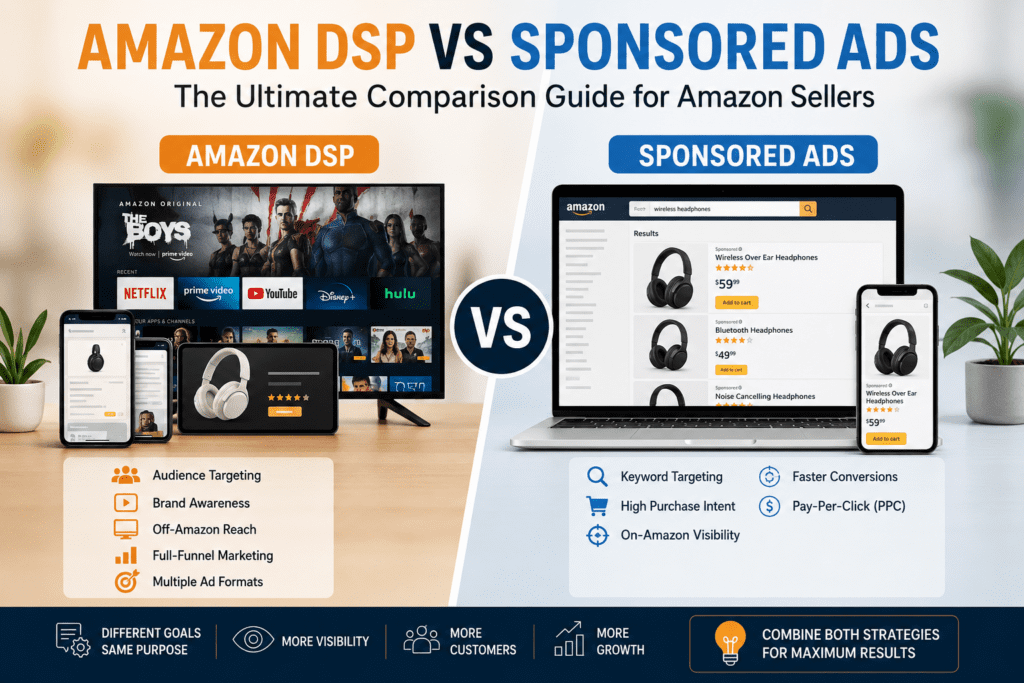
Amazon DSP focuses on audience-based advertising, allowing brands to reach shoppers both on and off Amazon using sophisticated behavioral targeting and retargeting capabilities.
Sponsored Ads, on the other hand, focus on capturing demand within Amazon’s marketplace through keyword targeting and product placements designed to drive immediate conversions.
Understanding these differences is crucial because choosing the wrong advertising strategy can lead to wasted budget, poor campaign performance, and missed growth opportunities.
In this comprehensive guide, we’ll break down everything you need to know about Amazon DSP vs Sponsored Ads, including:
- How each advertising solution works
- Their strengths and weaknesses
- Cost considerations
- Targeting capabilities
- Ideal use cases
- Performance expectations
- Budget requirements
- Strategic recommendations
By the end of this guide, you’ll understand which platform aligns best with your goals and how many successful brands combine both to create a powerful full-funnel advertising strategy.
Understanding Amazon’s Advertising Ecosystem
Before comparing Amazon DSP and Sponsored Ads directly, it’s important to understand where they fit within Amazon’s broader advertising ecosystem.
Amazon offers multiple advertising solutions designed to support different objectives throughout the customer journey.
1 . Awareness Stage
At the top of the funnel, brands need to introduce themselves to potential customers who may not yet know they exist.
Advertising solutions commonly used at this stage include:
- Amazon DSP Display Ads
- Amazon DSP Video Ads
- Prime Video Ads
- Fire TV Ads
- Streaming TV Ads
- Audio Ads
The goal here is visibility, audience growth, and brand awareness rather than immediate purchases.
2 . Consideration Stage
Once customers become aware of a brand, the next objective is nurturing interest and consideration.
At this stage, brands often use:
- DSP Retargeting Campaigns
- Sponsored Display Ads
- Sponsored Brands Video
- Store Spotlight Campaigns
These formats help keep products and brands visible as shoppers research options.
3 . Conversion Stage
When shoppers are actively searching for products, brands focus on converting interest into sales.
Popular conversion-focused ad formats include:
- Sponsored Products
- Sponsored Brands
- Sponsored Display
- Product Targeting Campaigns
These ads appear directly within Amazon search results and product detail pages, capturing high-intent buyers.
4 . Loyalty and Retention Stage
After a purchase, brands seek to maximize customer lifetime value.
Advertising solutions often include:
- DSP Remarketing Campaigns
- Audience Retargeting
- New Product Launch Campaigns
- Cross-Selling Strategies
This is where Amazon DSP becomes particularly valuable because it can continue reaching customers beyond Amazon’s marketplace.
Understanding these stages helps explain why Amazon DSP and Sponsored Ads are not necessarily competing solutions. They often serve different purposes within the customer journey.
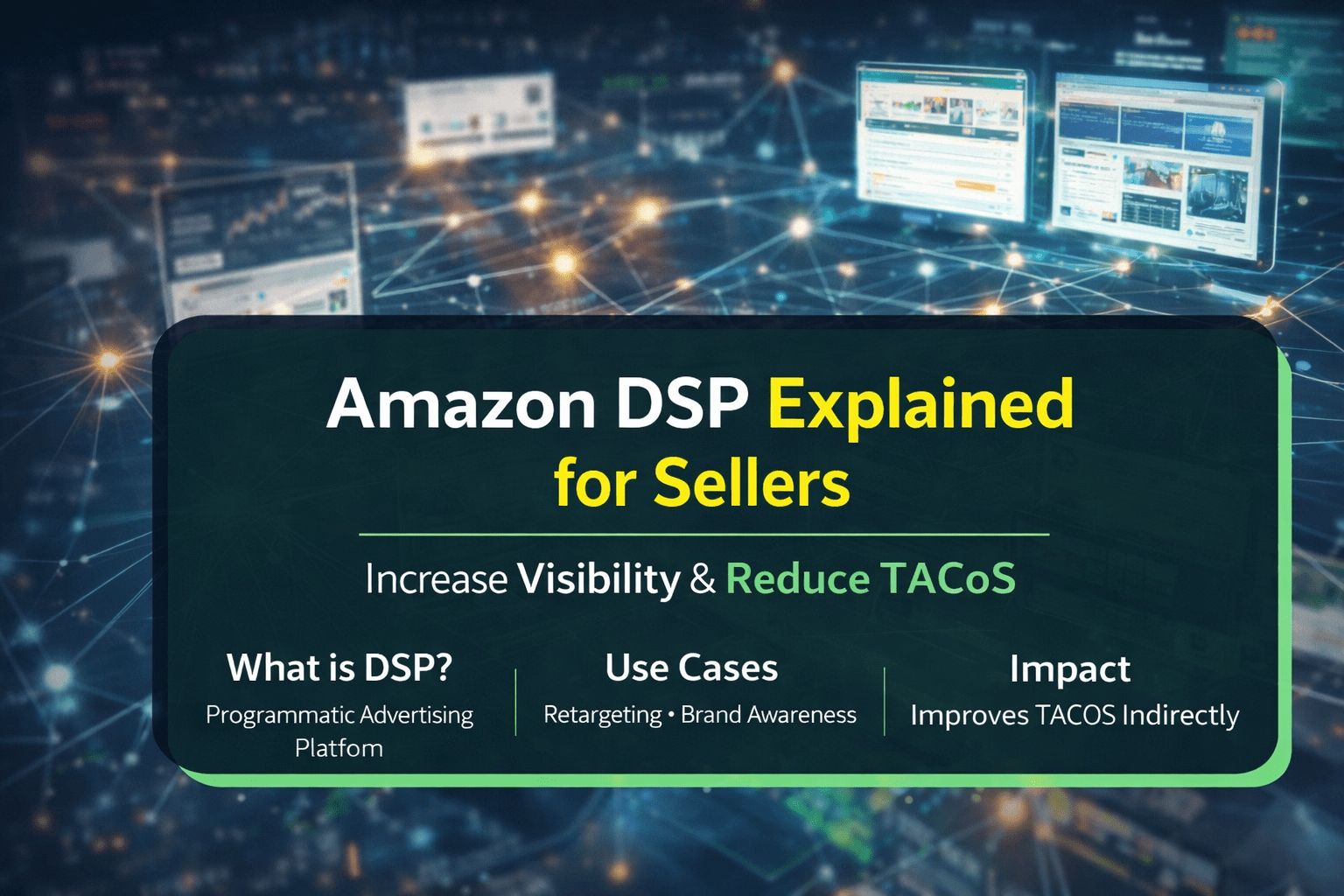
What Is Amazon DSP?
Amazon DSP stands for Demand-Side Platform.
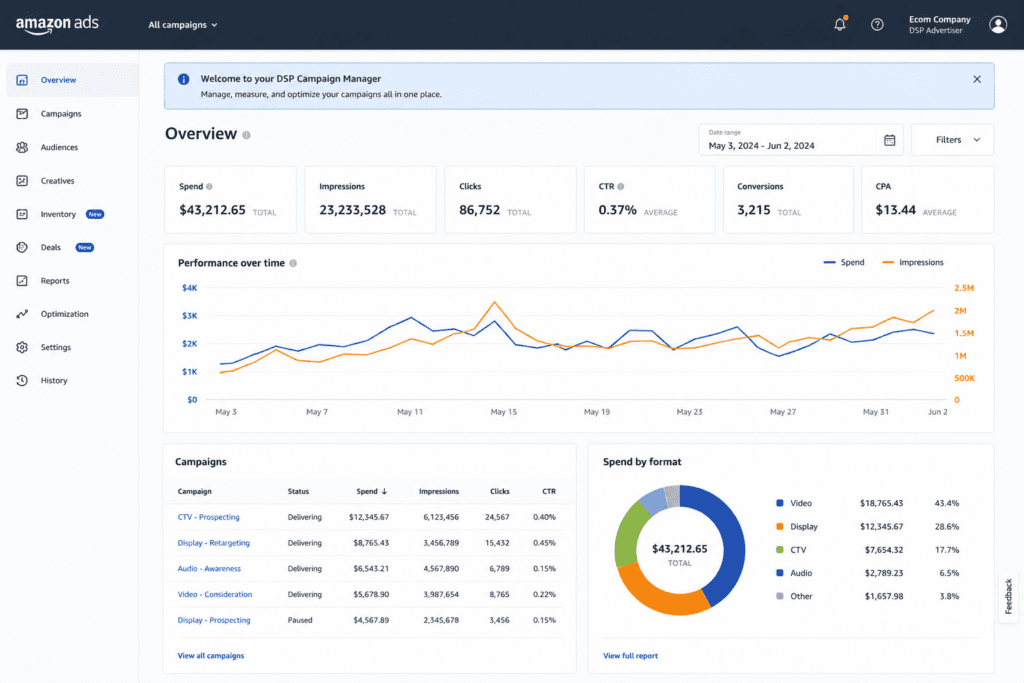
It is Amazon’s programmatic advertising solution that enables brands to buy display, video, and audio advertising inventory both on and off Amazon.
Unlike Sponsored Ads, which primarily target shoppers based on search intent, DSP focuses on audiences.
This means advertisers can reach consumers based on:
- Shopping behavior
- Purchase history
- Browsing activity
- Lifestyle interests
- Demographics
- Similar audience profiles
Amazon DSP leverages one of the largest consumer datasets in the world, allowing advertisers to target highly specific audience segments.
For example, a fitness supplement brand could target:
- People who recently purchased workout equipment
- Consumers browsing protein powders
- Shoppers interested in health and wellness
- Previous visitors to competitor listings
This audience-first approach gives brands significantly more control over who sees their advertisements.
Why Amazon Created DSP
Traditional digital advertising often relies on third-party cookies and external data providers. Amazon, however, possesses first-party shopping data collected directly from millions of customer interactions. DSP was created to help advertisers leverage this data across multiple channels. Instead of waiting for shoppers to search for products, advertisers can proactively reach potential customers wherever they spend time online. This dramatically expands advertising opportunities.
How Amazon DSP Works
Amazon DSP operates through programmatic advertising technology. Programmatic advertising uses automated systems to purchase advertising inventory in real time.
Rather than manually buying placements, advertisers define:
- Target audience
- Budget
- Bid strategy
- Creative assets
- Campaign objectives
Amazon’s system then automatically places ads in locations most likely to achieve campaign goals.
Step 1: Audience Selection
Campaigns begin with audience targeting. Advertisers can choose from:
In-Market Audiences
These shoppers are actively researching products within a category.
Examples:
- Home improvement shoppers
- Electronics buyers
- Beauty enthusiasts
- Pet owners
Lifestyle Audiences
Target consumers based on long-term interests.
Examples:
- Outdoor enthusiasts
- Frequent travelers
- Fitness-focused consumers
- Luxury shoppers
Remarketing Audiences
Reach users who previously interacted with your brand.
Examples:
- Product viewers
- Cart abandoners
- Previous purchasers
- Store visitors
Lookalike Audiences
Amazon identifies shoppers who behave similarly to existing customers. This allows brands to discover new potential buyers efficiently.
Step 2: Creative Development
Unlike Sponsored Products, DSP provides extensive creative flexibility.
Advertisers can create:
Static Display Ads – Traditional image-based advertisements.
Responsive Display Ads – Automatically optimized for different placements.
Video Ads – Short videos designed to engage audiences.
Streaming TV Ads – Appear on Prime Video and connected TV platforms.
Audio Ads – Delivered through Amazon Music and Alexa-enabled devices. Creative control allows brands to tell richer stories and strengthen brand identity.
Step 3: Real-Time Bidding
When a target audience member visits a website, app, or Amazon property, an advertising auction occurs.
Amazon evaluates:
- Audience relevance
- Bid amount
- Campaign objectives
- Historical performance
The winning advertiser earns the placement. This process happens within milliseconds.
Step 4: Performance Optimization
Amazon continuously analyzes campaign performance.
Metrics include:
- Impressions
- Reach
- Click-through rate
- Detail page views
- Add-to-cart rate
- Purchases
- Return on ad spend
Campaigns can then be optimized for:
- Awareness
- Traffic
- Conversions
- Customer acquisition
This automated optimization improves performance over time.
Where Amazon DSP Ads Appear
One of DSP’s greatest strengths is its extensive reach. Unlike Sponsored Ads, which primarily appear within Amazon, DSP campaigns can appear across numerous properties.
1 . Amazon-Owned Properties
Including:
- Amazon Homepage
- Product Detail Pages
- IMDb
- Fire TV
- Prime Video
- Twitch
- Amazon Music
2 . Third-Party Websites
Millions of websites participate in Amazon’s advertising network.
3 . Mobile Applications
Reach users through app-based placements.
4 . Streaming Platforms
Connected TV inventory continues to grow rapidly. This expanded reach enables brands to engage consumers throughout their digital journeys rather than only when they are actively shopping on Amazon.
Key Benefits of Amazon DSP
Many enterprise brands invest heavily in DSP because it offers capabilities unavailable through traditional Sponsored Ads.
Advanced Audience Targeting – DSP leverages Amazon’s extensive shopping intelligence. This often produces more accurate targeting than many traditional advertising platforms.
Massive Reach – Brands can connect with audiences beyond Amazon’s marketplace.
Powerful Retargeting – Retarget shoppers who viewed products but didn’t purchase.
Full-Funnel Advertising – Supports awareness, consideration, and conversion campaigns.
Rich Creative Formats – Video, audio, and display options provide greater storytelling opportunities.
Detailed Attribution – Understand how advertising influences customer behavior across multiple touchpoints.
New Customer Acquisition – Lookalike audience targeting helps brands expand into new customer segments.
For brands seeking aggressive growth, DSP can become a powerful customer acquisition engine.
Amazon DSP Ad Formats Explained
One of the biggest advantages of Amazon DSP is the variety of ad formats available. Unlike Sponsored Ads, which primarily focus on product promotion within Amazon’s marketplace, DSP allows brands to engage consumers through multiple channels and creative experiences.
This flexibility makes DSP especially effective for brands looking to build awareness, tell compelling stories, and nurture customer relationships throughout the buying journey.
Let’s explore the major Amazon DSP ad formats in detail.
Display Ads – Display ads are the most commonly used DSP format. These ads use images, logos, headlines, and calls-to-action to capture attention across Amazon-owned properties and third-party websites.
Display ads can appear:
- On Amazon product pages
- Amazon homepage placements
- Third-party websites
- Mobile applications
- News and content websites
Display advertising works particularly well for:
- Brand awareness campaigns
- Product launches
- Seasonal promotions
- Retargeting campaigns
Because display ads are highly visual, they help reinforce brand recognition and increase product familiarity over time.
Best Practices for Display Ads
To maximize performance:
- Use high-quality product imagery
- Maintain consistent branding
- Include clear calls-to-action
- Keep messaging concise
- Test multiple creative variations
Well-designed display ads often outperform generic creatives because they create stronger emotional engagement with shoppers.
Video Ads – Video advertising has become one of the fastest-growing segments within Amazon DSP. Video ads allow brands to showcase products, explain features, demonstrate usage, and communicate brand values more effectively than static images.
Video placements can appear on:
- Prime Video
- Fire TV
- Twitch
- IMDb
- Amazon-owned websites
- Third-party publishers
Video campaigns are particularly effective for:
- New product launches
- Product demonstrations
- Brand storytelling
- Awareness campaigns
- Premium product categories
Consumers typically retain more information from video content than static advertisements, making this format highly valuable for educating potential customers.
Benefits of DSP Video Ads
Video campaigns often generate:
- Higher engagement rates
- Better brand recall
- Increased awareness
- Improved purchase intent
- Stronger customer trust
For brands selling innovative or premium products, video can significantly improve campaign effectiveness.
Streaming TV Ads – Streaming TV advertising represents one of Amazon’s fastest-growing opportunities.
These ads appear on:
- Prime Video
- Fire TV
- Connected TV devices
- Partner streaming networks
Unlike traditional television advertising, streaming TV provides precise audience targeting capabilities.
Brands can target viewers based on:
- Purchase behavior
- Product interests
- Demographics
- Lifestyle data
This combination of television-scale reach and digital targeting precision creates a powerful advertising solution.
Why Streaming TV Matters
Consumer viewing habits continue shifting away from traditional cable television.
Streaming platforms now account for a significant portion of media consumption.
As a result, brands increasingly allocate budget toward connected TV advertising to maintain visibility among modern audiences.
Audio Ads – Amazon DSP also offers audio advertising opportunities.
Audio ads typically appear through:
- Amazon Music
- Alexa-enabled devices
- Audio streaming platforms
These advertisements reach consumers during activities such as:
- Exercising
- Driving
- Working
- Cooking
- Relaxing at home
Audio advertising allows brands to connect with consumers during moments when visual advertising may be less effective.
For example, a nutrition brand might advertise healthy snacks while users listen to workout playlists. This contextual relevance often improves advertising effectiveness.
Dynamic eCommerce Ads – Dynamic eCommerce Ads automatically pull product information from Amazon listings.
These ads can display:
- Product images
- Pricing
- Ratings
- Reviews
- Availability
The content updates automatically, ensuring shoppers always see current information.
Dynamic ads are especially useful for:
- Large catalogs
- Frequent price changes
- Promotional campaigns
- Retargeting efforts
Automation reduces management complexity while improving accuracy.
Advantages of Amazon DSP
Now that we’ve explored DSP’s capabilities, let’s examine its primary benefits.
Access to Amazon’s First-Party Data
Amazon possesses one of the most valuable consumer datasets in the world. Unlike many advertising platforms that rely heavily on third-party tracking, Amazon collects data directly from customer shopping behavior.
This provides advertisers with insights into:
- Purchase history
- Browsing patterns
- Category interests
- Product preferences
- Shopping frequency
Such data often leads to highly accurate targeting.
Reach Customers Beyond Amazon
Sponsored Ads mainly reach shoppers already browsing Amazon.
DSP extends visibility across:
- Websites
- Mobile apps
- Streaming platforms
- Connected TVs
- Audio channels
This expanded reach enables brands to influence customers before they begin searching. As a result, DSP supports stronger brand-building initiatives.
Sophisticated Retargeting Capabilities
Retargeting is one of DSP’s strongest features.
Brands can reconnect with users who:
- Viewed products
- Visited listings
- Added items to carts
- Purchased related products
These audiences often convert at higher rates because they have already demonstrated interest.
Full-Funnel Marketing
DSP supports every stage of the customer journey.
Brands can:
- Create awareness
- Generate consideration
- Drive conversions
- Build loyalty
This makes DSP particularly valuable for larger organizations seeking long-term growth.
Better New Customer Acquisition
Finding new customers remains one of the biggest challenges for growing brands. DSP’s audience modeling and lookalike targeting capabilities help identify shoppers who resemble existing customers. This expands reach while maintaining relevance.
Disadvantages of Amazon DSP
While DSP offers powerful capabilities, it isn’t the ideal solution for every brand. Understanding its limitations is equally important.
Higher Budget Requirements
Amazon DSP generally requires significantly larger advertising budgets than Sponsored Ads.
Typical investment levels include:
- Self-service DSP: $10,000–$15,000+ monthly
- Managed service DSP: $35,000–$50,000+ monthly
For many smaller sellers, these costs can be prohibitive.
Greater Complexity
DSP requires a deeper understanding of:
- Audience segmentation
- Programmatic advertising
- Creative development
- Attribution analysis
- Bid optimization
The learning curve is substantially steeper than traditional Amazon PPC. Many brands choose to work with agencies because of this complexity.
Longer Time to Measure Impact
Sponsored Ads often produce immediate sales data. DSP campaigns frequently focus on awareness and consideration metrics. As a result, ROI may take longer to evaluate. Brands must be willing to adopt a longer-term perspective.
Creative Production Requirements
DSP campaigns often require:
- Custom graphics
- Video assets
- Brand creative development
- Multiple ad variations
These production costs can add to overall campaign expenses.
What Are Amazon Sponsored Ads?
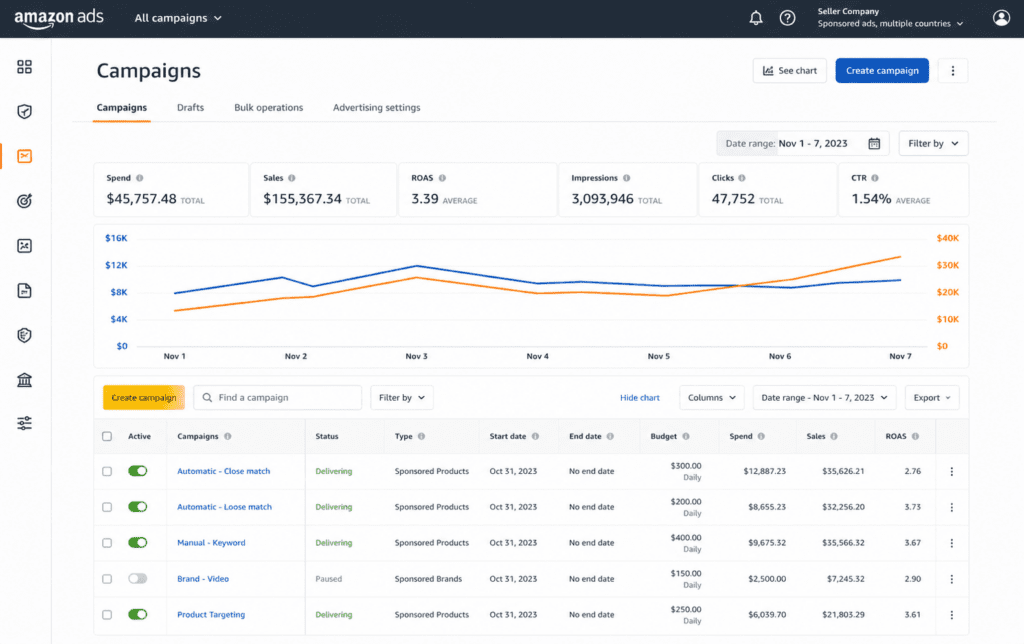
While DSP focuses on audience-based advertising, Sponsored Ads focus primarily on product visibility within Amazon’s marketplace. Sponsored Ads are Amazon’s pay-per-click advertising solution. They allow sellers to promote products directly to shoppers who are actively searching for products.
Sponsored Ads are among the most widely used advertising tools on Amazon because they are:
- Accessible
- Easy to launch
- Scalable
- Conversion-focused
Unlike DSP, Sponsored Ads generally target shoppers closer to making a purchase. This makes them particularly effective for generating sales.
How Amazon Sponsored Ads Work
Sponsored Ads operate using a PPC (Pay-Per-Click) model. Advertisers bid on keywords, products, or audience placements.
When shoppers perform relevant searches, Amazon determines which ads to display based on:
- Bid amount
- Relevance
- Historical performance
- Conversion potential
Advertisers only pay when users click their ads. This model provides clear performance tracking and cost control.
Types of Amazon Sponsored Ads
Amazon currently offers three primary Sponsored Ad formats:
Sponsored Products
Sponsored Products are the most commonly used Amazon advertising format. These ads promote individual listings and appear within:
- Search results
- Product detail pages
- Related product sections
Sponsored Products are highly effective because they reach shoppers actively searching for products.
Benefits of Sponsored Products
- Direct sales generation
- Increased visibility
- Improved keyword rankings
- Fast campaign deployment
- Flexible budgets
For most sellers, Sponsored Products serve as the foundation of their advertising strategy.
Sponsored Brands
Sponsored Brands allow businesses to showcase:
- Brand logo
- Custom headline
- Multiple products
These ads appear prominently at the top of search results. Sponsored Brands help increase:
- Brand awareness
- Store traffic
- Product discovery
Because they highlight multiple products simultaneously, they are particularly useful for established brands with broader catalogs. Sponsored Brands also support video creative, further enhancing engagement opportunities.
Sponsored Display Ads Explained
Sponsored Display is Amazon’s bridge between traditional PPC advertising and audience-based targeting. Unlike Sponsored Products, which primarily rely on keyword searches, Sponsored Display enables brands to reach shoppers based on their browsing behavior and interests.
These ads can appear:
- On Amazon product detail pages
- Amazon search results
- Third-party websites
- Mobile applications
- Amazon-owned properties
Sponsored Display is particularly useful for brands looking to re-engage potential customers who have shown interest but haven’t yet completed a purchase.
Key Features of Sponsored Display
Audience-Based Targeting
Advertisers can target shoppers who:
- Viewed specific products
- Viewed competitor products
- Purchased related products
- Fit specific interest categories
Automatic Ad Creation
Amazon automatically generates most creative elements using existing product listing content. This simplifies campaign setup and reduces creative requirements.
Remarketing Capabilities
Sponsored Display allows sellers to reconnect with shoppers after they leave product pages . This helps recover potential sales that may have otherwise been lost.
Cross-Device Reach
Ads can follow shoppers across multiple devices, improving visibility throughout the buying journey.
Advantages of Amazon Sponsored Ads
Sponsored Ads remain the most popular advertising solution among Amazon sellers for several reasons.
Low Barrier to Entry
Unlike DSP, Sponsored Ads require no large minimum spend. Advertisers can launch campaigns with budgets as low as a few dollars per day. This accessibility makes Sponsored Ads attractive for:
- New sellers
- Small businesses
- Emerging brands
- Product launches
Direct Conversion Focus
Sponsored Ads target shoppers who are actively searching for products. This high purchase intent often leads to:
- Higher conversion rates
- Faster sales generation
- Easier ROI measurement
Many sellers see results within days of launching campaigns.
Easy Campaign Setup
Amazon has simplified campaign creation significantly. Features include:
- Automatic targeting
- Suggested bids
- Keyword recommendations
- Campaign templates
This allows sellers with limited advertising experience to launch campaigns quickly.
Strong Impact on Organic Rankings
Advertising often contributes indirectly to organic growth. Increased sales velocity generated by Sponsored Ads can help improve:
- Keyword rankings
- Product visibility
- Organic sales performance
This creates a positive feedback loop that many successful sellers leverage.
Scalable Advertising Solution
Sponsored Ads can scale gradually.
Advertisers can:
- Test campaigns with small budgets
- Optimize performance
- Increase spend as profitability improves
This flexibility makes Sponsored Ads suitable for businesses at nearly every stage of growth.
Disadvantages of Amazon Sponsored Ads
Despite their effectiveness, Sponsored Ads are not without limitations.
Increasing Competition
Amazon advertising costs continue to rise. As more sellers compete for visibility:
- CPCs increase
- Competition intensifies
- Profit margins may shrink
Highly competitive categories often require substantial investment.
Limited Audience Targeting
Compared to DSP, Sponsored Ads offer less sophisticated audience segmentation.
Most campaigns rely on:
- Keywords
- Product targeting
- Basic audience signals
This limits the ability to build highly customized audiences.
Dependence on Amazon Traffic
Sponsored Ads primarily reach users already browsing Amazon. Brands seeking broader awareness may find this restrictive. Unlike DSP, Sponsored Ads offer limited opportunities to influence shoppers before they enter the marketplace.
Continuous Optimization Required
Successful PPC management requires ongoing effort.
Advertisers must regularly:
- Analyze search terms
- Adjust bids
- Add negative keywords
- Optimize listings
- Review performance metrics
Poor management can quickly reduce profitability.
Amazon DSP vs Sponsored Ads: Complete Comparison
Now let’s directly compare Amazon DSP and Sponsored Ads across the areas that matter most.
1. Advertising Objective
Amazon DSP
DSP is primarily designed for:
- Brand awareness
- Audience expansion
- Customer acquisition
- Retargeting
- Full-funnel marketing
DSP excels when brands want to influence shoppers before they begin searching.
Sponsored Ads
Sponsored Ads focus primarily on:
- Sales generation
- Product visibility
- Search placement
- Conversion optimization
Sponsored Ads perform best when targeting shoppers with existing purchase intent.
Winner
Depends on goals.
- Awareness → DSP
- Conversions → Sponsored Ads
2. Audience Reach
Amazon DSP
DSP reaches audiences across:
- Amazon
- Prime Video
- Fire TV
- Twitch
- IMDb
- Third-party websites
- Mobile apps
- Streaming platforms
This creates enormous scale.
Sponsored Ads
Sponsored Ads primarily appear:
- Search results
- Product pages
- Amazon-owned placements
Reach remains largely limited to Amazon shoppers.
Winner
Amazon DSP
DSP offers substantially broader reach.
3. Targeting Capabilities
Amazon DSP Targeting
DSP supports:
Behavioral Targeting – Target users based on shopping actions.
Lifestyle Targeting – Target interests and habits.
Demographic Targeting – Target age groups and household segments.
Lookalike Audiences – Find new customers similar to existing buyers.
Retargeting – Reconnect with previous visitors.
Custom Audiences – Leverage first-party data and audience segments.
Sponsored Ads Targeting
Amazon Sponsored Ads use several targeting methods to help sellers reach shoppers at the right moment in their buying journey.
Keyword Targeting
Display ads when shoppers search for specific keywords related to your products.
Product Targeting
Place ads on competitor listings or specific ASINs to attract relevant shoppers.
Category Targeting
Reach customers browsing entire product categories instead of individual products.
Views Remarketing
Reconnect with shoppers who previously viewed your products but did not make a purchase.
Winner
Amazon DSP
Its audience targeting capabilities are significantly more advanced.
4. Cost Structure
Amazon DSP
DSP generally uses CPM pricing. Advertisers pay for impressions rather than clicks.
Typical requirements:
- Self-service: $10,000–$15,000 monthly
- Managed service: $35,000–$50,000+ monthly
Additional creative costs often apply.
Sponsored Ads
Sponsored Ads use PPC pricing. Advertisers only pay when shoppers click.
Advantages include:
- No minimum spend
- Flexible budgets
- Easier testing
- Lower entry barrier
Winner
Sponsored Ads
Much more accessible for most brands.
5. Ease of Management
Amazon DSP
DSP requires expertise in:
- Programmatic advertising
- Audience segmentation
- Creative testing
- Attribution modeling
Many brands hire agencies to manage campaigns.
Sponsored Ads
Sponsored Ads are comparatively straightforward. Amazon provides:
- Automated targeting
- Suggested bids
- Campaign recommendations
Most sellers can manage campaigns internally.
Winner
Sponsored Ads
Far easier for beginners.
6. Creative Flexibility
Amazon DSP
Creative options include:
- Video ads
- Display ads
- Streaming TV ads
- Audio ads
- Dynamic ads
Brands control messaging, visuals, and storytelling.
Sponsored Ads Creative Control.Sponsored Ads offer creative options, but customization varies depending on the ad format.
Sponsored Products
Amazon automatically creates these ads using your product listing information, giving sellers little to no creative control.
Sponsored Brands
Allows customization with a brand logo, custom headline, featured products, and video content, making it ideal for building brand awareness.
Sponsored Display
Offers limited customization, with Amazon primarily using your product details while allowing basic adjustments such as headlines and branding elements.
Winner
Amazon DSP
Far greater creative freedom.
7. Reporting and Attribution
Amazon DSP
DSP offers advanced analytics including:
- Audience insights
- View-through conversions
- Cross-device reporting
- Customer journey analysis
This helps advertisers understand broader campaign impact.
Sponsored Ads
Sponsored Ads provide:
- Clicks
- Impressions
- Sales
- ACoS
- ROAS
These metrics focus primarily on direct response performance.
Winner
Amazon DSP
Provides deeper strategic insights.
Amazon DSP vs Sponsored Ads Performance Benchmarks
Although results vary by category, general performance trends include:
| Metric | Amazon DSP | Sponsored Ads |
|---|---|---|
| Reach | Very High | Moderate |
| Brand Awareness | Excellent | Good |
| Conversion Rate | Moderate | High |
| Customer Acquisition | Strong | Strong |
| Retargeting | Excellent | Limited |
| Setup Complexity | High | Low |
| Budget Requirements | High | Low |
| Speed of Results | Slower | Faster |
| Creative Flexibility | High | Limited |
| Ease of Measurement | Moderate | Easy |
These benchmarks help explain why many mature brands use both platforms together rather than choosing only one.
Which Advertising Solution Is Best for Different Types of Brands?
New Amazon Sellers
If you’re launching your first products, Sponsored Ads are almost always the better starting point.
Reasons include:
- Lower costs
- Easier management
- Faster sales generation
- Better learning opportunities
Most new sellers should master Sponsored Products before considering DSP.
Growing Brands
Brands generating consistent sales often benefit from adding:
- Sponsored Brands
- Sponsored Display
- Basic retargeting campaigns
This expands visibility while maintaining profitability.
Established Brands
Larger brands often gain substantial value from DSP.
Reasons include:
- Larger budgets
- Broader objectives
- Brand-building initiatives
- Multi-channel marketing goals
DSP becomes increasingly valuable as customer acquisition and awareness become priorities.
DTC Brands Expanding to Amazon
Direct-to-consumer brands often find DSP particularly attractive because it allows them to:
- Reach existing customers
- Build awareness
- Drive traffic both on and off Amazon
- Retarget audiences effectively
For these businesses, DSP can serve as a bridge between Amazon and broader digital marketing efforts.
How Successful Amazon Brands Use DSP and Sponsored Ads Together
One of the biggest misconceptions in Amazon advertising is that brands must choose between Amazon DSP and Sponsored Ads. In reality, many of the most successful Amazon brands use both platforms simultaneously because they serve different purposes within the customer journey.
Think of it this way:
Sponsored Ads capture existing demand. DSP creates new demand. When combined strategically, they create a powerful full-funnel advertising system that continuously attracts, nurtures, and converts customers.
The Full-Funnel Amazon Advertising Strategy
Modern shoppers rarely make purchasing decisions after a single interaction. Instead, they move through multiple stages before converting. Understanding these stages helps explain how DSP and Sponsored Ads work together.
Top of Funnel: Awareness
At the awareness stage, potential customers may not know your brand exists.
Your objective is simple:
Get in front of the right audience.
This is where Amazon DSP excels.
Brands use:
- Display Ads
- Video Ads
- Prime Video Ads
- Streaming TV Ads
- Audio Ads
These formats help introduce products before shoppers begin searching.
Example
A premium coffee brand launches a new organic coffee blend.
Rather than waiting for shoppers to search “organic coffee,” the brand uses DSP video campaigns targeting:
- Coffee enthusiasts
- Organic food shoppers
- Premium grocery buyers
This generates awareness among relevant audiences before purchase intent develops.
Middle of Funnel: Consideration
Once shoppers become aware of your brand, the next goal is building trust and interest.
DSP retargeting campaigns become extremely valuable here.
Advertisers can reconnect with:
- Product viewers
- Website visitors
- Store visitors
- Previous purchasers
Sponsored Display campaigns also help reinforce visibility.
Example
A shopper watches a DSP video ad but doesn’t buy immediately.
Over the next several days:
- Display ads remind them about the product
- Sponsored Display ads appear on related listings
- Brand messaging remains consistent
This increases familiarity and purchase consideration.
Bottom of Funnel: Conversion
When shoppers begin actively searching, Sponsored Ads take over.
The most effective formats include:
Sponsored Products – Capture high-intent searches.
Sponsored Brands – Promote multiple products simultaneously.
Sponsored Brands Video – Increase engagement within search results. At this stage, conversion becomes the primary objective.
Example
A shopper searches:
“best organic coffee beans”
The brand’s Sponsored Product ad appears at the top of search results. Because the shopper has already seen awareness campaigns, they are more likely to click and purchase.
Post-Purchase Retention
The customer journey doesn’t end after a purchase.
Amazon DSP can help brands:
- Promote complementary products
- Encourage repeat purchases
- Launch new products
- Increase customer lifetime value
Retention often generates significantly higher profitability than acquisition.
Real-World Advertising Scenarios
Let’s examine common business situations and determine which advertising solution makes the most sense.
Scenario 1: New Product Launch
Business Situation
A seller is introducing a completely new product category.
Recommended Strategy
Start with:
- Sponsored Products
- Sponsored Brands
Then gradually add:
- DSP Awareness Campaigns
- DSP Video Campaigns
Why?
New products need immediate visibility while simultaneously building awareness.
Scenario 2: Established Product With Strong Reviews
Business Situation
A product already performs well organically.
Recommended Strategy
Expand using:
- Sponsored Products
- Sponsored Display
- DSP Retargeting
Why?
Retargeting helps convert shoppers who already demonstrated interest.
Scenario 3: Large Brand Seeking Market Share Growth
Business Situation
An established brand wants aggressive expansion.
Recommended Strategy
Combine:
- DSP Awareness Campaigns
- Streaming TV Ads
- Sponsored Products
- Sponsored Brands
- Sponsored Display
Why?
Full-funnel advertising maximizes visibility at every stage.
Scenario 4: Limited Advertising Budget
Business Situation
A smaller seller has less than $3,000 monthly advertising budget.
Recommended Strategy
Focus primarily on:
- Sponsored Products
- Sponsored Brands
Avoid DSP initially.
Why?
Sponsored Ads typically generate stronger immediate returns at lower budgets.
Common Amazon Advertising Mistakes to Avoid
Whether using DSP or Sponsored Ads, many advertisers make avoidable mistakes. Understanding these pitfalls can save significant budget and improve campaign performance.
Mistake #1: Choosing DSP Too Early
Many new sellers are attracted by DSP’s advanced capabilities.
However, DSP often underperforms when:
- Product listings are weak
- Reviews are limited
- Conversion rates are low
- Budgets are insufficient
Build a strong Sponsored Ads foundation first.
Mistake #2: Ignoring Listing Optimization
Even the best advertising cannot overcome poor listings.
Before increasing ad spend, optimize:
- Product titles
- Images
- Bullet points
- A+ Content
- Brand Store
- Reviews
Higher conversion rates improve advertising efficiency dramatically.
Mistake #3: Focusing Only on ROAS
Many advertisers obsess over Return on Ad Spend. While important, ROAS doesn’t tell the complete story.
Additional metrics include:
- New-to-brand customers
- Market share growth
- Customer lifetime value
- Brand awareness
- Repeat purchase rates
DSP campaigns often generate value that isn’t immediately reflected in ROAS.
Mistake #4: Poor Audience Segmentation
With DSP especially, targeting everyone usually means targeting no one effectively. Create highly relevant audience segments.
Examples include:
- Cart abandoners
- Previous purchasers
- Category shoppers
- Competitor audiences
- High-value customers
Precision generally outperforms broad targeting.
Mistake #5: Neglecting Creative Testing
Creative performance has a major impact on advertising success.
Test:
- Headlines
- Images
- Videos
- Calls-to-action
- Product positioning
Small creative improvements can significantly increase campaign performance.
The Future of Amazon Advertising in 2026 and Beyond
Amazon’s advertising platform continues to evolve rapidly. Several trends are shaping the future.
Increased Video Advertising
Video consumption continues growing.
Expect more investment in:
- Prime Video Ads
- Streaming TV
- Interactive video formats
Brands that develop strong video strategies may gain a competitive advantage.
AI-Powered Campaign Optimization
Artificial intelligence is increasingly influencing:
- Bid adjustments
- Audience targeting
- Budget allocation
- Creative optimization
Automation will likely reduce manual campaign management requirements.
Greater Emphasis on First-Party Data
Privacy changes continue limiting third-party tracking. Amazon’s first-party shopping data becomes increasingly valuable. This strengthens DSP’s position within the digital advertising ecosystem.
Expansion of Retail Media Networks
Retail media is becoming one of the fastest-growing advertising sectors. Amazon remains a leader, but competition from Walmart, Target, and other retailers continues increasing. Brands that master retail media early may achieve substantial long-term advantages.
Frequently Asked Questions
1 . Is Amazon DSP worth it?
For brands with sufficient budget, strong conversion rates, and growth-focused objectives, Amazon DSP can be extremely valuable. Smaller sellers often achieve better initial results with Sponsored Ads.
2 . What is the minimum budget for Amazon DSP?
Self-service DSP campaigns often begin around $10,000 to $15,000 per month. Managed-service programs may require $35,000 to $50,000 or more.
3 . Can Amazon DSP drive direct sales?
Yes. Although DSP is often associated with awareness campaigns, it can also generate conversions through retargeting and audience-based targeting strategies.
4 . Which is better for beginners?
Sponsored Ads. They are easier to manage, require smaller budgets, and typically generate faster results.
5 . Do Sponsored Ads improve organic rankings?
Indirectly, yes. Higher sales velocity generated through advertising can improve organic keyword rankings over time.
6 . Can DSP target people who never visited my listing?
Yes. DSP can target shoppers based on interests, behaviors, demographics, and lookalike audiences.
7 . Can I use Amazon DSP without selling on Amazon?
Yes. Many direct-to-consumer brands use DSP to drive traffic to their own websites.
8 . Which advertising format delivers the highest conversion rates?
Sponsored Products typically produce the highest direct conversion rates because they target shoppers actively searching for products.
9 . Is Amazon DSP replacing Sponsored Ads?
No. Both solutions serve different purposes and complement each other effectively.
10 . How long does it take to see results from DSP?
Awareness campaigns may require several weeks to evaluate properly. Retargeting campaigns often show results much faster.
Final Verdict: Amazon DSP vs Sponsored Ads
When comparing Amazon DSP vs Sponsored Ads, there is no universal winner. The right choice depends on your business goals, advertising budget, growth stage, and marketing objectives.
Choose Sponsored Ads if you:
- Need immediate sales
- Have a smaller budget
- Are new to Amazon advertising
- Want simple campaign management
- Focus primarily on conversions
Choose Amazon DSP if you:
- Have a larger advertising budget
- Want advanced audience targeting
- Need off-Amazon reach
- Focus on brand awareness
- Want sophisticated retargeting capabilities
For many growing and established brands, the most effective strategy isn’t choosing one over the other.
It’s combining both. Sponsored Ads capture demand from shoppers actively searching for products. DSP creates demand by reaching potential customers before they start searching.
Together, they form a complete advertising ecosystem capable of driving awareness, consideration, conversions, and long-term customer loyalty.
As Amazon advertising becomes increasingly competitive, brands that adopt a full-funnel approach will be best positioned to maximize visibility, acquire new customers, and achieve sustainable growth in 2026 and beyond.