
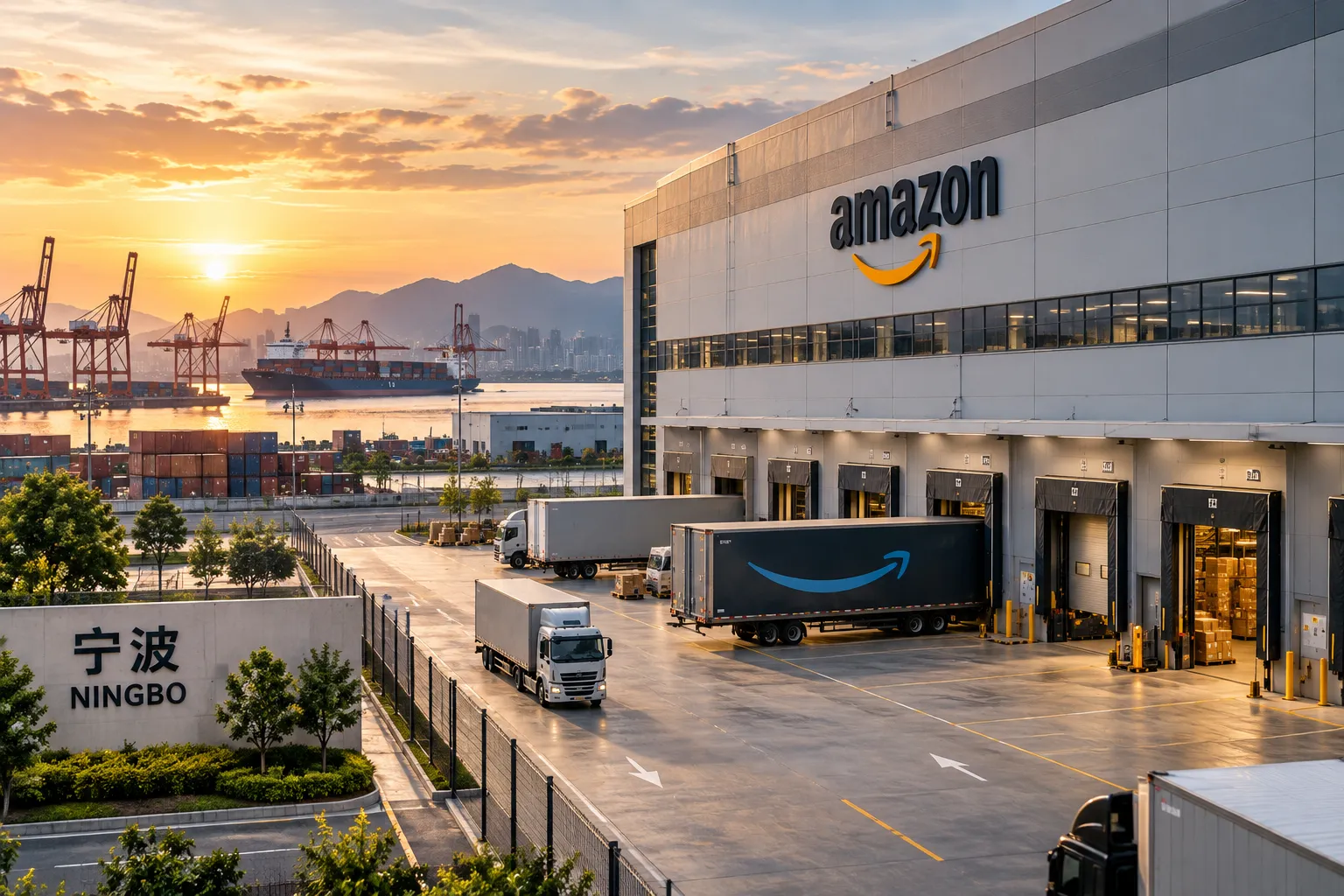
Amazon’s Global Warehousing and Distribution (GWD) program has opened its third China site, in Ningbo, completing a three-city network alongside Shenzhen and Shanghai. Storage runs $7.91 per cubic meter per month — roughly 10% below the other two sites — and shipments arriving at any GWD location through December 31, 2026 get their first 30 days of storage free. Both figures are confirmed independently by Amazon’s own Seller Central documentation and by trade coverage from EcomCrew and China Sellers, not just by a single blog’s reporting.
The pitch is straightforward: park bulk inventory in a warehouse near your Chinese manufacturer, and Amazon handles freight, export paperwork, customs clearance, and automatic replenishment into US FBA as orders come in. For sellers sourcing from eastern China, that’s a real logistics upgrade. It’s also a program with a bonded-warehouse rule attached that can leave inventory stranded if a SKU stalls — a detail that matters more than the headline storage rate.
How GWD Works, in Practice
You ship bulk stock to a GWD facility inside China instead of straight to a freight forwarder. Amazon stores it there, then automatically transfers units into Amazon’s fulfillment center network in the US as your sales pull inventory through — handling ocean freight, export declarations, US customs clearance, and the final FBA drop-off along the way. Eligibility is based on where your goods ship from, not where your company is registered, so a US-registered brand sourcing from a Zhejiang factory qualifies the same as a China-based exporter.
Booking runs through Send to Amazon Warehousing and Distribution in Seller Central: pick a China ship-from address, choose a GWD site from the list, add SKUs and quantities, and submit. Amazon says GWD storage runs up to 45% below US-based Amazon Warehousing and Distribution (AWD), and that pairing it with Amazon Global Logistics can get inventory into US fulfillment centers up to seven days faster — both are Amazon’s own figures, not independently audited.
The Three-Site Network Isn’t Interchangeable
Amazon built each facility for a different kind of catalog, and picking the wrong one erodes the savings fast:
| Site | Opened | Built For | Storage Rate |
| Shenzhen | April 9, 2026 | South China sourcing, general catalog | Baseline rate |
| Shanghai | July 16, 2026 | Small, fast-turnover goods via Yangshan Port (~20,000 sqm, 574 conveyor lines) | Baseline rate |
| Ningbo | September 2026 | Large/heavy items — 40m automated storage & retrieval, tallest in Amazon’s Asia network | $7.91 / cbm |
If your factory sits in Zhejiang or Jiangsu and you ship bulky, heavy SKUs — furniture, exercise equipment, large kitchen items — Ningbo is both the closer site and the cheaper one. For small, light, fast-moving goods near Shanghai’s port infrastructure, the Shanghai site’s conveyor setup is the better match even at the same baseline rate.
What You Actually Gain: Bypassing FBA Storage Limits
The strongest case for GWD has less to do with the storage rate than with one structural detail: automated replenishment out of GWD bypasses standard FBA restock limits entirely. That’s the constraint that has quietly cost sellers real Q4 revenue — units sitting in the country, ready to ship, blocked by a restock allowance during the exact two weeks that mattered. If you’re weighing manual versus automated replenishment for the holiday runway, a decision simulator for restocking inside Seller Central can help model the trade-off before you commit inventory to either path.
- Automated replenishment: Amazon decides how many units move to the US and when, based on your sales history — no minimum or maximum unit controls, but it comes with the fee waivers.
- Manual replenishment: you keep control of exact timing, useful for a Prime event or deal submission, but you give up the automated fee waivers.
Automated doesn’t mean accurate, either — Amazon’s model reacts to historical sales, not to a promotion or listing change you’re planning for November.
The Catch: Bonded-Warehouse Rules Can Trap Inventory
This is the detail most coverage of the Ningbo launch skips. GWD operates under Chinese bonded-warehouse rules, and at least at the Shenzhen site, Amazon enforces a 6-month storage limit with an optional 6-month extension requested separately — a 12-month outside limit. Once inventory is stowed and export-declared, bonded-warehouse rules prevent it from moving back into China. If a SKU hasn’t sold through by the time that clock runs out, the only options are pushing it into FBA regardless of demand or writing off the loss. Sellers considering Ningbo for slower-moving or higher-risk SKUs should confirm with Amazon whether the same 6-month clock applies at the new site before committing volume — the inventory as a strategic function it represents is exactly the kind of decision that deserves forecasting before shipping, not after.
- GWD also requires Amazon Global Logistics (AGL) enrollment, and switching costs rise the more inventory you’ve stowed — walking away gets expensive once you’re a thousand cartons in.
- This is a Chinese customs rule, not an Amazon policy choice, so it isn’t something Amazon can waive on request.
Ningbo’s Port Advantage Is Real
Ningbo-Zhoushan handled roughly 22.9 million TEU in the first half of 2026, an 8.8% year-over-year increase that moved it past Singapore into the number-two spot globally behind Shanghai. That kind of container volume means more sailing frequency, which shortens the window between Amazon triggering a replenishment order and those units actually being on the water — a real advantage for a site built around bulky, slower-turning inventory that benefits from tighter shipping cadence.
Run the Full Landed-Cost Math Before You Commit Q4 Inventory
The $7.91 figure is only the China-side storage line. The full landed-cost math has to include domestic trucking from your factory to Ningbo, ocean freight to the US, duties, the transfer fee into US fulfillment, and per-box handling — all of which sit downstream of that headline rate and don’t show up in Amazon’s announcement.
Take a mid-size furniture SKU: $7.91/cbm in Ningbo storage looks like a clear win against a comparable US AWD rate of roughly $9–$10/cbm. But add $180 in domestic trucking per pallet-equivalent shipment, ocean freight that runs $1,800–$2,400 per container depending on the season, duties in the 3–25% range depending on HTS classification, and a per-carton GWD transfer fee — and the storage-line saving can be a small fraction of the total landed cost per unit. The comparison that matters is total cost per unit landed in FBA, not the storage rate in isolation.
For Q4 specifically, treat the free first month as a controlled test rather than a full migration: send one SKU with predictable, established sell-through, watch how automated replenishment actually behaves against your own demand forecast, and keep parallel inventory planning running rather than assuming Amazon’s model accounts for a promotion you haven’t launched yet.
The Bottom Line
Ningbo gives sellers sourcing bulky goods from eastern China the cheapest GWD storage rate available and a real logistics upgrade — shorter inland hauls, port capacity to match, and replenishment that sidesteps FBA storage limits. The tradeoff is a bonded-warehouse clock that can turn a slow-moving SKU into a forced FBA push or a write-off, and a total landed cost that’s meaningfully higher than the $7.91 headline once trucking, freight, and duties are added back in. Test it on one SKU during the free-storage window, confirm the storage-duration terms for Ningbo specifically, and run the full cost stack before shifting meaningful volume.