
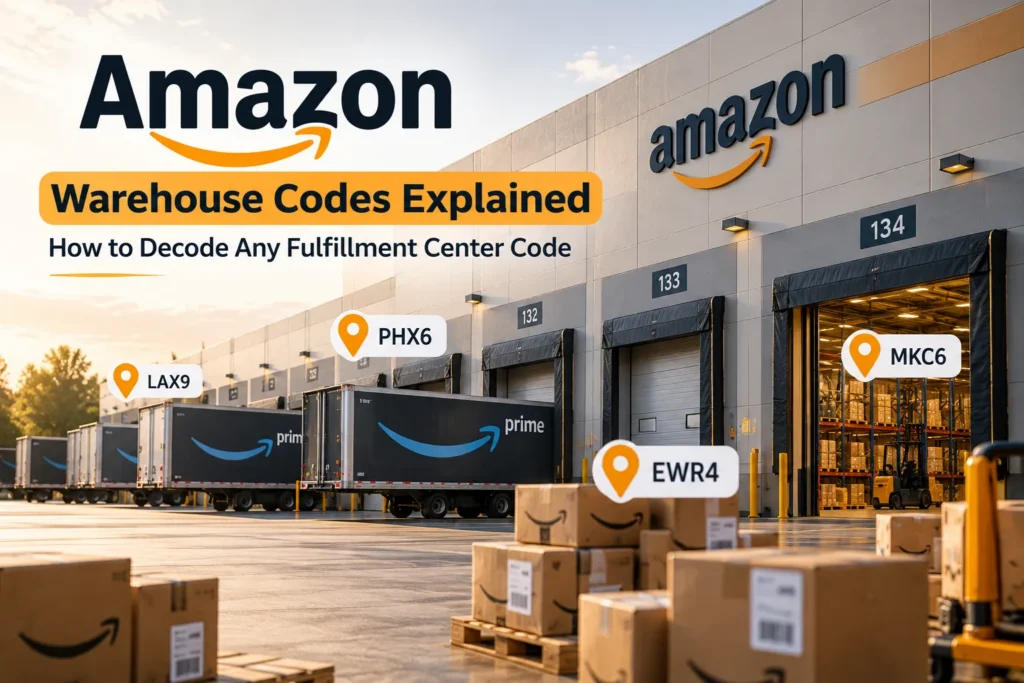
Amazon fulfillment center codes follow a consistent pattern: three letters from the nearest major airport’s IATA code, plus a number identifying which facility in that area. ONT8 is the 8th fulfillment center near Ontario International Airport in California; PHX3 is the 3rd near Phoenix. Once you understand this system, you can decode almost any code you encounter — including new facilities that won’t appear on any static list yet.
Key Takeaways
- The code format is consistent: a 3-letter airport-based prefix plus a sequential number — for example, JFK8 (near JFK Airport, New York) or LGB7 (near Long Beach Airport, California).
- Not every code is a standard fulfillment center — Amazon’s network includes distribution centers (DC), sortation centers (SC), delivery stations (DS), and specialty facilities like AMXL (extra-large items) and IXD (palletized freight entry), each serving a different function.
- Amazon operates roughly 110+ active US fulfillment centers, plus 100+ additional sortation, delivery, and specialty facilities — and this number changes monthly as sites open, close, or get repurposed, which is exactly why a static downloaded list goes stale fast.
- You don’t choose your warehouse — Amazon’s algorithm assigns your shipment destination based on product demand and your specific shipping plan, visible only when you actually create that shipment in Seller Central.
- The code matters for cost, not just curiosity — where your inventory is placed affects your exposure to the Inbound Placement Service Fee, making the destination worth understanding, not just decoding.
How Amazon’s FC Code System Actually Works
Every Amazon fulfillment center has a unique code, and the format is genuinely learnable rather than arbitrary. The first three characters mirror the IATA code of the nearest major airport, and the number that follows distinguishes between multiple facilities in that same metro area — since a single major metro can host more than ten different Amazon buildings. A few worked examples:
- ONT8 — the 8th facility near Ontario International Airport (Southern California)
- JFK8 — a facility near John F. Kennedy Airport (New York area)
- PHX3 — the 3rd facility near Phoenix
- DFW1 — near Dallas-Fort Worth International Airport
- EWR4 — near Newark Liberty International Airport
Once you know this pattern, you can make an educated guess at the general region for almost any FC code you encounter, even one that’s too new to appear in any published directory yet.
The Different Facility Types (Not All Codes Are the Same)
Amazon’s logistics network isn’t just fulfillment centers — several distinct facility types handle different stages of the journey from your inventory to a customer’s door:
| Type | Function |
| FC (Fulfillment Center) | The main hub where FBA inventory is stored, picked, packed, and shipped |
| DC (Distribution Center) | Regional facilities moving inventory between fulfillment centers and delivery stations |
| SC (Sortation Center) | Sorts packages by delivery route before final-mile handoff |
| DS (Delivery Station) | Final-mile facility where packages are loaded onto delivery vehicles |
| AMXL | Specialty facility handling extra-large or bulky items |
| IXD | Palletized freight entry point for bulk inbound inventory |
For sellers, the FC is generally the relevant destination for standard inbound FBA shipments — the other facility types matter more for understanding the broader journey your inventory takes after arrival, which is useful context but not typically where you’re shipping to directly.
How Many Fulfillment Centers Does Amazon Actually Have?
Worth being upfront about: published counts genuinely disagree, and that disagreement is itself informative. Recent 2026 sources cite figures ranging from roughly 110 to 175+ active US fulfillment centers, with total US facilities (including sortation, delivery, and specialty sites) cited anywhere from 600 to over 1,000, and one source citing 1,300+ facilities worldwide. This spread isn’t sloppy research — it reflects genuine definitional differences (which facility types count), Amazon’s rapid pace of opening/closing/repurposing sites, and the fact that Amazon itself doesn’t publish one authoritative master count. Treat any single precise number, including ones in this article, as a directional snapshot rather than a verified constant.
Amazon’s Four Major Logistics Corridors
Rather than scattered randomly, Amazon’s US network clusters heavily around four high-density corridors — understanding these is more durable and useful than memorizing individual codes:
- The Inland Empire (Southern California) — Ontario, Moreno Valley, Rialto, and San Bernardino form the primary West Coast hub, handling import volume from Pacific ports
- Dallas-Fort Worth Metroplex (Texas) — covers the South and Central US, including the FTW1 IXD (inbound cross-dock) for palletized freight entry
- Pennsylvania/New Jersey Northeast Corridor — the Lehigh Valley and Wilkes-Barre area in Pennsylvania, paired with Robbinsville and Carteret in New Jersey, serves the dense Northeast population corridor
- Memphis-Nashville-Louisville Triangle — functions as a middle-mile hub connecting Amazon’s broader network, leveraging the region’s existing air-freight infrastructure (Memphis being FedEx’s global hub city)
If you’re deciding where to base a prep center or 3PL relationship, aligning with one of these corridors rather than an isolated single city tends to give more flexibility, since inventory routed through a corridor has more potential destination facilities nearby.
Common Codes by Region (Reference Examples)
This is a larger sample of well-known, cross-referenced codes for reference — still not an exhaustive or guaranteed-current list, since Amazon’s network changes monthly. Always confirm your actual assigned code in Seller Central before shipping, rather than relying on any published directory, including this one.
| Code | City / Region | State | Airport Reference |
| ONT8 | Eastvale (Ontario area) | CA | Ontario International |
| LGB7 | Long Beach | CA | Long Beach Airport |
| SCK4 | Stockton | CA | Stockton Metropolitan |
| LAX9 | Los Angeles area | CA | Los Angeles International |
| PHX3 | Phoenix | AZ | Phoenix Sky Harbor |
| PHX5 | Phoenix | AZ | Phoenix Sky Harbor |
| PHX7 | Phoenix | AZ | Phoenix Sky Harbor |
| GYR3 | Goodyear (Phoenix area) | AZ | Phoenix Sky Harbor |
| DFW1 | Dallas-Fort Worth (IXD) | TX | DFW International |
| DFW6 | Dallas-Fort Worth area | TX | DFW International |
| FTW1 | Fort Worth (IXD) | TX | DFW International |
| JFK8 | New York area | NY | John F. Kennedy International |
| EWR4 | Newark | NJ | Newark Liberty International |
| EWR9 | Carteret | NJ | Newark Liberty International |
| MDW2 | Chicago area | IL | Chicago Midway |
| BFI4 | Seattle area | WA | Boeing Field |
| BHM1 | Birmingham | AL | Birmingham-Shuttlesworth |
| CVG3 | Hebron | KY | Cincinnati/Northern Kentucky |
California, Texas, Georgia, Florida, and New Jersey consistently rank among the states with the highest concentration of active facilities across sources reviewed, reflecting Amazon’s focus on major metro demand centers and freight corridors — though exact per-state counts vary by source and change over time (recent figures cite California anywhere from 18 to 35 active facilities depending on which facility types are counted).
Amazon Air Codes: The K-Prefix Exception
Codes beginning with K — such as KCVG or KAFW — follow a different pattern than standard fulfillment centers. These identify Amazon Air facilities, the company’s in-house air cargo hub network, distinct from the ground-based FC/DC/SC/DS system covered above. If you encounter a K-prefixed code, it’s referring to Amazon’s air freight infrastructure rather than a standard inbound FBA destination.
How to Find Your Actual Assigned Warehouse Code
Unlike a static directory, your actual shipment destination is only visible in one reliable place:
- Create an inbound shipment plan in Seller Central for the specific inventory you’re sending.
- Amazon’s system assigns the destination(s) automatically based on product demand forecasting and your shipment specifics — you cannot choose the facility yourself.
- The assigned FC code and full address appear directly in your shipment plan — this is the authoritative source, not a general directory.
- A single shipment can split across multiple facilities, particularly for larger shipments, so check the full plan rather than assuming one destination.
Why This Matters for Sellers
Understanding warehouse codes serves a few practical purposes beyond general curiosity: it lets you reference the correct facility in Seller Support tickets without confusion, helps you plan inbound shipping logistics and costs more accurately, and gives you visibility into your national inventory footprint — useful context for broader supply chain and even marketing decisions, since where your inventory is concentrated can inform regional demand insights.
The Inbound Placement Fee Connection
This is where warehouse codes stop being just an informational curiosity and start affecting your bottom line directly. Amazon’s Inbound Placement Service Fee applies when your inventory enters a facility that isn’t well-matched to where actual customer demand for that product is concentrated. Since you don’t choose your destination, this fee is effectively a function of how well your shipment planning aligns with Amazon’s own demand distribution — which is one reason simply understanding the code isn’t enough; understanding the fee structure that comes with placement is the more actionable layer. Programs like Amazon Warehousing and Distribution (AWD) offer an alternative bulk-storage and automatic-replenishment approach specifically designed to reduce this kind of placement friction.
What a Static Directory Can’t Tell You
A downloaded PDF list of codes, however comprehensive at the moment it’s compiled, has a structural weakness: it’s a snapshot. Amazon continuously opens new facilities, closes or repurposes others, and occasionally renames existing ones — with the exact count of active US facilities shifting monthly. A directory downloaded even a few months ago may already reference a code that’s been retired, or miss a new facility opened since. Understanding the underlying code system — the airport-prefix-plus-number pattern, the facility type distinctions — gives you a durable skill that doesn’t expire the way a static list does, and pairs with checking your live Seller Central shipment plan for the actual current assignment.
How EcomRanker Helps Sellers Navigate FBA Logistics
We treat warehouse placement as a cost and logistics planning input, not just a reference lookup — helping sellers understand how their inventory is being distributed across Amazon’s network and what that means for Inbound Placement fees and shipping cost planning. This connects to our broader Amazon Seller Central management work, where inventory and logistics decisions are reviewed alongside account health and advertising strategy as one coordinated picture.
Want help planning inbound shipments to minimize placement fees? Get in touch for a logistics strategy review.
Frequently Asked Questions
1 . What is an Amazon warehouse code?
A unique identifier for an Amazon fulfillment or logistics facility, typically formatted as a 3-letter airport-based prefix followed by a number — for example, ONT8 or JFK8.
2 . How does the Amazon FC code format work?
The first three letters generally mirror the IATA code of the nearest major airport, and the number distinguishes between multiple facilities serving that same metro area.
3 . Can I choose which Amazon fulfillment center my inventory goes to?
No. Amazon’s algorithm assigns your shipment destination automatically based on product demand and your specific shipping plan — sellers cannot select a preferred facility.
4 . How many Amazon fulfillment centers are there?
Roughly 110 or more active US fulfillment centers as of 2026, plus 100+ additional sortation, delivery, and specialty facilities. This number changes monthly as Amazon’s network evolves.
5 . What’s the difference between a fulfillment center and a sortation center?
A fulfillment center (FC) stores, picks, and packs your inventory. A sortation center (SC) sorts already-packed packages by delivery route before final-mile handoff — it’s a later stage in the journey, not where seller inventory is typically shipped.
6 . Where do I find my actual assigned warehouse code for a shipment?
In Seller Central, when you create an inbound shipment plan — Amazon assigns and displays the destination facility code and address directly within that specific plan.
7 . Does the warehouse code affect my fees?
Indirectly, yes. Placement that’s poorly matched to actual demand for your product can trigger Amazon’s Inbound Placement Service Fee, making your assigned destination relevant to cost, not just logistics tracking.
8 . Why isn’t there one official complete list of all Amazon warehouse codes?
Amazon doesn’t publish a single comprehensive directory, and the network changes too frequently (monthly openings, closures, and renames) for any third-party list to stay fully current for long.
9 . What does AMXL mean on an Amazon facility code or listing?
AMXL refers to Amazon’s specialty facilities and program for extra-large or bulky items, distinct from standard fulfillment center handling.
10 . What does a warehouse code starting with K mean, like KCVG?
A K-prefix identifies an Amazon Air facility — part of Amazon’s in-house air cargo hub network — rather than a standard ground-based fulfillment center.
11 . Why do different sources give different counts for the total number of Amazon fulfillment centers?
Because Amazon doesn’t publish one authoritative master count, and sources differ on which facility types they include (FCs only vs. FCs plus sortation, delivery, and specialty sites) and how recently they verified their data against a rapidly changing network.