
Local SEO is one of the most important digital marketing strategies for businesses that serve customers in a specific location. Whether you own a restaurant, salon, plumbing company, law firm, medical clinic, retail shop, or any service-based business, local SEO helps your business appear in front of nearby customers when they search online.
Today, millions of people search on Google using phrases like “near me,” “best restaurant in London,” “plumber in New York,” or “coffee shop nearby.” If your business is not optimized for local search, you may lose customers to competitors who appear higher in Google results.
In this detailed guide, you will learn what local SEO is, why it matters, how it works, and how businesses can improve their local search visibility effectively.
What Is Local SEO?
Local SEO (Local Search Engine Optimization) is the process of optimizing a business so it appears in local search results on Google and other search engines. It helps Google understand:
- Where your business is located
- What services or products you offer
- How trustworthy and relevant your business is
The primary goal of local SEO is to increase visibility among nearby customers who are actively searching for your services.
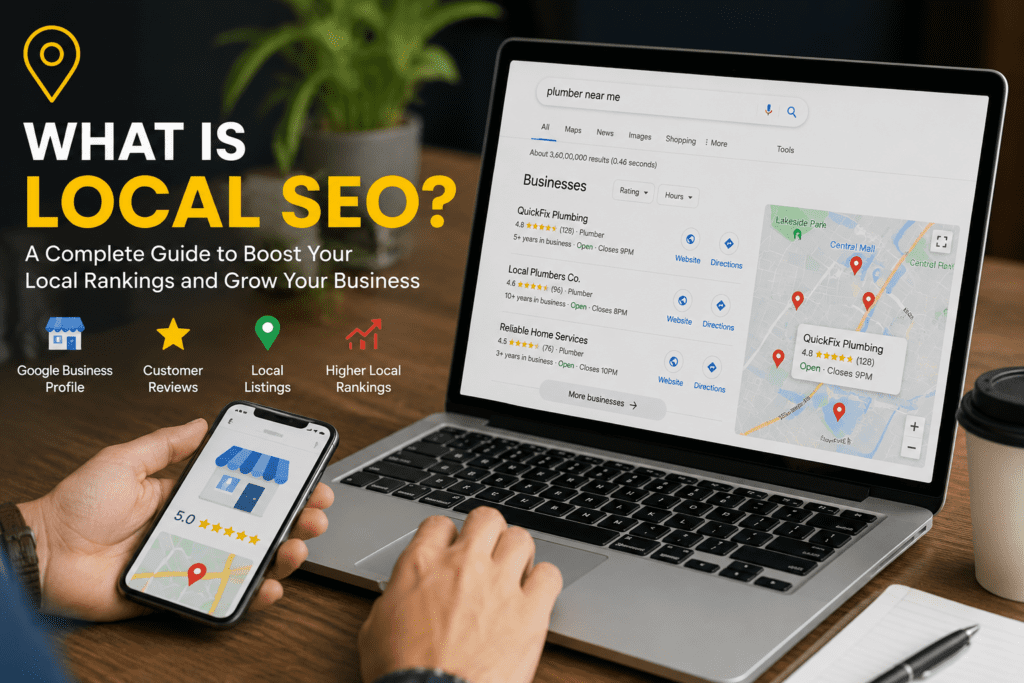
For example, when someone searches for “pizza near me,” Google displays businesses that are geographically close, highly relevant, and have strong customer reviews. Businesses that perform well in local SEO usually appear in:
- Google Map Pack results
- Google Maps
- Organic search results
- Local business listings
This means local SEO not only improves rankings but also increases phone calls, store visits, bookings, and sales.
Why Is Local SEO Important?
Local SEO is extremely important because customer behavior has changed dramatically over the last few years. Most consumers now use Google to discover local businesses before making a purchase decision.
According to Google:
- 30% of all mobile searches are location-related
- 78% of nearby searches lead to an offline business visit within one day
- 28% of local searches result in a purchase
These statistics show that local searches often come from customers who are ready to buy. Unlike general website traffic, local SEO targets high-intent users who are actively looking for services nearby.
If your business does not appear in local search results, potential customers may never discover you, even if your products or services are excellent.
For small businesses, local SEO creates an opportunity to compete with larger brands by focusing on local relevance instead of massive advertising budgets.
How Local SEO Works
Local SEO works by helping search engines evaluate and rank businesses based on relevance, distance, and prominence.
When someone performs a local search, Google analyzes multiple factors before deciding which businesses to show. These include:
- Business location
- Search relevance
- Online reviews
- Website quality
- Citations and directory listings
- Backlinks
- Google Business Profile optimization
Google mainly shows two types of local search results:
1. Local Map Pack Results
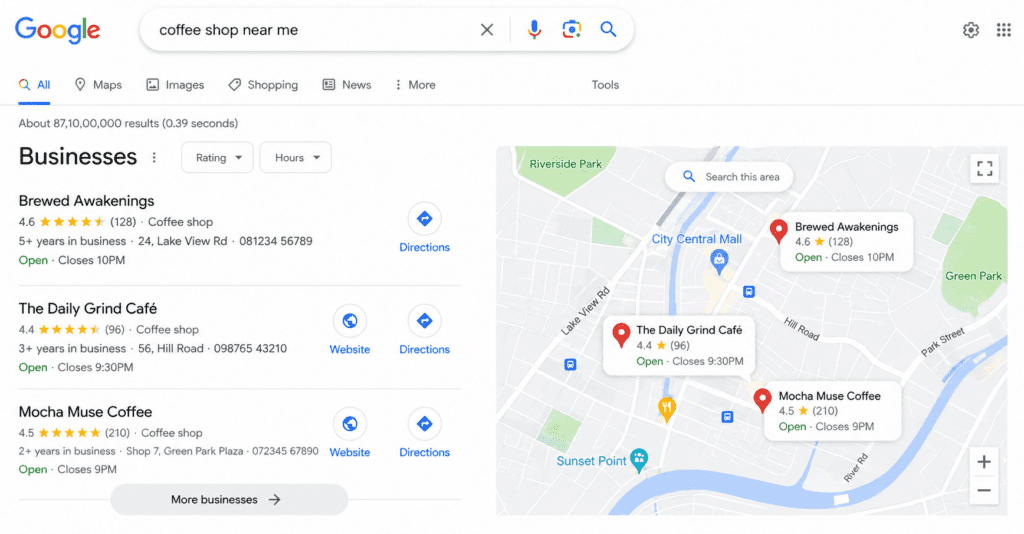
The Google Map Pack appears at the top of search results and displays:
- Business names
- Ratings and reviews
- Business hours
- Phone numbers
- Locations on Google Maps
This section is highly valuable because it receives significant clicks and visibility.
For example, if someone searches for “best bakery near me,” Google may display three nearby bakeries with maps and customer ratings. Businesses appearing here often receive more traffic and phone calls.
2. Organic Search Results
Below the map pack, Google displays traditional organic search results, also called “blue link” results.
These results are influenced by:
- Website SEO
- Content quality
- Keyword optimization
- Backlinks
- User experience
Businesses can rank in both map pack results and organic results simultaneously, increasing visibility and customer trust.
Benefits of Local SEO
Local SEO offers many advantages for businesses of all sizes.
Increased Visibility
Your business becomes visible to nearby customers searching for your services.
More Website Traffic
Optimized local pages attract highly targeted traffic from search engines.
Higher Conversion Rates
Local searches usually come from users ready to take action, resulting in better conversions.
More Calls and Store Visits
Appearing in Google Maps encourages customers to call or visit your business directly.
Better Brand Trust
Positive reviews and strong local presence improve customer confidence.
Cost-Effective Marketing
Compared to paid ads, local SEO provides long-term traffic and sustainable growth.
What Is a Good Local SEO Strategy?
A successful local SEO strategy starts with building a strong foundation and creating systems that continuously improve visibility over time.
Businesses should focus on:
- Optimizing Google Business Profile
- Getting customer reviews
- Building local citations
- Performing keyword research
- Improving website SEO
- Building backlinks
- Publishing localized content
The best local SEO strategies are designed to work continuously rather than relying on one-time efforts.
For example, restaurants often place QR code cards on tables asking customers to leave Google reviews. This creates a passive review generation system that improves rankings over time.
How To Do Local SEO
1. Create and Optimize Google Business Profile
Google Business Profile (formerly Google My Business) is one of the most important parts of local SEO.
It allows businesses to appear in:
- Google Maps
- Local Map Pack
- Local searches
An optimized profile improves visibility and customer trust significantly.
Important Optimization Tips
Choose the Correct Business Category
Select categories that accurately describe your business.
Add Complete Business Information
Include:
- Business name
- Address
- Phone number
- Website
- Business hours
Add Service Areas
If you deliver services to customers, specify the areas you serve.
Upload High-Quality Photos
Photos improve engagement and make listings more attractive.
Add Products and Services
Clearly describe your offerings.
Encourage Customer Reviews
Customer reviews improve rankings and trust.
Google states that customers are more likely to visit businesses with complete profiles.
2. Get More Customer Reviews
Reviews are a major local ranking factor.
Positive reviews help businesses:
- Build trust
- Improve click-through rates
- Increase conversions
- Rank higher in local searches
Businesses with many positive reviews often outperform competitors.
Best Practices for Reviews
- Ask satisfied customers to leave reviews
- Share review links
- Respond professionally to all reviews
- Never buy fake reviews
- Avoid review manipulation
Consistent review generation signals trust and reliability to both Google and customers.
3. Build Local Citations
A local citation is any mention of your business online that includes:
- Name
- Address
- Phone number
These citations usually appear in:
- Business directories
- Social media profiles
- Local listing websites
Examples include:
- Yelp
- Yellow Pages
- Apple Maps
- Bing Places
Consistent citations help search engines verify business information.
Citation Best Practices
- Keep business information consistent everywhere
- Submit to trusted directories
- Update old or incorrect listings
- Include your website URL
4. Perform Local Keyword Research
Keyword research helps businesses understand what customers search for online.
Instead of targeting broad terms only, businesses should focus on service-based and location-based keywords.
Examples:
- Emergency plumber in Manchester
- Dentist near me
- Hair salon in Chicago
- AC repair in Dubai
Local keyword research helps businesses create pages that match user intent.
Finding Service Keywords
Businesses should list all services they provide.
For example, a plumbing business may offer:
- Boiler installation
- Pipe repair
- Drain cleaning
- Emergency plumbing
- Water heater repair
These services can then be expanded using keyword research tools.
Checking Search Volume
Businesses can use tools like:
- Google Keyword Planner
- Ahrefs
- SEMrush
- Ubersuggest
These tools help identify search demand and keyword popularity.
Understanding Local Intent
Not all searches have local intent.
For example:
- “Best pizza near me” has local intent
- “How pizza is made” does not
Google usually displays map pack results when local intent exists.
5. Improve On-Page SEO
On-page SEO involves optimizing website pages to improve rankings.
Important on-page SEO factors include:
- SEO-friendly titles
- Meta descriptions
- Heading tags
- Local keywords
- Internal links
- Mobile optimization
- Fast loading speed
Businesses should also include location-specific information naturally throughout their content.
Important On-Page SEO Practices
Use Local Keywords Naturally
Mention your city, region, or service area throughout the page.
Optimize URLs
Example:
- Good URL: /plumber-london/
- Bad URL: /page123/
Improve Mobile Experience
Most local searches happen on mobile devices.
Add Contact Information
Display your phone number and address clearly on the website.
Create Service Pages
Each major service should have a dedicated optimized page.
6. Build High-Quality Backlinks
Backlinks are links from other websites pointing to your site.
Google considers backlinks as trust signals.
Local businesses can earn backlinks through:
- Local blogs
- News websites
- Business directories
- Sponsorships
- Partnerships
- Community events
Strong backlinks improve organic rankings significantly.
Local SEO Tools
Several tools help businesses manage and improve local SEO.
Google Business Manager
Used to manage Google Business Profiles.
Google Search Console
Tracks website search performance and keyword rankings.
Ahrefs
Useful for backlinks, keyword research, and competitor analysis.
Grid My Business
Tracks local map rankings across specific areas.
Yext
Helps manage citations across multiple platforms.
Google Keyword Planner
Provides local keyword search volume data.
Common Local SEO Mistakes
Many businesses fail to achieve good rankings because of avoidable mistakes.
Inconsistent Business Information
Different addresses or phone numbers confuse Google.
Ignoring Reviews
Not responding to reviews damages trust.
Keyword Stuffing
Overusing keywords reduces content quality.
Poor Mobile Experience
Slow or non-mobile-friendly websites hurt rankings.
Duplicate Listings
Multiple Google Business listings can create confusion.
Lack of Local Content
Businesses should publish location-focused content regularly.
Future of Local SEO
Local SEO continues to evolve as Google improves search algorithms and user experience.
Future trends include:
- Voice search optimization
- AI-powered local search
- Hyperlocal targeting
- Mobile-first indexing
- Personalized search results
Businesses that invest in local SEO early will continue gaining competitive advantages in their local markets.
Final Thoughts
Local SEO is essential for any business that serves customers in a specific location. It helps businesses appear in Google Maps, local searches, and organic search results, leading to more traffic, calls, leads, and sales.
A successful local SEO strategy includes:
- Optimized Google Business Profile
- Positive customer reviews
- Local citations
- Keyword research
- Strong on-page SEO
- Quality backlinks
- Consistent local content
As more consumers rely on Google to find nearby businesses, local SEO has become one of the most effective and profitable digital marketing strategies available today.
FAQs About Local SEO
1. What is local SEO?
Local SEO is the process of optimizing a business to appear in local search results on Google and other search engines. It helps businesses attract nearby customers searching for products or services in a specific area.
2. Why is local SEO important for businesses?
Local SEO helps businesses increase visibility, attract local customers, improve website traffic, generate leads, and boost sales. Since many users search for services “near me,” local SEO ensures your business appears in front of potential customers at the right time.
3. How does local SEO work?
Local SEO works by optimizing your online presence through Google Business Profile, local keywords, customer reviews, citations, backlinks, and website SEO. Google uses these signals to determine which businesses should appear in local search results.
4. What is Google Business Profile?
Google Business Profile (formerly Google My Business) is a free tool from Google that allows businesses to manage their appearance in Google Search and Google Maps. It includes business information such as address, phone number, hours, reviews, photos, and services.
5. Is Google Business Profile necessary for local SEO?
Yes, Google Business Profile is one of the most important elements of local SEO. Without it, businesses have very limited chances of appearing in Google Maps and local pack results.
6. What are local keywords?
Local keywords are search phrases that include a specific location or imply local intent. Examples include:
- Dentist in London
- Best café near me
- AC repair in Dubai
These keywords help businesses target nearby customers.
7. What is the Google Map Pack?
The Google Map Pack is a section in search results that displays local businesses along with a map, reviews, contact information, and directions. It usually appears at the top of local search results.
8. How long does local SEO take to show results?
Local SEO usually takes between 3 to 6 months to show noticeable improvements, depending on competition, website quality, optimization level, and consistency of SEO efforts.
9. Are customer reviews important for local SEO?
Yes, reviews are extremely important. Positive reviews improve trust, increase click-through rates, and help businesses rank higher in local search results.
10. How can I get more Google reviews?
You can get more reviews by:
- Asking customers directly
- Sharing review links
- Sending follow-up emails
- Using QR codes
- Providing excellent customer service
11. What are local citations?
Local citations are mentions of your business information online, including:
- Business name
- Address
- Phone number
They often appear on directories like Yelp, Yellow Pages, and Facebook.
12. Why is NAP consistency important?
NAP stands for Name, Address, and Phone Number. Consistent NAP information across all platforms helps Google verify your business and improves local rankings.
13. Can small businesses benefit from local SEO?
Absolutely. Local SEO helps small businesses compete with larger brands by focusing on local customers instead of national competition.
14. What is the difference between SEO and local SEO?
Traditional SEO focuses on improving rankings globally or nationally, while local SEO focuses specifically on attracting customers from a particular geographic area.
15. Does local SEO work for service-area businesses?
Yes. Businesses like plumbers, electricians, cleaners, and delivery services can use local SEO even if they do not have a physical storefront.
16. What are backlinks in local SEO?
Backlinks are links from other websites pointing to your website. High-quality backlinks improve your website authority and help increase rankings in local search results.
17. Is mobile optimization important for local SEO?
Yes. Most local searches happen on smartphones, so having a fast, mobile-friendly website is essential for better rankings and user experience.
18. What tools are useful for local SEO?
Popular local SEO tools include:
- Google Business Profile
- Google Search Console
- Google Keyword Planner
- Ahrefs
- SEMrush
- BrightLocal
- Yext
19. How often should I update my Google Business Profile?
Businesses should update their profiles regularly by adding:
- New photos
- Updated hours
- New services
- Posts and offers
- Customer responses
Regular updates improve engagement and trust.
20. Can local SEO increase sales?
Yes. Local SEO targets users who are actively searching for nearby businesses, which often leads to higher conversions, more phone calls, store visits, and increased sales.