

Amazon Redefines Seller Intelligence
In one of the most significant updates to Seller Central in recent years, Amazon has introduced a powerful new feature known as Seller Assistant — an AI-driven performance intelligence system designed to fundamentally change how sellers understand and optimize their business on the platform.
For years, Amazon sellers have operated in a data-rich but insight-poor environment. While Seller Central has always provided access to detailed metrics across business reports, advertising dashboards, and brand analytics, extracting meaningful insights required experience, time, and often external support. Sellers were forced to interpret raw numbers, connect fragmented data points, and make critical decisions without clear guidance.
With the launch of Seller Assistant, Amazon is moving toward a more intelligent, insight-driven ecosystem, where sellers are no longer left to decode complex data on their own. Instead, they are guided by structured insights that explain not just what is happening in their account, but why it is happening and what actions should be taken next.
This shift represents more than just a feature update — it signals a transformation in how Amazon expects sellers to operate in an increasingly competitive and data-driven marketplace.
What’s New: A Unified Performance Intelligence System
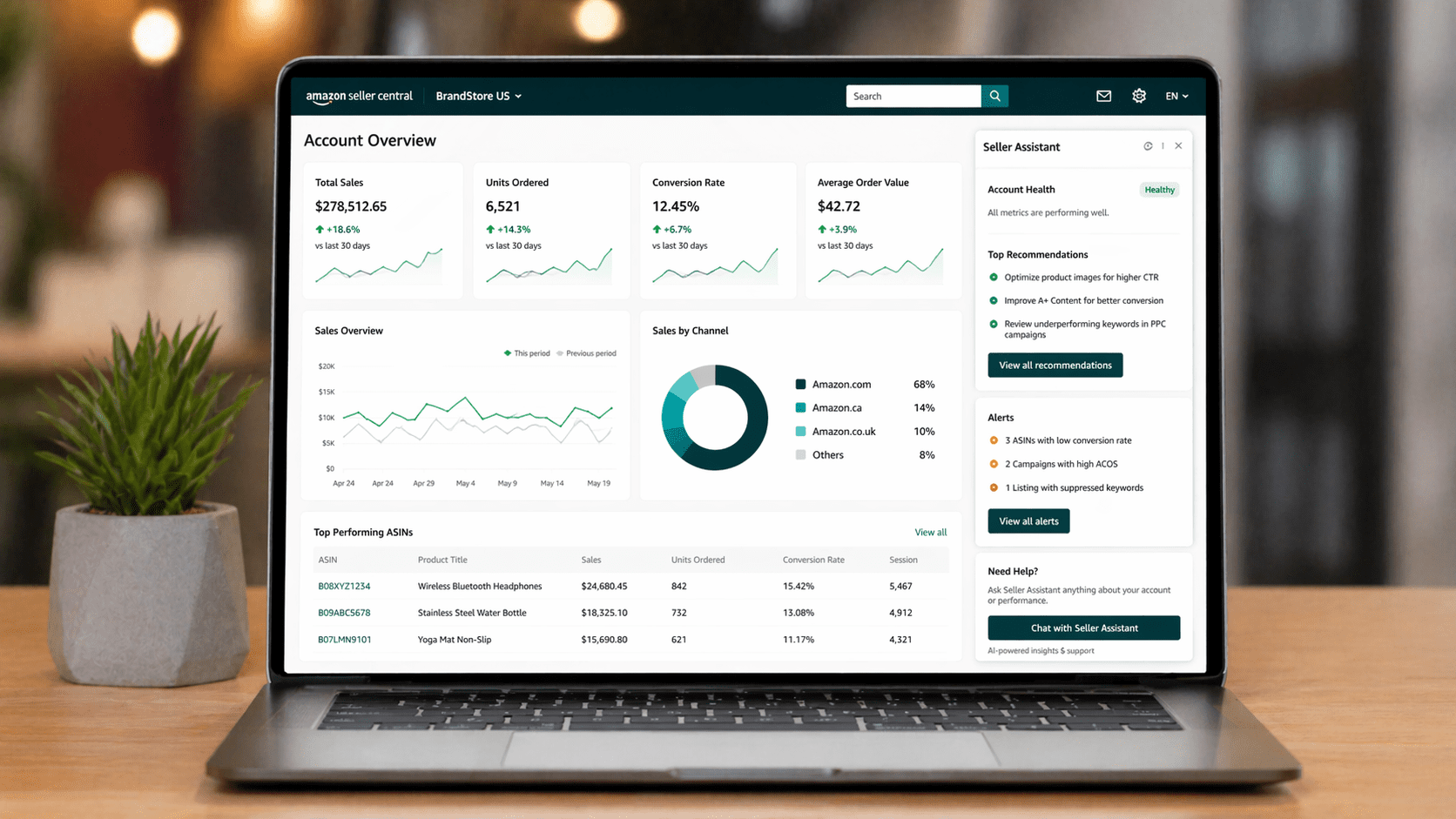
At its core, Seller Assistant introduces a centralized system that consolidates multiple layers of performance data into a single, easy-to-understand interface. Rather than navigating through multiple dashboards and reports, sellers can now access a comprehensive overview of their account performance in one place.
The tool allows sellers to monitor key metrics such as revenue trends, traffic fluctuations, conversion rates, and advertising performance without switching between different sections of Seller Central. More importantly, it connects these metrics to provide context, helping sellers understand how each factor influences overall performance.
One of the most impactful aspects of this update is its ability to highlight weak-performing ASINs. Instead of manually analyzing each product, sellers can quickly identify which listings are underperforming and require attention. This significantly reduces the time and effort needed to manage large catalogs.
In addition, Seller Assistant provides detailed insights into CTR (click-through rate), conversion rate, and traffic patterns. These metrics are no longer presented as isolated numbers but as interconnected signals that explain performance trends. Advertising efficiency is also brought into focus, allowing sellers to evaluate campaign effectiveness and identify areas of wasted spend.
Another key feature is the inclusion of year-over-year comparisons, enabling sellers to analyze seasonal trends and long-term performance changes. This allows for more strategic planning, as sellers can anticipate demand patterns and adjust their approach accordingly.
Why This Matters: From Complexity to Clarity
The introduction of Seller Assistant addresses one of the most persistent challenges in Amazon selling — the complexity of data interpretation. Previously, sellers had access to vast amounts of information but lacked the tools to convert that information into actionable insights.
This often led to a heavy reliance on agencies, freelancers, and third-party software. Sellers would outsource analysis to experts who could interpret the data and recommend strategies. While this approach provided value, it also created dependency and increased operational costs.
Seller Assistant changes this dynamic by making insights automated and accessible. Sellers no longer need to spend hours analyzing reports or rely entirely on external support to understand their performance. Instead, they can access clear, structured insights directly within Seller Central.
This democratization of data interpretation empowers sellers to make faster and more informed decisions. It reduces the barrier to entry for new sellers while enabling experienced sellers to operate more efficiently.
Key Features: A Deeper Look at Capabilities
Unified Dashboard: Centralized Decision-Making
One of the standout features of Seller Assistant is its unified dashboard, which brings together all critical performance metrics into a single view. This eliminates the need to navigate between multiple sections of Seller Central, saving time and reducing complexity.
The dashboard provides a holistic overview of business performance, allowing sellers to quickly assess the health of their account. By presenting data in a structured and connected format, it enables sellers to identify trends and patterns that would otherwise be difficult to detect.
This centralized approach transforms Seller Central from a collection of reports into a true decision-making platform, where insights are readily available and actionable.
Problem Detection: Immediate Identification of Issues
Seller Assistant introduces automated problem detection, which is one of its most impactful features. Instead of requiring sellers to manually analyze data, the tool proactively identifies performance issues and highlights them clearly.
For example, it can detect when a product is experiencing low CTR, indicating that the listing may not be attracting clicks. It can also identify low conversion rates, suggesting that customers are not finding the listing compelling enough to make a purchase. Additionally, it can highlight traffic drops, which may be linked to lost keyword rankings or reduced visibility.
By surfacing these issues in real time, Seller Assistant allows sellers to respond quickly and effectively. This reduces the risk of prolonged performance declines and ensures that problems are addressed before they significantly impact revenue.
Growth Insights: From Analysis to Opportunity
Beyond identifying problems, Seller Assistant also focuses on growth opportunities. It provides recommendations on areas that can be optimized to improve performance and scale successful products.
For instance, it may highlight high-performing ASINs that have the potential for further growth, encouraging sellers to invest more in advertising or expand keyword targeting. It can also identify underutilized opportunities, such as keywords that are driving traffic but not being fully leveraged.
This forward-looking approach shifts the focus from reactive problem-solving to proactive growth planning. Sellers are not only fixing issues but also identifying ways to expand their business and increase profitability.
Industry Impact: A Shift in the Seller Ecosystem
The launch of Seller Assistant is likely to have a significant impact on the Amazon seller ecosystem. By making performance insights more accessible, Amazon is reducing the reliance on external analysis and empowering sellers to take greater control of their business.
This could lead to a decrease in demand for basic reporting and analytics services, as sellers can now access these insights directly within Seller Central. However, it is unlikely to eliminate the need for expertise entirely.
Instead, the role of agencies and consultants is expected to evolve. Rather than focusing on data interpretation, they will need to shift toward providing strategic guidance, creative optimization, and advanced growth planning. This transition reflects a broader trend in digital marketing, where automation handles routine tasks while human expertise focuses on higher-level strategy.
At the same time, increased accessibility to insights may lead to greater competition. As more sellers gain the ability to optimize their accounts effectively, the overall quality of listings and campaigns is likely to improve. This raises the bar for success and makes differentiation even more important.
Expert Perspective: Insight vs Execution
While Seller Assistant simplifies analysis, it does not replace the need for execution. The tool provides clarity, but it does not automatically implement changes or guarantee results.
For example, identifying a low CTR is only the first step. Improving CTR requires redesigning images, optimizing titles, and understanding customer behavior. Similarly, recognizing low conversion rates does not automatically improve them — it requires strategic changes to content, pricing, and positioning.
This is why services such as Amazon account audit services, Amazon PPC management services, and Amazon SEO optimization services remain critical. These services focus on execution, ensuring that insights are translated into effective actions that drive measurable results.
In this context, Seller Assistant should be viewed as a tool that enhances decision-making rather than a replacement for expertise.
What Sellers Should Do Now: Adapting to the Update
With the introduction of Seller Assistant, sellers need to adapt their approach to account management. The first step is to integrate the tool into their daily workflow, using it as the primary source of performance insights.
Sellers should regularly review their account summary to identify trends and detect issues early. They should pay close attention to ASIN-level performance, focusing on products that require optimization or have growth potential.
Once issues are identified, sellers should take targeted action to improve listings, refine advertising campaigns, and enhance overall performance. This includes optimizing images, improving content, adjusting pricing, and implementing data-driven advertising strategies.
At the same time, sellers should focus on scaling high-performing products by increasing visibility and expanding reach. By combining insights with execution, they can maximize the impact of Seller Assistant and drive sustainable growth.
Commercial Opportunity: The Evolution of Agencies
The launch of Seller Assistant creates both challenges and opportunities for agencies and service providers. As basic analytics become automated, agencies must move beyond reporting and position themselves as growth partners.
This involves offering services that go beyond data interpretation, such as advanced strategy development, creative optimization, and full-funnel growth planning. Agencies that can deliver measurable results and drive long-term growth will continue to thrive in this new environment.
Internal services such as Amazon growth consulting services, Amazon listing optimization services, Amazon PPC expert services, and Amazon sales acceleration services become even more important in this context. These services focus on execution and strategy, which are areas where automation cannot fully replace human expertise.
Conclusion: A Turning Point for Amazon Sellers
The launch of Amazon Seller Assistant marks a significant turning point in the evolution of Seller Central. By transforming data into actionable insights, Amazon is empowering sellers with greater clarity and control over their business.
This shift reduces dependency on external analysis and enables faster, more informed decision-making. However, it also raises the level of competition and increases the importance of execution and strategy.
Ultimately, Seller Assistant represents a balance between automation and expertise. It provides the tools needed to understand performance, but success still depends on how effectively those tools are used.
Sellers now have more clarity than ever before — but growth will always require strategy, creativity, and continuous optimization.