
Choosing between Fulfillment by Amazon (FBA) and Fulfillment by Merchant (FBM) is one of the most important decisions Amazon sellers will make in 2026. Your fulfillment model directly affects profitability, customer experience, operational complexity, Buy Box performance, and the long-term scalability of your business. While many sellers assume FBA is automatically the best option, the reality is far more nuanced. The right fulfillment strategy depends on your product type, margins, operational capabilities, and growth goals.
As Amazon’s marketplace becomes increasingly competitive and fulfillment fees continue to rise, sellers must carefully evaluate whether Amazon’s logistics network or self-managed fulfillment provides the stronger long-term advantage. At Ecom Ranker, we help brands analyze their fulfillment economics and operational strategy to determine the most profitable approach for sustainable Amazon growth.
What Is Amazon FBA?
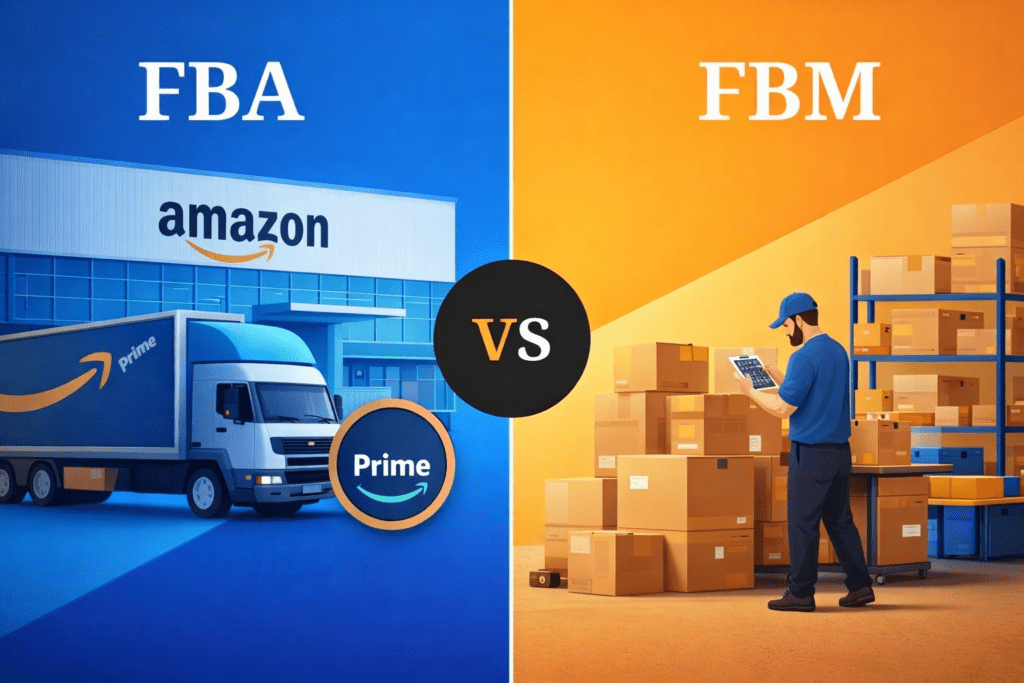
Fulfillment by Amazon (FBA) is Amazon’s outsourced logistics service that allows sellers to store inventory in Amazon fulfillment centers while Amazon handles warehousing, packing, shipping, returns, and fulfillment-related customer support. Once your inventory is received into Amazon’s network, the platform takes over nearly the entire post-purchase logistics process.
When a customer places an order, Amazon picks the product from warehouse inventory, packages it according to its fulfillment standards, ships it to the buyer, and handles return processing if necessary. This allows sellers to operate a much more streamlined business without needing to maintain their own warehouse, shipping team, or customer support infrastructure for fulfillment.
One of the biggest reasons sellers choose FBA is the automatic Prime badge, which gives listings significantly greater visibility and typically improves conversion rates.
What Is Amazon FBM?
Fulfillment by Merchant (FBM) means the seller manages all fulfillment operations independently rather than outsourcing logistics to Amazon. Inventory is stored in the seller’s own warehouse, office, home, or third-party logistics facility, and the seller is responsible for processing and shipping every order.
Under FBM, the seller controls the entire post-purchase experience, including inventory storage, packaging, shipping carrier selection, return handling, and customer communication related to fulfillment. This method provides substantially greater operational control but requires much more hands-on involvement.
FBM is often preferred by sellers who already have shipping infrastructure in place or sell products that are not well suited to Amazon’s FBA fee structure.
FBA vs FBM: Core Differences Explained
Although both fulfillment methods allow sellers to list products on Amazon, the operational and financial differences between them can significantly affect profitability and scalability.
| Feature | FBA (Fulfillment by Amazon) | FBM (Fulfillment by Merchant) |
|---|---|---|
| Inventory Storage | Stored in Amazon warehouses | Stored by seller/3PL |
| Order Fulfillment | Amazon picks, packs, ships | Seller fulfills manually |
| Customer Service | Amazon handles fulfillment-related issues | Seller handles all issues |
| Returns Processing | Managed by Amazon | Managed by seller |
| Prime Eligibility | Automatic | Only via Seller Fulfilled Prime |
| Buy Box Advantage | Higher likelihood | More difficult to win |
| Operational Control | Lower | Full control |
| Fee Structure | Higher fees | Lower platform fees but higher internal workload |
| Scalability | Easier to scale quickly | Requires operational expansion |
This table provides a simplified overview, but the true decision requires analyzing the broader strategic implications of each method.
Why Many Sellers Prefer FBA in 2026
For sellers focused on rapid growth, FBA remains one of the most powerful tools available on Amazon. The biggest advantage is Prime eligibility, which dramatically improves product visibility and conversion rates. Millions of Amazon shoppers specifically filter for Prime products, and Prime-eligible listings generally convert better due to faster shipping expectations and increased trust.
In addition, FBA often improves Buy Box win percentage because Amazon favors offers it can fulfill directly. Since Amazon controls the shipping speed and delivery experience, it views FBA listings as lower risk from a customer satisfaction perspective.
Another major benefit is operational simplicity. Sellers can offload warehousing, shipping, returns, and much of customer service, allowing them to focus on sourcing, advertising, and growth strategy rather than logistics.
For lean teams or rapidly scaling brands, FBA can create enormous operational leverage.
Why More Sellers Are Reconsidering FBA
Despite its advantages, FBA has become significantly more expensive in recent years. Rising fulfillment fees, storage costs, long-term storage penalties, and peak season surcharges have forced many sellers to reevaluate whether Amazon’s convenience justifies the cost.
For products with lower margins, oversized dimensions, or slower turnover, FBA fees can destroy profitability. Sellers often discover that after storage, shipping, and Amazon fee deductions, their net profit is substantially lower than expected.
Another concern is reduced inventory control. Once products are in Amazon’s warehouses, sellers lose visibility into how items are handled, stored, and packaged. This can create issues for premium brands, fragile products, or businesses with strict packaging standards.
As a result, many brands are becoming more selective about which SKUs they place into FBA.
Why FBM Is Becoming More Attractive in 2026
As Amazon fees continue to rise, FBM is becoming increasingly attractive for sellers with the infrastructure to support self-fulfillment. By managing logistics internally, sellers avoid FBA storage and fulfillment fees, which can substantially improve margins on certain product categories.
FBM is especially advantageous for oversized, heavy, fragile, customized, or slow-moving products. These product types often perform poorly under Amazon’s FBA fee structure due to excessive storage or shipping charges.
FBM also gives brands complete control over packaging, customer presentation, shipping methods, and warehouse operations. For premium or specialty brands, this control can improve customer experience and strengthen brand identity.
However, these advantages come with increased operational complexity, which makes FBM less suitable for sellers without logistics capabilities.
Which Fulfillment Method Is More Profitable?
Profitability depends entirely on the product.
For small, lightweight, fast-selling products with healthy margins, FBA often delivers stronger profitability despite higher fees because improved conversion rates, Prime eligibility, and Buy Box advantages drive more sales volume.
For oversized, heavy, slow-moving, or low-margin products, FBM often produces stronger net margins because sellers avoid Amazon’s expensive storage and fulfillment fees.
The key is to evaluate fulfillment strategy at the SKU level—not the account level.
Smart brands do not choose one fulfillment method for every product. They choose the most profitable method for each SKU.
Why Hybrid Fulfillment Is the Smartest Strategy for Many Brands
In 2026, many successful Amazon sellers use a hybrid fulfillment model that combines both FBA and FBM.
Rather than committing entirely to one method, brands strategically assign fulfillment based on product economics.
Best-selling, Prime-sensitive products may go to FBA to maximize sales velocity and Buy Box share.
Oversized, slow-moving, or margin-sensitive SKUs may remain FBM to preserve profitability.
This hybrid strategy allows brands to maximize revenue while controlling fulfillment costs across the catalog.
It also provides backup flexibility—if FBA inventory runs out, sellers can temporarily switch to FBM to avoid stockouts and lost ranking.
Final Verdict: FBA vs FBM in 2026
There is no universal winner in the FBA vs FBM debate.
FBA remains the strongest option for brands seeking rapid scaling, Prime visibility, and operational simplicity. FBM remains highly valuable for sellers focused on control, margin preservation, and specialized product fulfillment.
For most sophisticated Amazon brands, the best answer in 2026 is not FBA or FBM—it is a strategic combination of both.
The winning fulfillment strategy is the one that aligns with your margins, operations, catalog, and growth objectives.
Partner With Ecom Ranker to Build the Right Amazon Fulfillment Strategy
At Ecom Ranker, we help Amazon sellers evaluate fulfillment economics at the SKU level to determine the most profitable strategy for scaling.
Whether you need help with Amazon profitability analysis, fulfillment optimization, PPC strategy, listing optimization, or full marketplace growth planning, our team can help you maximize performance across every stage of the Amazon funnel.
FAQs for FBA vs FBM
What is the difference between FBA and FBM on Amazon?
The main difference between FBA and FBM is who handles order fulfillment. With FBA (Fulfillment by Amazon), Amazon stores, packs, ships, and manages returns for your products. With FBM (Fulfillment by Merchant), the seller handles storage, packing, shipping, and customer service independently.
Is FBA better than FBM for Amazon sellers?
FBA is often better for sellers who want Prime eligibility, higher Buy Box win rates, and easier scalability. However, FBM can be more profitable for oversized, heavy, low-margin, or slow-moving products. The best option depends on your product type and business model.
Is FBM more profitable than FBA?
FBM can be more profitable than FBA when sellers have efficient shipping operations and sell products with high Amazon fulfillment fees. Many oversized or low-margin products generate better net profit under FBM.
Does FBA Help You Win the Buy Box?
Yes, FBA often improves Buy Box win rates because Amazon favors Prime-eligible offers fulfilled through its own logistics network. However, pricing, seller metrics, and shipping performance also influence Buy Box eligibility.
Can You Use Both FBA and FBM Together?
Yes, many successful Amazon sellers use a hybrid fulfillment strategy that combines FBA and FBM. This allows brands to use FBA for high-volume products and FBM for oversized, slow-moving, or low-margin inventory.
Which Products Are Better for FBA?
FBA is typically better for small, lightweight, fast-selling, and high-margin products that benefit from Prime eligibility and Amazon’s logistics network.
Which Products Are Better for FBM?
FBM is generally better for oversized, heavy, fragile, customized, slow-moving, or low-margin products where Amazon’s FBA fees may reduce profitability.
How Do I Choose Between FBA and FBM?
To choose between FBA and FBM, sellers should evaluate product size, weight, margins, sales velocity, operational capabilities, and long-term business goals. Many brands use SKU-level profitability analysis to determine the best fulfillment method.