


Amazon is a data-driven marketplace where small changes can create big differences in performance. If you want to consistently improve your sales, you must understand and implement a strong amazon listing split testing strategy. Split testing, also known as A/B testing, allows you to compare different versions of your listing elements to identify what works best.
Most sellers rely on guesswork when optimizing listings, but top-performing brands use data. By testing images, titles, bullet points, and A+ content, you can improve both CTR and conversion rate, which directly impacts your ranking and revenue.
What is Amazon Listing Split Testing?
Amazon listing split testing is the process of comparing two versions of a listing element to determine which one performs better. This could involve testing different images, titles, or content variations while measuring performance metrics such as clicks and conversions.
A strong amazon listing optimization strategy uses split testing to remove assumptions and make data-driven decisions. Instead of guessing what customers prefer, you rely on actual performance data to optimize your listing.
Why Amazon Split Testing is Important for SEO & Ranking
Amazon’s algorithm prioritizes listings that generate higher CTR and conversion rates. When your listing performs better, Amazon considers it more relevant and pushes it higher in search results.
This means that an effective amazon listing split testing strategy not only improves conversions but also boosts organic ranking. Testing helps you identify the exact elements that drive performance, allowing you to scale winning variations.
What You Should Test in Amazon Listings
One of the most important aspects of split testing is knowing what to test. Each element of your listing plays a different role in the conversion funnel.
The main image is the most critical element for CTR. Testing different angles, backgrounds, or product presentations can significantly impact clicks. Even small changes can lead to noticeable improvements.
Titles should also be tested to find the best combination of keywords and readability. A well-optimized title improves both visibility and click-through rate.
Bullet points directly affect conversion rate. Testing different messaging styles—such as feature-focused versus benefit-driven—helps identify what resonates with customers.
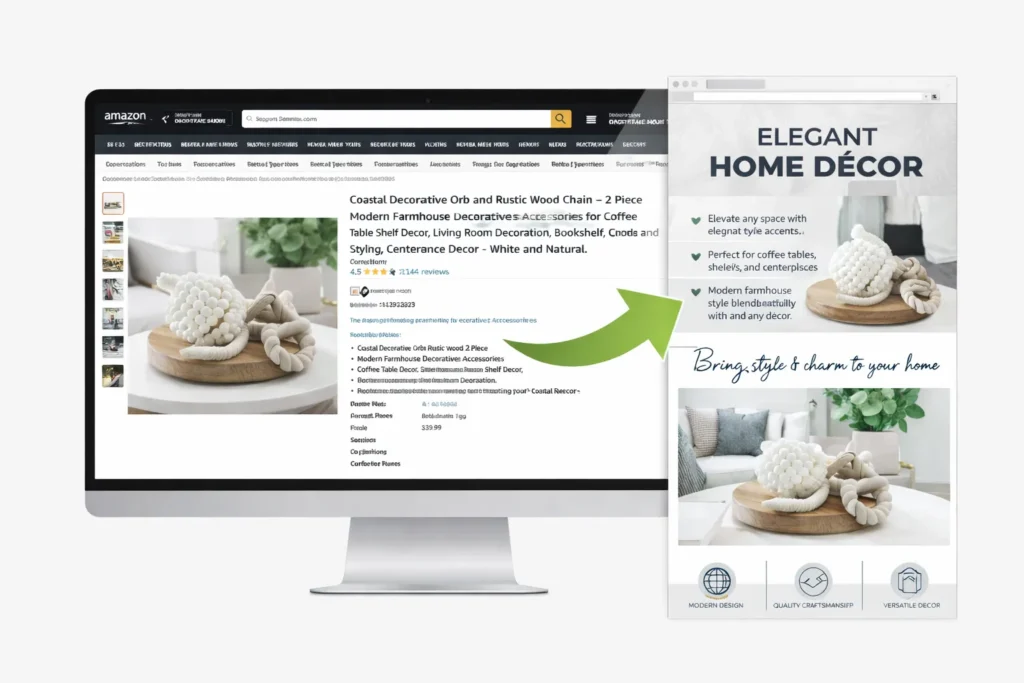
A+ content is another powerful area for testing. Different layouts, visuals, and storytelling approaches can influence how customers perceive your product and brand.
How to Run Amazon Split Tests (Step-by-Step)
To implement a successful amazon listing split testing strategy, you must follow a structured process.
Start by selecting one element to test, such as the main image or title. Testing multiple elements at once can create confusion and make it difficult to identify what caused the change in performance.
Next, create two variations—your original version and a new optimized version. Run the test for a sufficient period, usually 2–4 weeks, to gather reliable data.
During the test, monitor key metrics such as CTR, conversion rate, and sales. Once the test is complete, analyze the results and implement the winning version.
This process should be repeated continuously to keep improving your listing.
Key Metrics to Track in Split Testing
To measure the success of your tests, you need to focus on the right metrics.
CTR (Click-Through Rate) shows how effective your listing is at attracting clicks. Improvements in CTR usually come from better images and titles.
Conversion rate indicates how well your listing turns visitors into buyers. This is influenced by bullet points, images, A+ content, and pricing.
Sales and revenue provide the final measure of success. A winning variation should lead to increased sales over time.
Tracking these metrics ensures your amazon listing conversion rate optimization efforts are effective.
Common Mistakes in Amazon Split Testing
Many sellers make mistakes that reduce the effectiveness of their tests. One common mistake is testing multiple elements at once, which makes results unclear.
Another mistake is running tests for too short a duration. Without enough data, results can be misleading.
Some sellers also ignore data and make decisions based on assumptions. Split testing should always be data-driven.
Avoiding these mistakes ensures your amazon split testing strategy delivers accurate and actionable insights.
Advanced Amazon Split Testing Strategy
To take your strategy to the next level, you should adopt advanced techniques.
Testing based on customer behavior helps you align your listing with real user preferences. You can also segment tests based on traffic sources, such as organic versus PPC traffic.
Seasonal testing allows you to optimize your listing for different times of the year, capturing more relevant traffic.
Continuous testing is key. The market evolves, and what works today may not work tomorrow. A long-term amazon listing optimization strategy involves ongoing experimentation and improvement.
How Split Testing Improves Amazon Ranking
Amazon rewards listings that perform well. When your CTR and conversion rate increase, your product becomes more relevant in Amazon’s algorithm.
This creates a positive cycle:
- Better listing → higher CTR
- Higher CTR → better ranking
- Better ranking → more traffic
- More traffic → more sales
A strong amazon listing split testing strategy helps you build this cycle and scale your business.
Conclusion
Implementing an effective amazon listing split testing strategy is essential for long-term success. It allows you to optimize your listing based on real data, improve conversions, and boost ranking.
Instead of guessing, focus on testing, analyzing, and improving continuously. This approach ensures your listing stays competitive and delivers consistent growth.
FAQs: Amazon Listing Split Testing Strategy
What is Amazon listing split testing and how does it work?
Amazon listing split testing, also known as A/B testing, is the process of comparing two versions of a listing element to identify which one performs better. This can include testing different images, titles, bullet points, or A+ content. The goal is to measure performance based on key metrics like CTR and conversion rate. A strong amazon listing split testing strategy allows sellers to make data-driven decisions instead of relying on guesswork, leading to better optimization and higher sales.
Why is split testing important for Amazon listing optimization?
Split testing is important because Amazon’s algorithm rewards listings that perform well in terms of clicks and conversions. By testing different elements, you can identify what attracts more clicks and what convinces customers to buy. This improves your amazon listing optimization strategy, increases conversion rate, and ultimately boosts your product ranking on Amazon.
What elements should I test in my Amazon listing?
You should focus on testing key elements that directly impact performance. These include the main image (for improving CTR), title (for visibility and clicks), bullet points (for conversion), and A+ content (for trust and engagement). Testing these elements systematically helps improve both amazon listing conversion rate optimization and overall listing performance.
How long should I run an Amazon split test?
An Amazon split test should typically run for at least 2–4 weeks to collect enough data for accurate analysis. Running tests for too short a time may lead to incorrect conclusions due to temporary fluctuations in traffic or sales. A proper testing duration ensures reliable results for your amazon split testing strategy.
Can split testing improve Amazon ranking?
Yes, split testing directly impacts ranking because it improves CTR and conversion rate. Amazon’s algorithm prioritizes listings that generate better performance signals. When your listing performs better, it becomes more relevant in search results, leading to higher rankings and more visibility.
What metrics should I track during split testing?
The most important metrics to track are CTR (click-through rate), conversion rate, and sales. CTR helps you understand how effective your listing is at attracting clicks, while conversion rate shows how well it turns visitors into buyers. Monitoring these metrics ensures your amazon listing split testing strategy delivers real improvements.
What are common mistakes in Amazon split testing?
Common mistakes include testing multiple elements at once, running tests for too short a time, and ignoring data when making decisions. These mistakes lead to unclear results and poor optimization. A structured and data-driven approach is essential for successful testing.
How often should I perform split testing on my listing?
Split testing should be an ongoing process rather than a one-time activity. As market trends, competition, and customer behavior change, your listing must evolve. Regular testing helps you stay competitive and continuously improve your amazon listing optimization strategy.