
When running Amazon PPC campaigns, most sellers focus on ROAS (Return on Ad Spend) to measure performance. While ROAS is important, it doesn’t tell the full story.
To truly scale your Amazon business, you need to understand the difference between ROAS and TACoS (Total Advertising Cost of Sales)—and how to use both together.
What is ROAS in Amazon Ads?
ROAS (Return on Ad Spend) measures how much revenue you generate for every rupee spent on ads.
Formula:
ROAS = Revenue ÷ Ad Spend
Example:
- Ad Spend = ₹1,000
- Revenue = ₹5,000
ROAS = 5x
This means you earn ₹5 for every ₹1 spent on ads.
Why ROAS Matters
ROAS is a key metric for evaluating ad efficiency and profitability.
Benefits of ROAS:
- Helps measure campaign performance quickly
- Indicates how profitable your ads are
- Useful for short-term optimization
- Helps in budget allocation
A higher ROAS means your campaigns are more efficient.
What is TACoS?
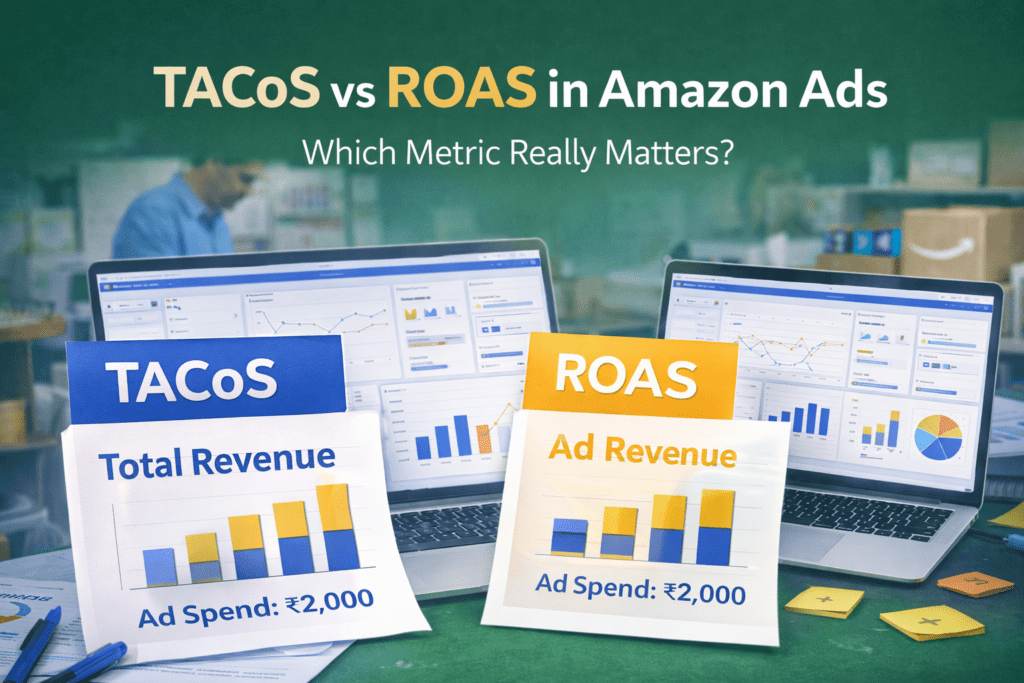
TACoS (Total Advertising Cost of Sales) measures ad spend against total revenue (organic + paid).
Formula:
TACoS = Ad Spend ÷ Total Revenue
Unlike ROAS, TACoS gives a big-picture view of business growth, including the impact of ads on organic sales.
TACoS vs ROAS (Key Differences)
| Metric | Focus |
|---|---|
| ROAS | Efficiency |
| TACoS | Growth |
ROAS Focus:
- Short-term returns
- Campaign-level performance
- Immediate profitability
TACoS Focus:
- Long-term scaling
- Organic + paid impact
- Brand growth and ranking
Key Insight: Short-Term vs Long-Term Thinking
ROAS is Short-Term
ROAS helps you optimize campaigns quickly, but it can limit growth if you focus only on efficiency.
Example:
- Cutting ad spend increases ROAS
- But reduces visibility and sales
TACoS is Long-Term
TACoS reflects how ads contribute to overall business growth.
Example:
- Higher ad spend may reduce ROAS
- But increases organic ranking and total sales
When to Focus on ROAS vs TACoS
Focus on ROAS When:
- You want profitability
- You’re managing tight budgets
- You’re optimizing mature campaigns
Focus on TACoS When:
- You’re launching new products
- You want to scale aggressively
- You’re building organic ranking
How to Balance TACoS and ROAS
The real success comes from using both metrics together.
1. Set Clear Goals
Decide if your goal is profit or growth.
2. Track Both Metrics
Don’t rely on just ROAS—monitor TACoS regularly.
3. Scale Smartly
Increase ad spend if TACoS is stable or decreasing (good sign of organic growth).
4. Optimize Listings
Better listings improve conversion rate, which improves both ROAS and TACoS.
Common Mistakes Sellers Make
❌ Focusing only on ROAS
❌ Cutting ads too early
❌ Ignoring organic sales impact
❌ Not tracking TACoS trends
❌ Over-optimizing for efficiency
Pro Strategy for Advanced Sellers
- Accept lower ROAS during launch phase
- Monitor TACoS trend over time
- Aim for decreasing TACoS as organic sales grow
- Use ROAS for daily optimization and TACoS for strategic decisions
Conclusion
ROAS and TACoS are not competitors—they are complementary metrics.
- ROAS helps you measure efficiency
- TACoS helps you measure growth
Always align ROAS with a strong TACoS strategy for long-term success on Amazon.