
For more than two decades, Google has dominated the search engine industry. Today it still controls roughly 90% of the global search market, making it the default tool most people use to find information online.
However, the search landscape in 2026 looks very different from even a few years ago.
People are no longer relying on a single search engine to discover information. Instead, they use multiple platforms depending on what they are looking for.
For example:
- People searching for products often start on Amazon
- Those looking for tutorials or reviews search on YouTube
- Younger users often discover information on TikTok
- Researchers increasingly rely on AI answer engines like Perplexity and ChatGPT
These changes mean that search behavior has become fragmented across platforms, each specializing in a specific type of discovery.
At EcomRanker, we see this shift clearly when working with eCommerce brands and marketplace sellers. Many businesses still focus entirely on Google SEO, while ignoring other search channels that are now equally important.
If you run an online business, understanding where your customers actually search for information is essential for building a strong digital strategy.
For example, if you sell products on Amazon, optimizing for Amazon search algorithms can be more important than Google SEO.
You can learn more about this in our guide on:
https://ecomranker.com/amazon-a9-algorithm/
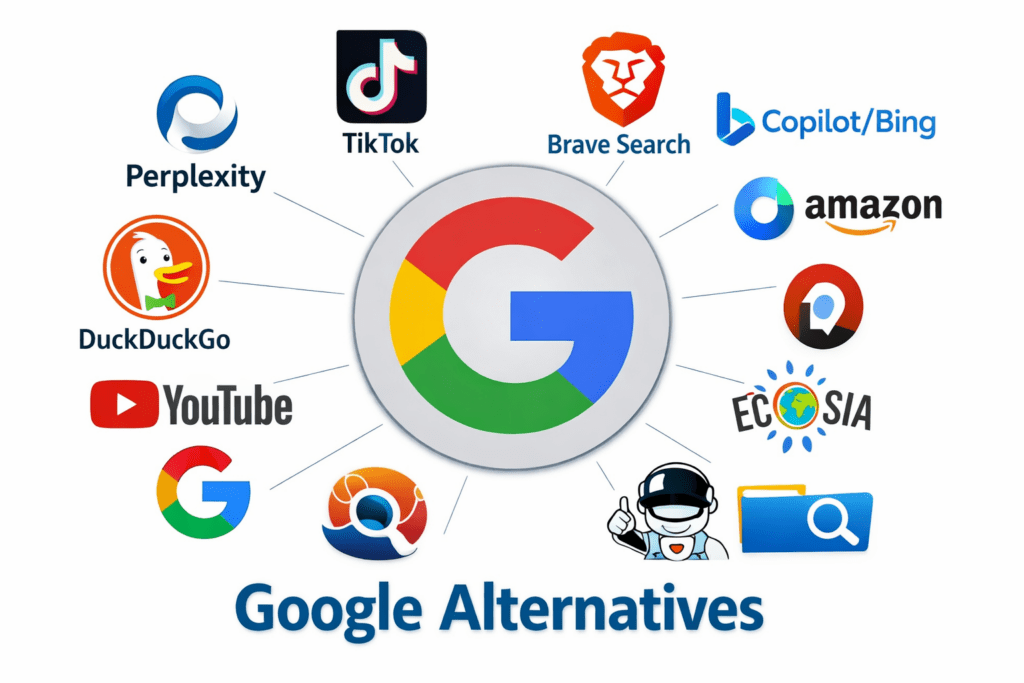
In this article, we’ll explore 12 powerful alternatives to Google and explain when and why you should use them.
What Counts as a Search Engine in 2026?
Traditionally, search engines referred to platforms that indexed web pages and returned a list of results based on a query.
Today, that definition has expanded significantly.
In 2026, a search engine can be any platform where users enter a query to discover information, content, or products.
This includes:
- AI answer engines
- Video search platforms
- Social discovery platforms
- Product marketplaces
- Privacy-focused search engines
For example:
- YouTube processes billions of searches every month
- Amazon handles a majority of online product searches
- TikTok is increasingly used for product discovery and news
- AI engines like Perplexity provide summarized answers instead of links
For businesses, this means search engine optimization now extends far beyond Google.
Why People Are Looking for Google Alternatives
There are several reasons why users are exploring other search platforms.
1. Privacy Concerns
One of the biggest criticisms of traditional search engines is data tracking.
Google collects large amounts of user data to personalize results and deliver targeted advertising.
Privacy-focused search engines such as DuckDuckGo and Brave Search are growing in popularity because they avoid tracking users.
These platforms provide search results without building personal data profiles.
2. Better Results for Specific Searches
Different search engines often perform better for different types of queries.
For example:
Google works well for general research
Amazon is better for product searches
YouTube excels at tutorial content
TikTok is effective for trends and discovery
Understanding this distinction helps users find more relevant results faster.
3. AI-Powered Answers
The rise of AI answer engines is one of the biggest changes in modern search.
Platforms like Perplexity, ChatGPT, and Microsoft Copilot can analyze multiple sources and deliver summarized answers instantly.
Instead of browsing through several websites, users can get a direct explanation of a topic.
4. Independent Search Algorithms
Some users prefer search engines that use independent indexing systems rather than relying on Google or Bing.
For example, Brave Search operates its own search index, offering a different perspective on search results.
12 Best Alternatives to Google
Let’s explore some of the most useful search engines available today.
1. ChatGPT
ChatGPT has become one of the most widely used AI tools for answering questions and generating information.
Millions of users now rely on it as a conversational search assistant.
Unlike traditional search engines that provide links, ChatGPT can:
Explain concepts
Summarize complex topics
Generate ideas
Assist with writing and coding
Many marketers and researchers now use ChatGPT to speed up information discovery.
2. Perplexity
Perplexity is rapidly becoming one of the most powerful AI research tools.
What sets it apart is its citation-based answers.
Each response includes links to original sources, allowing users to verify information quickly.
Perplexity is particularly useful for:
Market research
Competitive analysis
Industry insights
For entrepreneurs and marketers, it can dramatically reduce research time.
3. Claude
Claude, developed by Anthropic, focuses heavily on structured reasoning and high-quality writing.
It is widely used for tasks such as:
Content writing
Technical analysis
Business documentation
Claude is often praised for producing thoughtful and detailed responses compared to other AI assistants.
4. Microsoft Copilot
Microsoft Copilot integrates AI search into the Microsoft ecosystem.
It is built into:
Windows
Microsoft Edge
Microsoft Office tools
For professionals working within Microsoft environments, Copilot provides seamless AI-powered search capabilities.
5. YouTube
YouTube is widely considered the second-largest search engine in the world.
People search YouTube for:
Product reviews
Tutorials
Software guides
Educational content
For businesses, YouTube SEO can be extremely valuable.
Many products require demonstration or explanation, making video search highly effective.
6. Amazon
For product discovery, Amazon often matters more than Google.
Research shows that a majority of shoppers begin their product search on Amazon rather than on traditional search engines.
If you sell products online, Amazon search optimization is critical.
You can learn more in our guide:
7. TikTok
TikTok has rapidly evolved into a powerful discovery engine.
Younger audiences frequently search TikTok for:
Product recommendations
Travel destinations
Restaurant reviews
News updates
Many brands now use TikTok as part of their content discovery strategy.
8. DuckDuckGo
DuckDuckGo is one of the most well-known privacy-focused search engines.
It avoids:
User tracking
Search profiling
Personalized advertising
Users who prioritize privacy often choose DuckDuckGo for everyday searches.
9. Brave Search
Brave Search is a privacy-first search engine that uses its own independent search index.
Unlike many other alternatives, it does not rely on Google or Bing results.
Key advantages include:
Independent indexing
Privacy protection
Integrated AI answers
10. Ecosia
Ecosia is an environmentally focused search engine.
Its business model is unique: advertising revenue from searches is used to fund global tree-planting initiatives.
Millions of trees have already been planted through Ecosia searches.
11. Phind
Phind is designed specifically for developers.
It helps programmers quickly find:
Code solutions
Technical documentation
Debugging advice
Many developers use Phind instead of browsing multiple programming forums.
12. Internet Archive (Wayback Machine)
The Internet Archive allows users to explore historical versions of websites.
This tool is extremely valuable for:
Journalists
Researchers
Digital marketers
It can reveal how websites looked years ago and track changes over time.
How Alternative Search Engines Impact Your Business
For modern businesses, understanding multi-platform search behavior is crucial.
Customers may discover your brand through different platforms depending on their intent.
For example:
Product discovery → Amazon
Tutorial searches → YouTube
Trend discovery → TikTok
Research queries → AI answer engines
At EcomRanker, we help brands build strategies that cover these multiple discovery channels.
You can explore our insights on marketplace growth here:
Final Thoughts
Google remains the dominant search engine, but the way people search online is evolving rapidly.
In 2026, users rely on a combination of platforms depending on their needs.
AI tools, video platforms, product marketplaces, and privacy-focused search engines are all becoming important parts of the search ecosystem.
For businesses, the key takeaway is simple:
Search optimization now means optimizing across multiple platforms, not just Google.
Brands that understand where their customers search will have a major advantage in the digital marketplace.
If you want expert guidance on improving your visibility across marketplaces and search platforms, visit:
Frequently Asked Questions
Are alternative search engines better than Google?
Not necessarily better, but they often provide more specialized results depending on the search intent.
Which search engine is best for privacy?
DuckDuckGo and Brave Search are two of the most popular privacy-focused search engines.
Where do most product searches start?
Many product searches begin directly on Amazon rather than Google.
Should businesses optimize for platforms beyond Google?
Yes. Platforms like Amazon, YouTube, and TikTok are now important discovery engines for many audiences.