
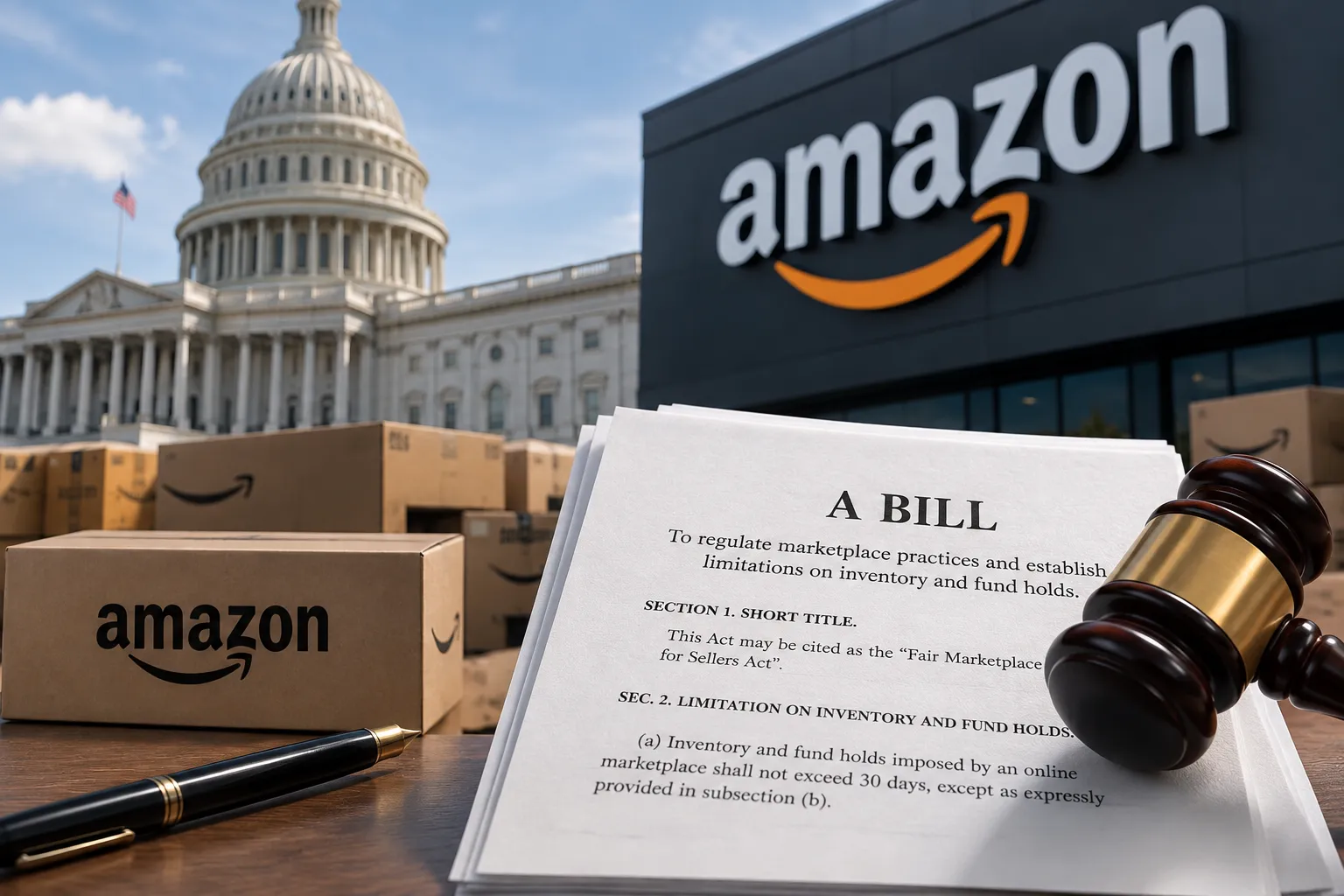
Representatives Becca Balint (D-VT) and Nydia Velázquez (D-NY) introduced the Online Sellers’ Bill of Rights Act of 2026 (H.R. 9799) on July 21, requiring “critical trading partners” — a category expected to cover Amazon and Walmart, and potentially others — to provide evidence before suspending a seller, cap most inventory and fund holds at 30 days, and give sellers written notice within 72 hours of any hold. The bill has 8 cosponsors and sits with the House Judiciary Committee. It does not change any current Amazon or Walmart policy while it moves through Congress, and there’s no floor vote scheduled.
What the Bill Would Actually Require
| Area | Proposed Requirement |
| Inventory and fund holds | Capped at 30 days unless the platform shows, by a preponderance of the evidence, that goods or funds are tied to unlawful conduct |
| Notice of a hold | Written notice within 72 hours, explaining the reason and the appeal process |
| Policy changes | At least 30 days’ advance notice before material changes affecting fees or eligibility |
| Suspension/deactivation | Platform must provide evidence and identify the specific policy violated before acting |
| Rulemaking | FTC required to issue implementing rules within 180 days of enactment |
Rep. Balint framed the bill directly: “No corporation should have the power to destroy someone’s livelihood with the click of a button.” The findings section argues small sellers have become dependent on a small number of dominant platforms that can cut off access to customers and income with limited transparency or due process.
The Enforcement Teeth
What separates this from a typical policy wish-list is the enforcement mechanism. A violation would be treated as an unfair method of competition under the FTC Act, giving the agency direct authority to act. Beyond that, the bill creates three additional paths to enforcement: state attorneys general could sue on behalf of residents, sellers could bring their own federal lawsuits even if their marketplace agreement requires arbitration, and successful sellers could recover treble damages plus attorneys’ fees and court costs. That combination — a private right of action that overrides arbitration clauses, paired with treble damages — is a materially stronger enforcement structure than most federal consumer-protection statutes carry.
Who’s Backing It, and Who’s Fighting It
The bill is publicly backed by Public Knowledge, the Open Markets Institute, and Public Citizen — advocacy groups that have argued for years that platform power over independent sellers is under-regulated. Public Knowledge’s statement frames the core problem as platforms lacking the investigative tools to distinguish rule-breaking sellers from innocent ones, leaving legitimate sellers locked out of their own funds and inventory for months at a time.
The most substantive public opposition has come from NetChoice, a trade association whose members include Amazon, Google, and Meta. Its critique, titled “The Online Sellers’ Bill of Rights Has a Counterfeiter Problem,” argues the bill’s fixed 30-day windows and rigid notice schedule would freeze enforcement processes that platforms currently update as counterfeiters and scammers change tactics — and that the litigation exposure built into the bill gives platforms an incentive to communicate less with sellers, since every notice becomes potential evidence in a lawsuit. NetChoice also points to research from the Connected Commerce Council showing 70% of small online sellers already use more than one sales channel and 77% mix online selling with brick-and-mortar or wholesale — arguing the bill’s picture of a seller fully dependent on one dominant platform doesn’t match how most small sellers actually operate. Worth noting for context: the Connected Commerce Council itself receives funding from Amazon and Google, so that data point comes from a group with its own stake in the outcome, the same as the advocacy groups on the other side.
Why “Critical Trading Partner” Matters More Than It Sounds
The bill’s protections don’t apply narrowly to “online marketplaces” — they apply to any “critical trading partner,” a broader term Section 5 defines around a platform’s ability to restrict a seller’s access to customers, tools, or services, without setting a specific market-share or dominance threshold in the bill text itself. That threshold would instead be established later through FTC rulemaking. Practically, that means the final scope of who’s covered — Amazon and Walmart for certain, but potentially eBay, Etsy, Poshmark, or other platforms sellers have raised similar concerns about — won’t be settled until after the bill passes, if it does, and the FTC completes its 180-day rulemaking process.
Where This Actually Stands
As of this writing, H.R. 9799 has been referred to the House Judiciary Committee with no committee vote or floor schedule announced. Bills at this stage routinely stall without further cosponsor momentum or committee action, and nothing in the bill’s current text changes any Amazon or Walmart policy today. Sellers should treat this as a proposal worth tracking, not a change to plan around yet.
What Sellers Should Do Right Now
Regardless of whether this bill advances, the underlying problem it targets — opaque holds and suspensions with limited explanation — is one sellers already have to manage under current rules. Navigating a suspension under today’s rules still depends on the same fundamentals this bill would make mandatory: organized compliance records, documented communication with Amazon, and a clear paper trail showing good-faith policy adherence. If the bill does eventually pass, having that documentation already in place only makes a platform’s evidence burden easier to meet on your behalf, not harder.
- Keep supplier invoices, authenticity documentation, and compliance records organized and easily retrievable — this is the single best protection against a prolonged hold under either the current system or the proposed one.
- Don’t restructure account strategy around this bill passing — it hasn’t cleared committee, and prior similar seller-protection proposals in past Congresses have stalled at this same stage.
- If you sell across multiple channels already, the NetChoice-cited data suggests you’re in the majority of small sellers, not the exception — worth keeping in mind as this debate over platform dependency continues regardless of this bill’s fate.
The Bottom Line
H.R. 9799 would meaningfully shift leverage toward sellers if enacted as written — evidence requirements before suspension, a 30-day cap on holds, and real financial teeth behind enforcement. It would also, per its critics, risk hamstringing legitimate anti-fraud enforcement with rigid deadlines that don’t adapt to how counterfeiters actually operate. Both of those things can be true, and which concern should weigh more heavily is a genuinely contested policy question, not a settled one. For now, the bill is a proposal with real backing and real opposition sitting in committee — worth watching, not worth acting on yet.