
Only 1 in 5 of TikTok Shop’s hundred largest US sellers also ranks among Amazon.com’s top 10,000. Flip it around and the gap widens: just 1 in 25 of Amazon’s hundred largest sellers ranks among TikTok Shop’s top 10,000. According to a September 10, 2026 Marketplace Pulse analysis that matched the two platforms’ top-10,000 seller lists by business name, a brand that succeeds on TikTok is roughly five times more likely to also succeed on Amazon than the other way around.
Across both full top-10,000 lists, only 498 businesses appear on both — about 5% of either list. And among those 498 sellers who do show up on both, a seller’s rank on Amazon has almost no relationship to its rank on TikTok. Being big on one platform says close to nothing about being big on the other.
Why the Bridge Only Runs One Direction
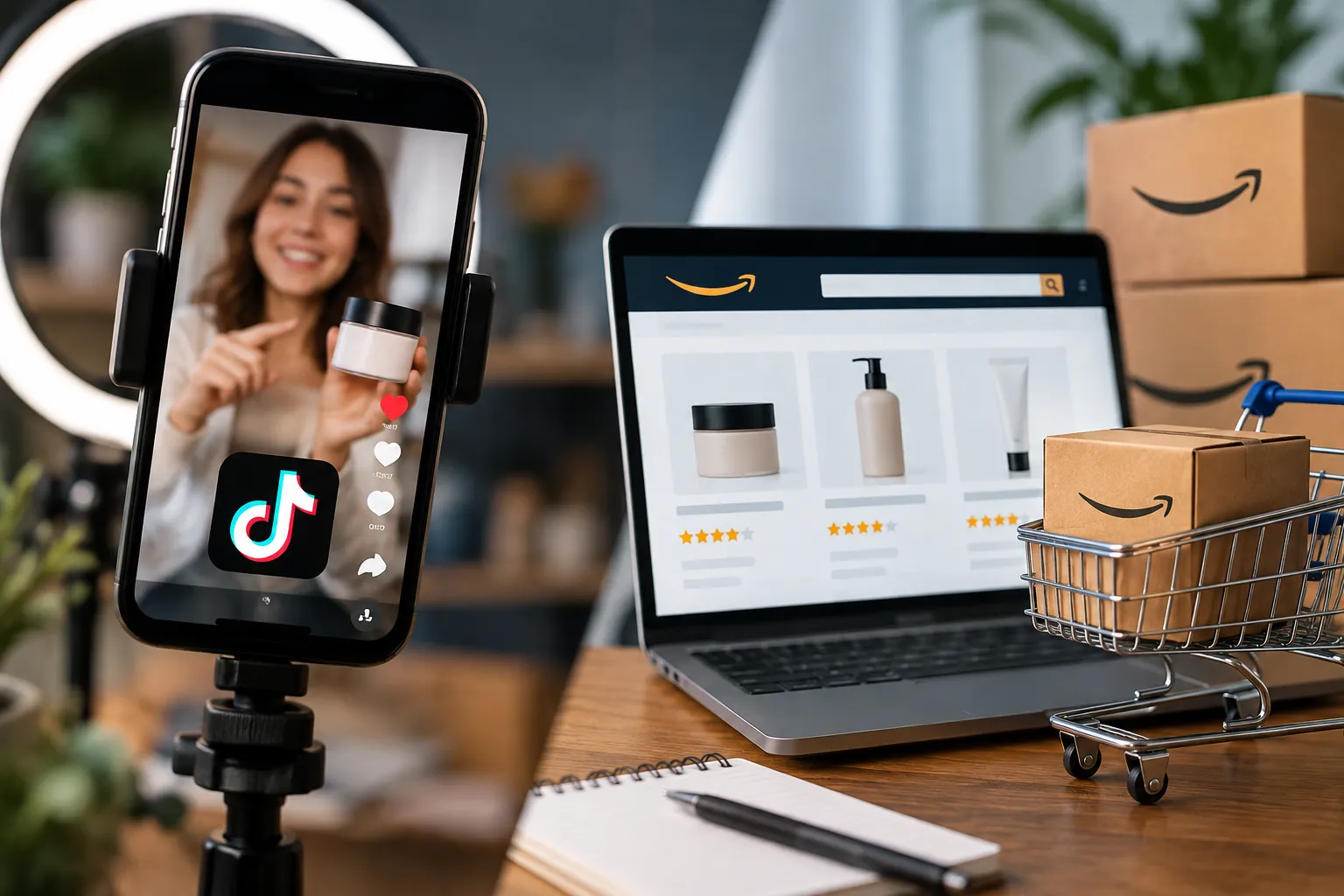
The asymmetry comes down to what each platform is actually for. TikTok creates desire; Amazon is where two decades of Prime have trained American shoppers to complete a purchase almost by reflex — saved payment method, a promised delivery date, painless returns, trusted reviews. When a product gets demonstrated in a TikTok video, a large share of viewers don’t buy inside the app. They open Amazon, search the brand name, and buy where they already buy everything else.
This isn’t a new pattern that TikTok Shop created — it predates the shopping feature entirely. In 2021, a pair of leggings became Amazon’s best-selling clothing item purely because TikTok videos that couldn’t even link to a product page sent millions of viewers to go search for it on Amazon instead. TikTok Shop later added in-app checkout, fulfillment, and a creator commission program specifically to keep more of those sales inside the app, and a meaningful share now do stay. But the search-on-Amazon reflex is still intact for a large portion of that demand, and a brand that wins the TikTok feed often inherits an Amazon business it never had to build directly.
Amazon Has Tried to Build Its Own Version of This Twice
The reverse doesn’t happen because Amazon has never managed to become a discovery platform, despite trying more than once. Amazon Live has struggled to hold even a thousand concurrent viewers on a typical day. Amazon Inspire, its TikTok-style short-video feed, launched in December 2022 as a close relative of Spark, a nearly identical feature from 2017 that had already gone nowhere — and Inspire itself was shut down in 2025, lost among dozens of other features inside the Amazon app. Neither ever built the kind of habitual, browsing-driven demand engine that TikTok has become for physical products.
What Actually Transfers Between the Two Platforms
Success on Amazon is built from search rank, review count, advertising budget, and inventory positioned in Amazon’s fulfillment network — durable assets, but ones that mean nothing to a TikTok algorithm. Success on TikTok depends on TikTok content and creator strategy: a product whose value can be shown on camera in roughly fifteen seconds, a brand that treats content as a primary channel rather than an add-on, and a network of creators earning commission on every sale they generate. Most products that sell well on Amazon fail that test outright — a replacement charging cable, a set of storage bins, a pack of printer paper are things people search for by name, not things anyone chooses to film.
Even Where the Product Fits, the Market Is Already Concentrated
Where a product does suit short-form video, the market a new seller enters on TikTok Shop has already sorted itself sharply. Separate Marketplace Pulse tracking found that the top 1% of TikTok Shop sellers generate 60% of tracked US GMV, and the top 0.1% — fewer than 90 sellers, each averaging over $100 million in lifetime sales — account for more than a quarter of total GMV on their own. That’s a steeper concentration curve than Amazon’s: on Amazon, roughly 1.6% of the active seller base (fewer than 8,000 sellers) generates half of third-party GMV, while on TikTok Shop the top 1% alone clears that same 50% threshold. Content is cheap to produce and new creators appear daily, so the door onto the platform is genuinely open — but the room behind it is one where demand is already concentrated around brands that have been building creator relationships since before the newer entrant arrived.
What This Means If You’re Weighing TikTok Shop as an Amazon Seller
The practical takeaway is about where to measure the return, not whether to try the platform at all:
- If the product can genuinely be demonstrated on camera, fund creators and measure the result primarily in Amazon branded search volume and direct traffic — not in TikTok Shop order counts alone, since a large share of the actual purchase intent it generates may complete on Amazon instead of inside the app.
- If the product can’t be shown doing something in fifteen seconds — a commodity replacement part, a bulk consumable, anything bought by spec rather than demonstration — TikTok is very unlikely to become a meaningful channel, and no amount of listing optimization changes that.
- Don’t expect an established Amazon rank to buy any head start on TikTok Shop specifically. The data shows essentially no correlation between the two, so a TikTok launch has to be built and evaluated on its own terms, with its own content and creator investment, not treated as a natural extension of Amazon success.
For sellers already investing in organic Amazon search rank, that search-completion reflex is worth protecting and reinforcing rather than assuming it will simply persist — it’s the actual mechanism carrying value from any outside content effort back onto the platform where the sale gets recorded.
The Bottom Line
The split between the two platforms is hardening, not blurring. TikTok has become the demand engine for products that can be shown, worn, applied, or consumed on camera; Amazon remains where that demand gets settled, whether or not the sale started there. For a brand deciding where to put next quarter’s content and advertising budget, the data argues for treating TikTok as a discovery investment that pays off primarily in Amazon branded search, not as a parallel sales channel to run with the same playbook. Selling across multiple platforms still diversifies risk, but this data is a reminder that the two audiences, and the tactics that win each one, don’t transfer as cleanly as a single unified strategy would assume.