
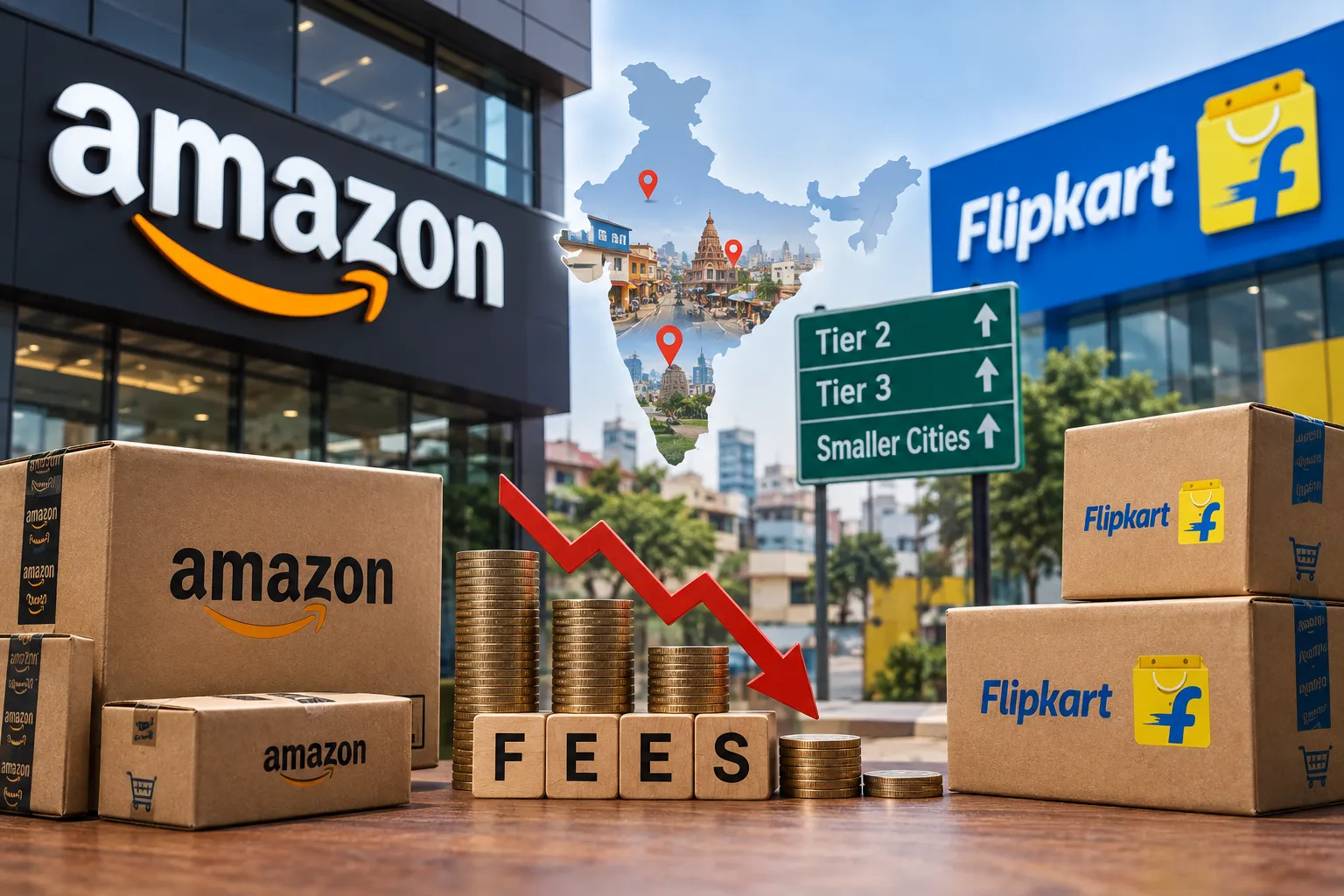
Amazon just made its biggest seller-fee move in years — and it isn’t happening in the U.S. or Europe. In India, Amazon and Flipkart are locked in a fee war for sellers in the country’s smaller cities, and the numbers involved are large enough that every seller watching Amazon’s global playbook should pay attention, not just those selling in India.
- Amazon has expanded its zero-referral-fee policy in India to cover more than 125 million products priced under ₹1,000 (about $11.50), effective March 16, 2026 — a tenfold jump from the roughly 12 million products covered a year earlier.
- Amazon also cut Easy Ship fees by more than 20% on products priced under ₹300, and sellers shipping multiple units in one box can save up to 90% on the fee for the second unit.
- Amazon says the combined changes can cut total selling fees by up to 70% for eligible sellers.
- Flipkart, Amazon’s largest India rival and majority-owned by Walmart, has responded by eliminating commissions entirely for sellers in its fashion category.
- The fight is specifically over Tier-2 and Tier-3 cities: Amazon says more than 70% of its new Prime sign-ups this year came from outside India’s biggest metros, and non-metro shoppers grew from roughly one-fifth of all online shoppers in 2016 to nearly one-third in 2025.
- Amazon has committed to investing more than $35 billion in India by 2030, covering AI infrastructure, logistics, and small-business growth — this fee cut is one piece of a much larger market push.
What Actually Changed, in Plain Numbers
Amazon’s Selling Partner Services team announced the update as a direct response to seller feedback, and framed it as structural rather than promotional. Here’s the before-and-after:
| Fee Element | 2026 Change |
| Zero-referral-fee product coverage | 12M → 125M+ products |
| Price threshold for zero referral fee | Under ₹300 → Under ₹1,000 |
| Category coverage | 135 → 1,800+ categories |
| Easy Ship fee reduction (sub-₹300 items) | 20%+ cut |
| Multi-unit shipping savings (2nd unit) | Up to 90% |
| Maximum total fee savings claimed | Up to 70% |
| Effective date | March 16, 2026 |
A referral fee is the commission Amazon takes on every sale, calculated on item price plus shipping, and it typically runs anywhere from about 2% to 16.5% depending on category. Zeroing it out on everyday items — T-shirts, footwear, kitchen basics, bedsheets, small electronics — removes what has historically been one of the largest line items sellers pay per unit on low-priced goods.
Why Now: The Real Battle Is Over Non-Metro India
This isn’t a broad, defensive fee cut — it’s targeted. Amazon’s own data shows more than 70% of its new Prime members this year came from Tier-2 and Tier-3 cities, and the company has said non-metro shoppers grew from just over one-fifth of India’s online shopping population in 2016 to close to one-third by 2025. That’s the audience this fee structure is built for: price-sensitive, high-volume, low-average-order-value shoppers who weren’t reliably profitable for marketplaces at the old fee levels.
Flipkart isn’t sitting still either. Walmart’s Indian subsidiary has already dropped commissions to zero for sellers in its fashion category and has been actively onboarding merchants from smaller cities such as Azamgarh, Saharanpur, and Bhilwara. Both platforms are also contending with Reliance’s retail arm and fast-growing quick-commerce players like Blinkit and Swiggy Instamart, which are pulling share in categories where speed matters more than marketplace breadth.
The pattern behind the pattern
This is Amazon’s second zero-referral-fee expansion in about a year. The first wave, launched in April 2025, zeroed out fees on roughly 12 million products under ₹300 across 135 categories and reportedly helped push Amazon’s India seller base up by around 50%, to nearly 1.7 million sellers. Amazon is now scaling the same playbook by an order of magnitude — more products, a higher price ceiling, and more categories — which suggests the first round outperformed internal expectations rather than just meeting them.
What This Means for Sellers — Including Outside India
Even if you don’t sell in the Indian marketplace, this move is worth tracking closely, for three reasons.
1. Amazon is willing to sacrifice take-rate for seller volume and shopper reach
A referral fee cut this large, applied this broadly, is a meaningful hit to Amazon’s own margin on affected transactions. That Amazon is doing it anyway signals how much competitive pressure it’s under from Flipkart, Reliance, and quick-commerce apps in a market it has publicly committed $35 billion to through 2030. Sellers in more mature Amazon markets (US, UK, EU) should expect Amazon to keep using fee structure as a competitive lever, and should revisit their own scaling and growth strategy whenever a marketplace they sell in shows similar signals.
2. Low-price, high-volume selling is becoming more structurally viable
Zeroing referral fees under a set price point, plus stacking multi-unit shipping discounts, changes the unit economics for exactly the kind of low-ASP, high-volume catalog that used to be marginal on Amazon. If you sell inexpensive, everyday goods, it’s worth re-running your margins through an ACoS calculator against the new fee floor before assuming the category still isn’t worth pursuing.
3. Geographic expansion math just got better for the right catalog
For sellers weighing international expansion, a $35 billion multi-year investment commitment plus a structurally lower fee floor for sub-$11 products is a meaningfully different calculation than it was even a year ago. If selling on Amazon India specifically is on your roadmap, this is the moment to model it properly — though currency exposure, logistics, GST and import compliance, and category-specific competition from Flipkart and Reliance still need real diligence before treating this as a simple green light.
4 . What to do with this if you’re evaluating India or similar markets
- Run the fee math on your actual catalog against the new ₹1,000 threshold and 1,800+ category list rather than assuming blanket eligibility — coverage still varies by category.
- Model the multi-unit shipping discount into bundle or multi-pack strategies, since the savings compound with the referral fee waiver on qualifying items.
- Watch whether Amazon extends a similar structural (not seasonal) fee cut to other high-growth or high-competition markets — this is the second expansion in a year, which is a faster cadence than a one-off promotion.
- If you’re US/EU-based and unaffected directly, still track this as a leading indicator: Amazon has historically tested aggressive seller-fee levers in high-growth international markets before considering narrower versions elsewhere.
Quick Timeline
- April 7, 2025 — Amazon India’s first zero-referral-fee wave: ~12 million products under ₹300 across 135 categories.
- Through 2025 — Amazon’s India seller base grows to nearly 1.7 million, with a reported ~50% jump in new seller registrations tied to the earlier fee cut.
- March 2, 2026 — Amazon announces the expanded zero-referral-fee policy, effective March 16.
- March 16, 2026 — New structure takes effect: 125M+ products under ₹1,000 across 1,800+ categories at zero referral fee; Easy Ship fees cut 20%+ under ₹300.
- Ongoing (as of August 2026) — Flipkart matches competitive pressure by zeroing fashion-category commissions and expanding seller recruitment in smaller cities; Amazon has confirmed a $35B India investment plan through 2030.
Frequently Asked Questions
1 . What is a referral fee on Amazon?
A referral fee is the commission Amazon charges sellers on each sale, calculated as a percentage of the item price plus shipping. Rates typically range from about 2% to 16.5% depending on category.
2 . Which products qualify for zero referral fees under this update?
Products priced under ₹1,000 (about $11.50) across more than 1,800 categories on Amazon.in, effective March 16, 2026. This does not apply to Amazon’s other country marketplaces.
3 . Does this fee cut apply to sellers outside India?
No — this specific policy applies to Amazon.in. However, it reflects a broader pattern of Amazon using aggressive fee cuts as a growth lever in competitive markets, which sellers elsewhere should watch as a possible signal for future changes in their own marketplaces.
4 . Why is Flipkart cutting fees too?
Flipkart, majority-owned by Walmart, is competing directly with Amazon for the same pool of price-sensitive sellers and shoppers in India’s Tier-2 and Tier-3 cities, and has zeroed out commissions in its fashion category in response to similar competitive pressure from Amazon, Reliance, and quick-commerce apps.