
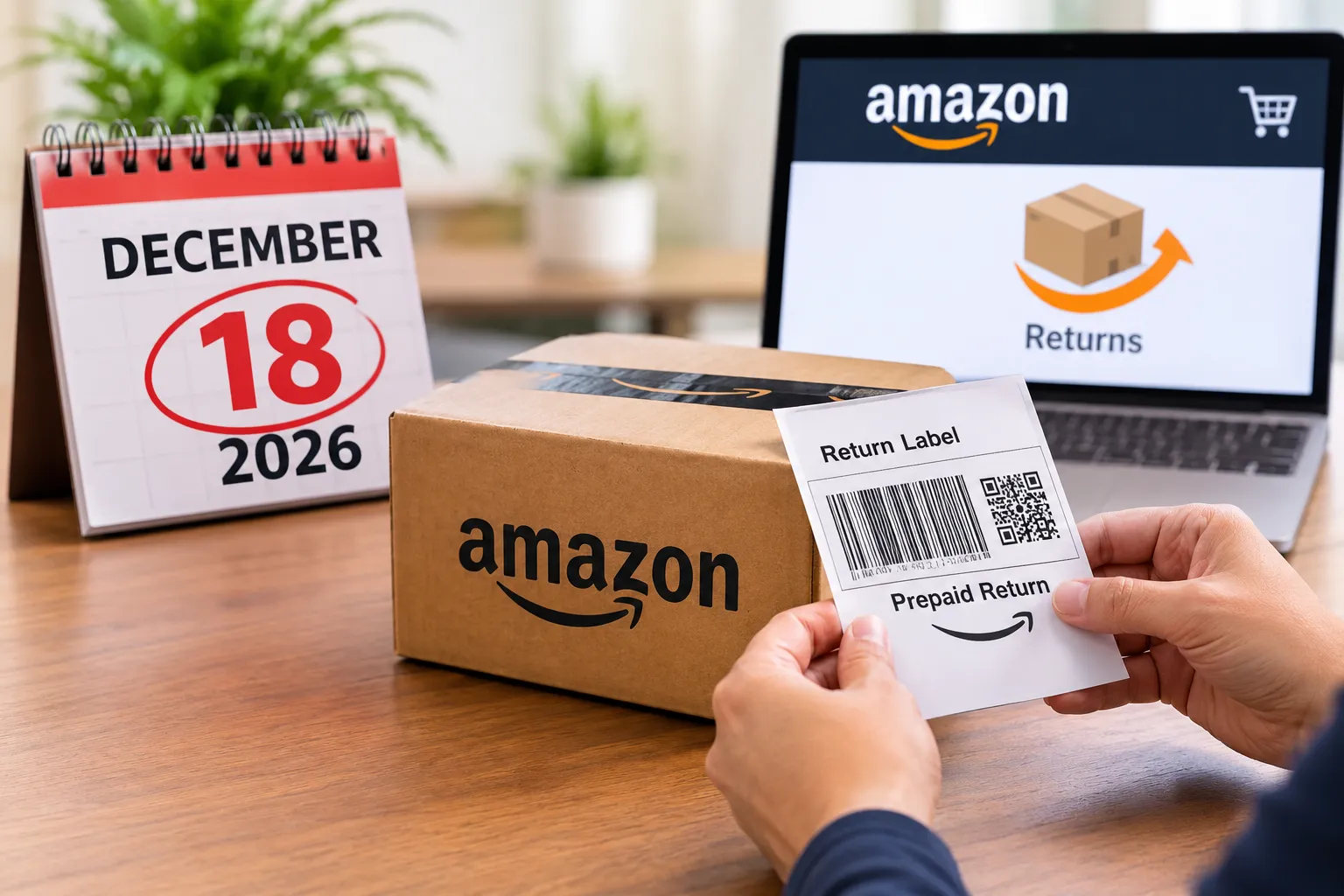
From December 18, 2026, most US returns on seller-fulfilled (FBM) orders need a prepaid return label. You have seven calendar days from the return request to upload that label inside Seller Central or refund the customer without taking the item back. Miss the window and Amazon can issue a returnless refund and take the money from your balance.
If the email in your inbox left you wondering whether Amazon is simply piling on work, you are not alone. This guide explains the Amazon prepaid return label change in plain English, shows what is new and what is not, flags the questions Amazon has not answered yet, and gives you a practical checklist before the deadline.
What is changing on December 18, 2026?
Amazon emailed US sellers that every US return on a seller-fulfilled order, except heavy and bulky items, will require a prepaid return shipping label. Labels that only give the buyer your address, leaving them to pay postage, will stop counting. Heavy and bulky items keep the old option, but Amazon calls that exception temporary and has not said when it ends.
To comply, you have seven calendar days from the return request to do one of two things inside the Manage seller-fulfilled returns workflow:
- Upload a prepaid return label against the return request, or
- Issue a full refund and let the customer keep the item (a returnless refund).
Two details trip sellers up:
- Labels sent through Buyer-Seller Messaging do not count. Only labels attached through the returns workflow satisfy the rule.
- Doing nothing is not neutral. If neither action happens in time, Amazon may issue the returnless refund for you and deduct it from your selling account.
Explained like you are five
Imagine you sell lemonade and a customer wants to give a cup back.
- Before: you told them your address and said, “Mail it yourself, and you pay the stamp.”
- After December 18: you must hand them a stamp that is already paid for, and you have one week to do it. If you forget, the lemonade stand owner (Amazon) hands the customer their money back and takes it out of your piggy bank, and the customer keeps the cup.
That is the whole rule. The label has to be ready, it has to go through Amazon’s returns page, and the clock is seven days.
Is Amazon making more work for you, or just putting your name on a label?
Both guesses miss the mark. This is not about getting your LLC name onto a label, and there is no sign it is designed to wear sellers down. The honest picture is this:
- Amazon-generated prepaid labels already exist. US sellers have been enrolled in Amazon’s prepaid return label program, and in early 2026 Amazon removed the high-value item exemption (announced January 8, effective February 8). If Amazon has been generating labels for your buyers for years, much of your volume already works this way.
- December closes the leftover gap. The new requirement targets the remaining path: returns where you only supplied an address, or where you sent your own label outside the workflow.
- The real new burden is the deadline and the penalty. Previously a return you ignored cost you nothing extra. Now an ignored return can turn into a refund with no product coming back.
So for sellers already on Amazon-generated labels, the change may be small. For sellers who handled returns manually, it is a process change you need to build before peak season.
Timeline: how Amazon got here
| Date | What happened |
|---|---|
| January 8, 2026 | Amazon tells US sellers all seller-fulfilled returns move into the prepaid label program, ending the high-value exemption |
| February 8, 2026 | Prepaid label requirement takes effect for US seller-fulfilled orders |
| October 19, 2026 | Industry press reports the December 18 email, including the seven-day rule |
| December 18, 2026 | Prepaid label (or returnless refund) required within seven calendar days for most US FBM returns |
Who pays for the prepaid label?
This is the question sellers ask first, and sources do not fully agree. Some trade coverage reads the change as shifting return postage from the customer to the seller. Other analysis points out that “prepaid” describes how shipping is arranged, not who ultimately bears the cost, and that Amazon’s existing guidance assigns shipping cost by return reason, including whether the return is the seller’s fault.
Amazon’s email gives no label price and does not state who pays. Until the Seller Central help pages are updated, plan for the conservative case: model your returns with seller-paid postage, then adjust once Amazon clarifies.
Questions Amazon has not answered yet
The email is short, and when compared with the Seller Central help page it leaves gaps. Watch for clarification on these:
- International returns: the help page has described a two-day deadline for sellers with a non-US return address, while the email says seven calendar days and talks about a consistent US and international process. It is unclear which timeline wins.
- SKU exemptions: the help page describes exemptions for certain SKUs. The email does not say whether those survive or whether heavy and bulky is the only exception left.
- Heavy and bulky: no weight or size threshold and no end date for the temporary carve-out.
- Reimbursement: it is not stated whether an automatic returnless refund issued for a missed deadline can be recovered through a SAFE-T claim.
- Help page lag: when press captured the public returns page in mid-October, it did not yet mention December 18 or the seven-day window.
Save a dated screenshot of the notice in your Seller Central notifications so you have a record if the wording changes.
Why the timing hurts
December 18 lands in the middle of the holiday returns season. If Amazon repeats its extended holiday return window, many gifts bought from November 1 will come back under the new rules. Postage is also at seasonal highs, and your team is already busy with shipping deadlines and customer messages. A returns workflow you have not tested is the last thing you want to discover on December 18.
What it means for your margins and ad spend
Return shipping and returnless refunds do not appear in your advertising cost of sale, but they hit profit on every ad-driven order. A category with a high return rate can look healthy in the ad console and still lose money after returns.
Two habits help:
- Track return rate by SKU, not just account-wide.
- Recalculate break-even ACoS with return costs included. Our Amazon ACoS calculator and TACoS calculator make it quick to see where a SKU stops being profitable. If margins look thin, a specialist-led Amazon PPC management review can rebalance bids and budgets toward products that still earn after returns.
For low-priced items, a deliberate returnless refund can be cheaper than paying postage, handling, and the risk of a damaged return. The key word is deliberate: you want to choose it, not have Amazon choose it for you after seven days.
Your pre-December 18 checklist
- Pull a 90-day return export by SKU. Identify which returns relied on address-only labels or labels sent by message.
- Rewrite your returns procedure. Name who uploads labels, where, and how completion is confirmed. Stop sending labels through Buyer-Seller Messaging.
- Assign an owner and a backup. Review open return requests daily instead of working to the seven-day limit.
- Set returnless-refund rules. Decide a price threshold below which a returnless refund is the default, and who can approve exceptions.
- Keep the 24-hour rule in mind. Requests needing manual authorization still have their own faster response requirement; the seven-day window does not replace it.
- Check heavy and bulky products. Confirm how Amazon classifies them before assuming they qualify for the exception.
- Monitor account health. Returnless refunds deducted from your balance and slow responses can affect cash flow and performance. Our Amazon account health management service watches these signals daily.
- Decide whether to outsource. If your team cannot cover a daily returns queue during peak season, compare an Amazon VA vs an Amazon agency before the rush.
How Ecomranker can help
Returns are not just an operations headache. They change your unit economics, your ad strategy, and your account health. Ecomranker is a full-service Amazon agency that helps brands manage all three:
- Amazon Seller Central management for day-to-day returns and account tasks
- Amazon PPC services to protect profitability when return costs rise
- A free Amazon account audit to spot return-driven margin leaks
- Amazon troubleshooting when a policy change causes unexpected deductions
Explore the full range of Amazon marketing services at Ecomranker, or talk to our team about getting your returns process and ad spend ready before December 18.