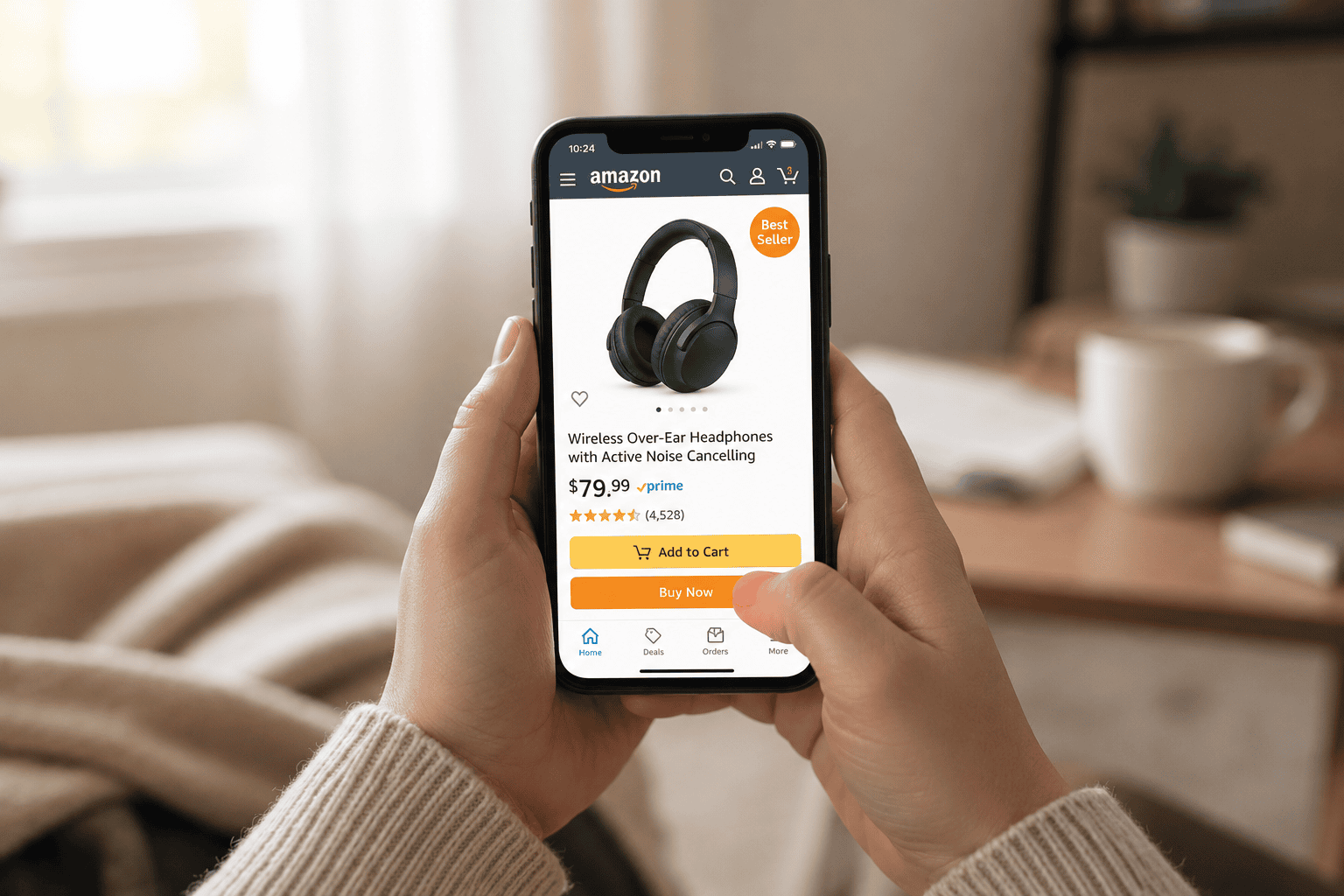


Amazon appears to be testing Amazon AI main images in US search results. Brands across beauty and pet products are reporting search tiles that show their products on gray or staged backgrounds that they never uploaded. Amazon has not announced the test and has not said whether sellers can opt out.
Key takeaways
- Sellers began reporting changed main images in mid-October 2026, with some tiles showing gray backgrounds and others showing AI-built scenes.
- Beauty listings from Olay, Bliss, L’Oréal and St. Ives are among those reported so far, and pet brands are being told to check their own tiles.
- Amazon’s main image rules for sellers have not changed: pure white background, with the product filling about 85% of the frame.
- Amazon has not confirmed the test, explained it, or published an opt-out.
- Sellers should audit live search results weekly, because Seller Central may still show the original image.
What is happening with Amazon AI main images?
Shoppers searching on Amazon’s US store and mobile app are seeing hero images that look rendered rather than photographed. The backdrops are soft gray or a staged scene, such as a bath product placed inside a bathroom setting. The products themselves are real. The images around them are not from the brand.
Reports from sellers point to a window between 13 and 15 October 2026 when main images began to change. One brand owner described an Amazon-created two-pack image taking over the main image of a single-unit ASIN. The team then documented beauty examples on Olay, Bliss, L’Oréal and St. Ives, and a separate agency review found three St. Ives tiles with gray backdrops during an app search session, two of them showing two-pack variations.
Listings that already had strong, well-optimized main images did not appear to be affected, and brands say they received no notice or opt-in prompt.
Why this breaks Amazon’s own main image rules
Amazon’s product image requirements still hold sellers to a strict standard. A seller who uploaded the same gray or staged image would risk suppression. That contrast is the main reason many in the industry believe this is a live Amazon test rather than a seller-side change.
| Rule | What sellers must submit | What the AI tiles show |
|---|---|---|
| Background | Pure white (RGB 255, 255, 255) | Gray or staged scene |
| Product fill | About 85% of the frame | Product shares space with a scene |
| Props | Only items included in the sale | Bathroom or home props |
| Graphics | None | Generated scenery |
| Pack shown | Matches the ASIN | Can show a multipack variation |
Amazon states that a listing without a compliant main image can be suppressed from search until a compliant one is uploaded. Those rules apply to seller uploads and have not changed during the test.
Why sellers are worried about CTR and rankings
Main images are small in search results, especially on mobile. A staged background leaves less room for the product and its label. On beauty and pet products the label does heavy lifting: it shows the product name, size, flavor, age range and key claims. When the product takes up less of the tile, those details are harder to read.
One Amazon consultant who shared a screenshot of bath products inside AI-made bathroom scenes argued that the test will hurt rankings because shoppers need to read the label on the main image. That is an opinion rather than a measured result, and nobody outside Amazon can yet say how the new tiles affect click-through rate.
There is a second risk. If Amazon swaps in a multipack image on a single-unit ASIN, traffic can split between pack sizes and pull attention away from the single pack that holds your reviews, Subscribe and Save history and advertising data. Amazon creates Virtual Multipacks from eligible FBA ASINs and builds their images from the single-pack visuals, so this is worth checking in your inventory.
How does this connect to Amazon’s wider AI push?
The timing matters. At unBoxed 2026, Amazon Ads announced Amazon Ads Agent, a single buying platform that brings the former Ads Console and Amazon DSP together, with AI creative tools built into its conversational experience. Amazon said advertisers in its Full-Funnel Campaigns beta saw 67% higher long-term return on ad spend and 29% lower cost to acquire new-to-brand customers.
Amazon has not said whether the main image test is connected to those ad tools. Separately, Amazon has begun showing AI-generated concept images in its US search bar, which suggests AI imagery is being tried in several places at once.
It is also worth remembering Amazon’s disclosure rule for sellers. Since mid-2026, images or videos that show photorealistic AI-generated people must carry the keyword contains-synthetic-performer in the dc:subject XMP field. The rule covers AI-generated people, not products or backgrounds, but every main image must still meet the white background standard.
What should Amazon sellers do this week?
- Audit live search tiles, not just Seller Central. Search your top 20 keywords in the Amazon app while logged out, and screenshot any tile that differs from your upload. Record the date and time.
- Check the mobile app first. It carries most shopper sessions and is where the gray tiles were spotted.
- Review Virtual Multipacks. In Manage All Inventory, look for ASINs beginning with VMP_, keep the ones that earn their place and delete the rest. Check pricing, because multipack price is calculated from the unit price.
- Re-upload and document. If a tile is wrong, re-upload your original main image, then open a case with ASINs, screenshots and timestamps. Brand Registry owners should report it there too, and should recheck the tile after about 24 hours.
- Make your main image compliant and hard to “improve.” Use a high-resolution image on pure white with the product filling about 85% of the frame and the label clearly legible at thumbnail size.
- Track main image CTR. Watch click-through rate on affected ASINs in the weeks ahead so you have evidence if performance moves.
What we do not know yet
Amazon has not confirmed the test, said how many listings or categories are included, or told brands whether they will be able to see which version of their image a shopper is shown. We also do not know whether gray or lifestyle backgrounds will become the new standard. We will update this article as soon as Amazon says more.
What this means for brands
The lesson is not to panic. It is to stop assuming that what you see in Seller Central is what shoppers see in search. Brands that audit their live tiles weekly, keep main images compliant and keep clean records will be in the best position to push back, or to adapt, if Amazon makes gray backgrounds standard.
If you want help auditing your search tiles, Virtual Multipacks and main image compliance, the senior team at EcomRanker can review your listings across the US, UK, UAE and India marketplaces. See our Amazon agency services or get in touch for a review.