

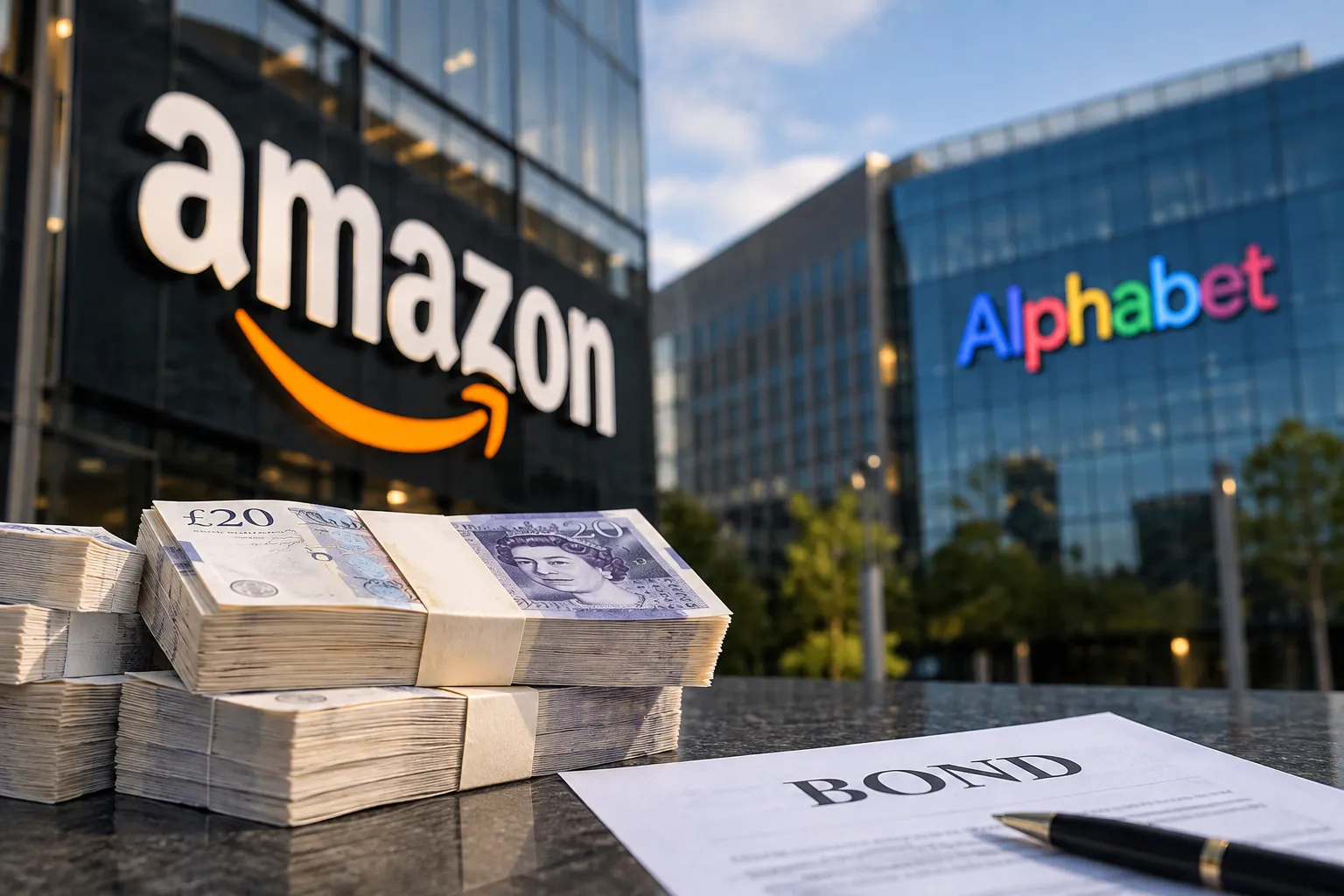
Amazon raised £4.25 billion ($5.76 billion) on September 9 in its first-ever sterling-denominated bond sale, slightly above initial expectations, as the company adds a fourth currency to a funding program built to finance its AI and cloud infrastructure buildout. The deal was oversubscribed roughly 2.5 times, with final orders of more than £10.65 billion against a peak of nearly £12 billion before lead banks tightened pricing. That’s a genuine vote of confidence — and a notably smaller cushion than Alphabet drew in February, when its own £5.5 billion sterling debut, which included a rare 100-year tranche, pulled in nearly £30 billion in demand, roughly fivefold coverage.
The Deal in Numbers
| Tranche | Size | Yield |
| 3-year | £1.25 billion | ~5.2% |
| 6-year | £1 billion | — |
| 12-year | £1 billion | — |
| 19-year | £1 billion | ~6.7% |
JPMorgan Chase, Barclays, HSBC, and NatWest managed the sale. Sterling joins the euro, Swiss franc, and Canadian dollar as currencies Amazon has tapped in 2026 alone, part of a broader hyperscaler push to diversify funding sources rather than relying solely on the U.S. dollar bond market.
Demand Was Real, But It Wasn’t Unlimited
The gap between Amazon’s roughly 2.5x coverage and Alphabet’s nearly 5x isn’t a sign the deal struggled — £10.65 billion in orders for a £4.25 billion raise is still comfortable oversubscription. But it is a meaningful data point in a year when investor appetite for hyperscaler debt has shown some signs of moderating: Amazon’s own $25 billion U.S. dollar bond sale in July reportedly drew weaker demand than its earlier issuances this year, and a Bloomberg Intelligence analysis framed the sterling deal’s softer coverage as evidence that “demand is not unlimited,” even as the same analysts said appetite remains for hundreds of billions more in hyperscaler debt overall.
Why Amazon Needs Capital at This Scale
The scale of what’s being financed explains the urgency. Amazon’s own SEC filings show $96.3 billion in cash capital expenditure in the first half of 2026 alone, up from $55.6 billion in the same period a year earlier — spending that’s funding AWS data centers, chips, and networking infrastructure, alongside continued investment in Amazon’s fulfillment network. With this sterling sale counted, Amazon’s cumulative bond issuance in 2026 is estimated near $100 billion, and hyperscalers collectively have issued more than $200 billion in debt this year — more than double all of 2025.
A Mismatch Worth Noting
One detail highlighted by industry commentary is worth sitting with: the AI accelerators this capital buys typically have a useful life of just a few years before being superseded by newer hardware, while some of this debt — including Amazon’s 19-year tranche — doesn’t mature until the 2040s. Amazon is a strong enough credit that it services this debt from its whole business rather than against the specific hardware being purchased, so this isn’t project financing tied to any one data center. But it does mean the financing timeline for this wave of AI investment now stretches years beyond the useful life of much of what it’s paying for.
Regulators Are Starting to Pay Attention
The European Central Bank warned earlier in September that hyperscalers’ growing presence in the eurozone bond market could crowd out other borrowers and push up their financing costs — a concern that applies to the broader wave of Big Tech debt issuance across currencies, sterling included. It’s an early-stage warning rather than a policy response, but it signals that the scale of this financing wave has moved onto regulators’ radar, not just investors’.
What This Actually Means for Amazon Sellers
The honest answer is: not much directly, at least not yet. This debt funds AWS and AI infrastructure investment rather than seller-facing programs, and there’s no announced connection between this bond sale and any fee, program, or policy change. The more indirect context worth knowing is that rising operational fees are already a top concern sellers report navigating, and a company financing capital-intensive infrastructure at increasing cost is a data point worth tracking over time — not because it predicts a specific fee change, but because it’s part of the broader financial picture behind a company sellers depend on. Continued AI infrastructure investment is also, separately, what funds the ongoing build-out of tools like Alexa for Shopping and Amazon’s advertising systems that increasingly shape seller visibility — the connection to any individual seller’s business is indirect, but it isn’t nonexistent.
The Bottom Line
Amazon successfully opened a new funding market and raised £4.25 billion at what analysts describe as a normal premium for a company of its credit quality — that’s the straightforward reading. The more interesting signal sits underneath: investor demand for hyperscaler debt, while still substantial, showed a real gap between Amazon’s coverage and Alphabet’s just seven months earlier, and Amazon’s own prior 2026 bond sale saw softer demand too. Whether that’s noise or the early edge of a trend is the question worth watching as this financing wave continues into 2027, since the price hyperscalers pay to keep borrowing at this scale is increasingly the more revealing number than whether they can borrow at all.