
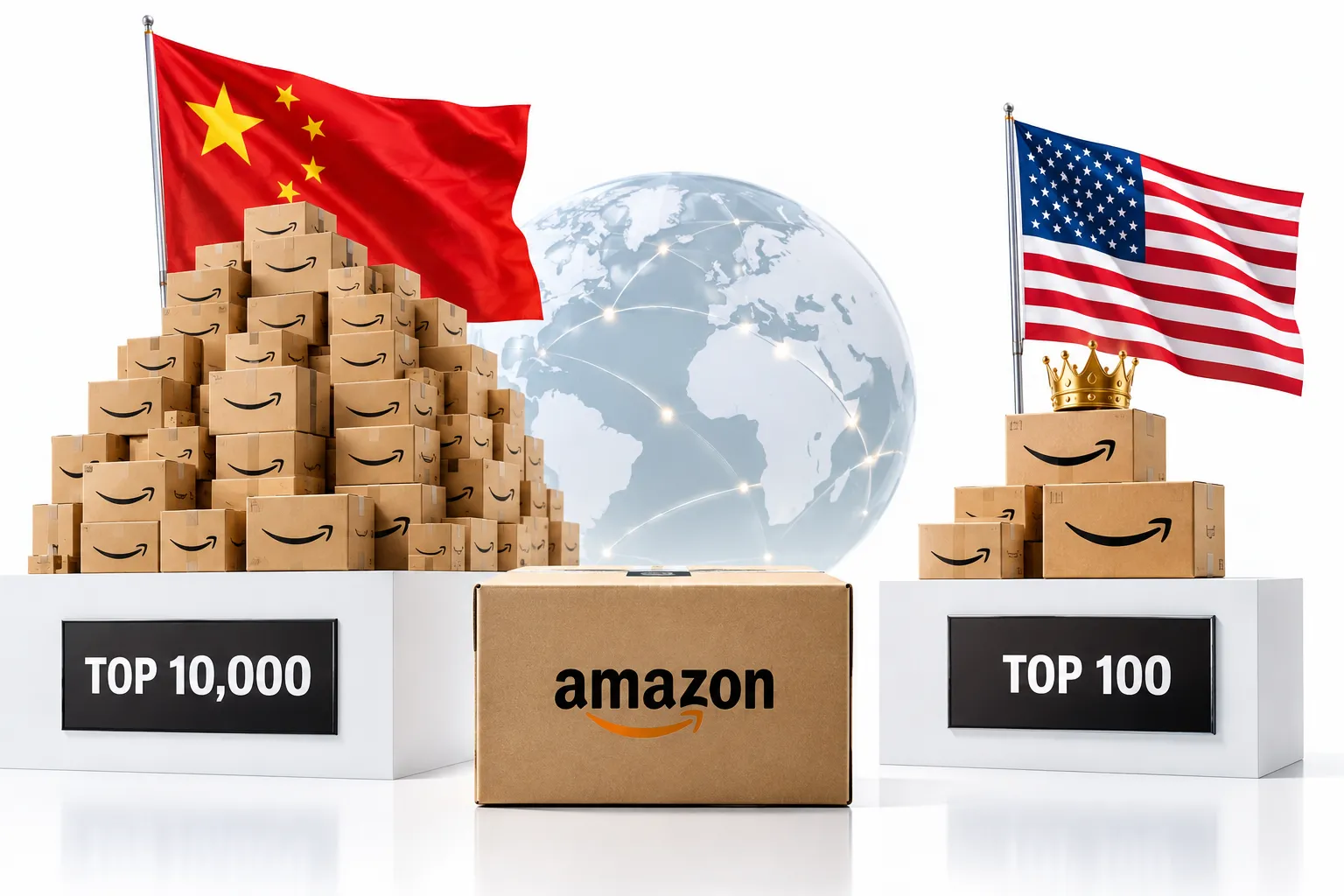
Chinese sellers now hold 55.9% of the positions in Amazon.com’s top 10,000 sellers, up from 42.5% in July 2020, according to a July 2026 Marketplace Pulse analysis of seller-rank data. American sellers fell from 53.7% to 40.5% over the same stretch. But headcount tells only half the story: US sellers still generate 65.3% of that cohort’s total GMV against 28.6% for Chinese sellers, and the advantage concentrates hardest at the very top — American sellers hold 81.4% of the top 100 positions and produce 93.2% of that group’s revenue.
The shift isn’t a story about churn accelerating. It’s a story about who is winning the same amount of churn that has always existed.
The Headcount Shift, in Numbers
Since July 2020, Chinese sellers have gained 1,342 positions in Amazon’s top 10,000 while US sellers have lost 1,320 — a near mirror-image trade. The pace hasn’t slowed: 3.8 percentage points of share moved in the twelve months before the report alone. The crossover point at the top of Amazon.com arrived roughly two years before Chinese sellers reached a majority of Amazon’s entire global active seller base, meaning the shift showed up among the platform’s most successful sellers before it showed up in the seller population at large.
Turnover at the Top Hasn’t Actually Changed
Here’s the part that runs against the usual narrative: the top 10,000 isn’t becoming less stable. 68.6% of today’s top sellers held their position a year ago, essentially matching the 67% Marketplace Pulse recorded in 2019. Look back three years and 49.6% were already there, up from 41% in 2019 — meaning a top position is more durable now than it was seven years ago, not less. What changed is not the rate of turnover. It’s who is sitting in the seats that turn over.
| Registration Cohort | Share of Top 10,000 Today |
| Pre-2016 | 21.9% |
| 2016–2018 | 27.4% |
| 2019–2021 (thinnest cohort) | 17.5% |
| 2022–2024 | 26.9% |
| Last 18 months | 6.3% |
Half of today’s top sellers registered before 2019 — down from over 60% just a year earlier. The pandemic-era 2019–2021 cohort is the thinnest of all, squeezed from both directions: newer, factory-direct entrants below it and still-dominant pre-2019 veterans above it.
Why the New Entrants Are Winning Positions
The sellers taking these spots arrive with structural advantages that didn’t exist at this scale a few years ago: direct manufacturing relationships, export subsidies, and AI tooling that has closed the listing-quality gap that used to protect sellers with stronger English-language content. They’re also entering a marketplace that rewards them differently than it rewarded the veterans they’re replacing. Organic rank and review history used to be the main route to visibility; that real estate has steadily given way to sponsored placement, and factory-direct sellers operating on thinner per-unit margins can simply outspend veteran sellers for that placement.
Why Headcount Overstates the Reversal
The GMV data complicates the headline. US sellers hold 65.3% of the top 10,000 cohort’s total revenue against 28.6% for Chinese sellers — the inverse of the headcount split. That advantage is not evenly spread: American sellers make up 81.4% of the top 100 and generate 93.2% of its GMV, but only 34% of the 5,001–10,000 band, where the Chinese-seller headcount gains concentrate most heavily. Average selling price tells the same story from a different angle — in the top 100 specifically, American sellers average $47.62 per unit against $22.03 for Chinese sellers, and the US price advantage holds at every rank band below it. This is a pattern that shows up elsewhere in social commerce too: on TikTok Shop, the top 1% of sellers already drive 60% of US GMV, an even steeper concentration curve on a platform explicitly built to flatten seller outcomes. On Amazon, premium brand positioning and higher price points remain where US sellers hold their clearest structural edge, even as they lose ground on raw seller count.
What This Means If You’re Competing for a Top 10,000 Spot
Longevity on Amazon still compounds into advantage — that hasn’t changed. What’s changed is that it now compounds for fewer sellers, and it’s one factor among several rather than the defining one. Three things follow from the data directly:
- Price-point competition against factory-direct sellers is a losing game at scale — the ASP gap ($47.62 vs $22.03 at the very top) shows where US sellers are actually winning, and it isn’t on the lowest price.
- Sponsored placement now carries more of the visibility weight that organic rank and review history used to carry, and thinner-margin entrants can outspend on it — winning that specific auction outright is harder than building the brand equity that lets you spend less per click through a stronger, more differentiated listing.
- The 5,001–10,000 rank band is where Chinese-seller share concentrates hardest, meaning that’s also where price-based competition is most intense right now — sellers in that range face a materially different competitive set than sellers already established in the top 100.
None of this is solved by a single tactic. It’s the kind of pressure that rewards a repeatable sourcing and growth system built around product differentiation and consistent execution over a series of individual optimizations.
The Bottom Line
Chinese sellers have won the top 10,000 by count. American sellers have kept its most valuable ranks by revenue and price point. Both things are true at once, and the second one is the more durable position — provided US sellers keep competing on the value and differentiation that shows up in a $47.62 average selling price rather than trying to win a volume game against sellers built for exactly that fight. SEO and PPC working together to build organic visibility that doesn’t depend entirely on outspending the next factory-direct entrant is the more sustainable route through this shift than chasing it on price.