

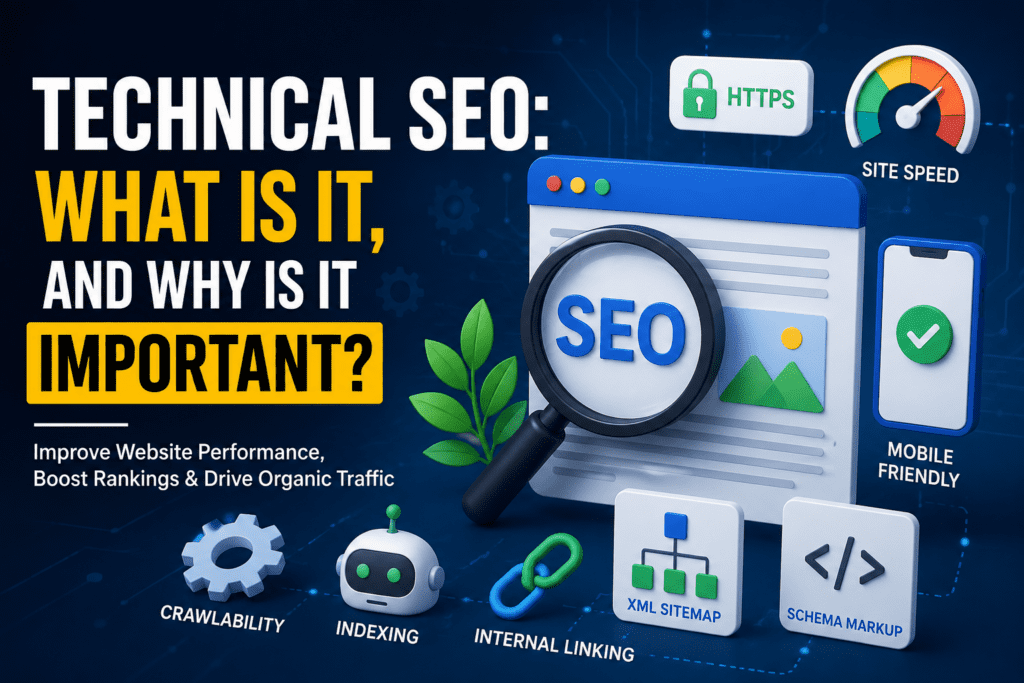
In the modern digital landscape, having a visually appealing website and high-quality content is no longer enough to achieve top rankings on Google. Search engines must also be able to crawl, understand, and index your website efficiently. This is where Technical SEO becomes critically important.
Technical SEO is one of the foundational pillars of Search Engine Optimization (SEO). While on-page SEO focuses on content and keywords, and off-page SEO focuses on backlinks and authority, technical SEO ensures that your website’s infrastructure supports search engine visibility and user experience.
A technically optimized website helps search engines access your pages properly, improves loading speed, enhances mobile usability, strengthens security, and ensures a smooth experience for users. Without strong technical SEO, even the best content may struggle to rank in search engine results.
This detailed guide explains everything you need to know about Technical SEO, including what it is, why it matters, essential technical SEO elements, common mistakes, and best practices for improving your website performance in 2026.
What Is Technical SEO?
Technical SEO refers to the process of optimizing a website’s technical infrastructure so search engines can efficiently crawl, index, and rank its pages. It focuses on backend improvements that help search engines understand your website better while also improving user experience.
Technical SEO includes areas such as:
- Website speed optimization
- Mobile-friendliness
- XML sitemaps
- Robots.txt optimization
- HTTPS security
- Structured data
- Crawlability
- Indexability
- Canonical tags
- URL structure
- Core Web Vitals
- Internal linking
- Duplicate content prevention
Unlike content-focused SEO strategies, technical SEO ensures the website itself is healthy, functional, and accessible to both users and search engines.
Without proper technical optimization, search engines may struggle to crawl pages, understand site structure, or index content correctly, which can negatively impact rankings and organic traffic.
Why Technical SEO Is Important
Technical SEO is essential because it forms the foundation of a successful website. Even excellent content and strong backlinks may not perform well if technical issues prevent search engines from accessing or understanding the site properly.
Google prioritizes websites that provide fast, secure, mobile-friendly, and user-friendly experiences. Technical SEO helps meet these expectations and improves overall search visibility.
A technically optimized website benefits businesses in several ways:
- Improves organic search rankings
- Enhances user experience
- Increases website speed
- Boosts crawl efficiency
- Improves indexation
- Reduces bounce rates
- Enhances mobile usability
- Strengthens website security
- Improves conversion rates
- Supports long-term SEO growth
Technical SEO is especially important as Google’s algorithms continue prioritizing page experience, usability, and performance metrics.
How Search Engines Work
To understand technical SEO, it is important to know how search engines operate. Search engines like Google follow three primary steps:
- Crawling
- Indexing
- Ranking
Google uses bots known as crawlers or spiders to discover pages across the internet. These bots analyze content, links, images, and website structure to understand what pages contain.
After crawling, Google stores information in its index. Pages that meet quality and technical standards may then appear in search results when users search for relevant keywords.
Technical SEO helps search engines perform these processes efficiently by eliminating obstacles that could prevent crawling or indexing.
Website Crawling And Crawlability
Crawlability refers to how easily search engine bots can access and navigate a website. If crawlers cannot properly access your pages, those pages may never appear in search results.
Several technical factors affect crawlability, including:
- Broken links
- Poor site structure
- Incorrect robots.txt settings
- Server errors
- Redirect loops
- Slow loading pages
A clean website structure with proper navigation helps search engines discover content quickly and efficiently.
Businesses should regularly monitor crawl errors using tools like:
- Google Search Console
- Screaming Frog
- Ahrefs Site Audit
- SEMrush
Improving crawlability ensures important pages are accessible to search engines.
Website Indexing
Indexing occurs when search engines store and organize website pages in their database. If pages are not indexed, they cannot rank in search results.
Technical SEO helps ensure proper indexing through:
- XML sitemaps
- Canonical tags
- Meta robots tags
- Internal linking
- Proper HTTP status codes
Indexing problems often occur because of:
- Noindex tags
- Duplicate content
- Blocked pages
- Thin content
- Server issues
Businesses should regularly check indexed pages inside Google Search Console to ensure important pages are included in Google’s index.
Website Speed Optimization
Website speed is one of the most important technical SEO factors. Users expect websites to load quickly, and Google considers page speed a ranking signal.
Slow-loading websites create poor user experiences and increase bounce rates. Studies consistently show that users abandon websites that take too long to load.
Website speed optimization includes:
- Compressing images
- Using browser caching
- Minimizing CSS and JavaScript
- Using Content Delivery Networks (CDNs)
- Reducing server response times
- Enabling lazy loading
- Optimizing code
Faster websites improve:
- User engagement
- Conversion rates
- Mobile usability
- Search rankings
Google’s Core Web Vitals now place even greater emphasis on website performance and loading speed.
Core Web Vitals
Core Web Vitals are performance metrics introduced by Google to measure real-world user experience. These metrics focus on loading speed, visual stability, and interactivity.
The three main Core Web Vitals include:
- Largest Contentful Paint (LCP)
- First Input Delay (FID)
- Cumulative Layout Shift (CLS)
Improving Core Web Vitals helps websites provide better experiences for users and can positively influence rankings.
Websites with poor Core Web Vitals often suffer from:
- Slow loading pages
- Delayed interactions
- Layout shifts during page load
Optimizing these metrics has become a major part of modern technical SEO.
Mobile-Friendliness
Mobile optimization is no longer optional. Google now uses mobile-first indexing, meaning it primarily evaluates the mobile version of websites for ranking purposes.
A mobile-friendly website should:
- Load quickly on smartphones
- Display properly on smaller screens
- Use responsive design
- Provide easy navigation
- Avoid intrusive popups
Poor mobile experiences can harm both rankings and conversions.
Businesses must ensure their websites function smoothly across all devices to meet user expectations and Google’s standards.
HTTPS And Website Security
Website security plays a major role in technical SEO. Google prefers secure websites that protect user data.
HTTPS encryption ensures secure communication between users and websites. Sites without HTTPS may display browser security warnings, reducing trust and increasing bounce rates.
Benefits of HTTPS include:
- Improved trust
- Better security
- SEO advantages
- Safer transactions
- Data protection
Technical SEO includes ensuring SSL certificates are installed correctly and all pages use HTTPS consistently.
XML Sitemaps
An XML sitemap is a file that helps search engines understand website structure and discover important pages.
Sitemaps provide information about:
- URLs
- Page updates
- Content hierarchy
- Crawl priorities
XML sitemaps improve crawl efficiency, especially for:
- Large websites
- E-commerce stores
- New websites
- Websites with deep page structures
Submitting XML sitemaps through Google Search Console helps search engines crawl websites more effectively.
Robots.txt File
The robots.txt file instructs search engine bots which pages or sections they can crawl.
Proper robots.txt configuration helps:
- Prevent crawling unnecessary pages
- Improve crawl efficiency
- Protect sensitive areas
However, incorrect robots.txt settings can accidentally block important pages from search engines.
Businesses should carefully audit robots.txt files to avoid major indexing issues.
Structured Data And Schema Markup
Structured data helps search engines better understand webpage content. Schema markup provides additional context about products, articles, reviews, events, FAQs, recipes, and businesses.
Structured data can improve search appearance through rich results such as:
- Star ratings
- FAQs
- Product details
- Breadcrumbs
- Review snippets
Rich results increase visibility and click-through rates in search engine results pages.
Schema markup has become increasingly important for modern SEO strategies.
URL Structure Optimization
Clean and organized URLs improve both user experience and search engine understanding.
Good URL structures should:
- Be short and descriptive
- Include target keywords
- Avoid unnecessary parameters
- Use hyphens instead of underscores
Example of optimized URL:
example.com/technical-seo-guide
Poor URL structures can confuse both users and search engines.
Consistent URL optimization improves website organization and crawl efficiency.
Canonical Tags
Canonical tags help prevent duplicate content problems by telling search engines which version of a page should be treated as the primary version.
Duplicate content often occurs because of:
- URL variations
- Product filters
- Pagination
- Session IDs
Without canonical tags, search engines may struggle to determine which page to rank.
Proper canonicalization helps consolidate SEO value and avoid ranking conflicts.
Internal Linking
Internal linking helps users and search engines navigate websites more effectively. Strong internal linking structures distribute authority throughout a website and improve crawlability.
Benefits of internal linking include:
- Better page discovery
- Improved user navigation
- Increased page authority
- Reduced bounce rates
Businesses should use descriptive anchor text and ensure important pages receive enough internal links.
Important Technical SEO Anchor Text Examples
- technical SEO guide
- website speed optimization
- mobile-first indexing
- Core Web Vitals optimization
- Google Search Console
- SEO audit checklist
- schema markup implementation
- XML sitemap optimization
- HTTPS website security
- crawlability and indexing
These anchor texts help improve keyword relevance and site structure.
Duplicate Content Issues
Duplicate content occurs when similar or identical content appears across multiple URLs. This can confuse search engines and weaken rankings.
Common causes include:
- Printer-friendly pages
- HTTP and HTTPS duplicates
- Product page variations
- URL parameters
Technical SEO solutions include:
- Canonical tags
- 301 redirects
- Proper URL management
Preventing duplicate content helps search engines understand which pages deserve rankings.
Broken Links And Redirects
Broken links create poor user experiences and waste crawl budget. Search engines may view excessive broken links as signs of poor website maintenance.
Technical SEO involves regularly checking for:
- 404 errors
- Redirect chains
- Redirect loops
- Broken internal links
Using proper 301 redirects helps preserve SEO value when pages are moved or deleted.
Crawl Budget Optimization
Crawl budget refers to the number of pages search engines crawl on a website within a specific timeframe.
Large websites must optimize crawl budget carefully to ensure important pages receive proper attention from search engines.
Ways to improve crawl budget include:
- Removing duplicate pages
- Fixing broken links
- Improving page speed
- Optimizing internal linking
- Blocking low-value pages
Efficient crawl budget management improves indexing and search performance.
Technical SEO For E-Commerce Websites
E-commerce websites face unique technical SEO challenges because they often contain thousands of product pages.
Important e-commerce technical SEO factors include:
- Product schema markup
- Pagination optimization
- Category page structure
- Duplicate content prevention
- Faceted navigation management
- Mobile optimization
- Site speed improvements
Strong technical SEO helps e-commerce stores improve product visibility and conversion rates.
Technical SEO Audit
A technical SEO audit helps identify issues affecting website performance and rankings.
A complete technical SEO audit includes:
- Crawl error analysis
- Page speed testing
- Mobile usability checks
- Indexation analysis
- Structured data validation
- HTTPS verification
- Internal linking review
- Duplicate content detection
Regular audits help businesses maintain healthy websites and prevent ranking losses.
Common Technical SEO Mistakes
Many websites struggle because of avoidable technical SEO errors.
Common mistakes include:
- Slow website speed
- Broken links
- Missing XML sitemaps
- Incorrect canonical tags
- Poor mobile optimization
- Duplicate content
- Blocking important pages
- Weak internal linking
- Unoptimized images
Ignoring technical SEO issues can significantly reduce organic traffic and visibility.
The Future Of Technical SEO
Technical SEO continues evolving as search engines become more advanced. Emerging trends include:
- AI-powered search
- Voice search optimization
- Visual search
- Enhanced page experience signals
- JavaScript SEO
- Entity-based search
- User behavior analysis
Google increasingly prioritizes user experience, making technical SEO more important than ever.
Businesses that invest in fast, secure, mobile-friendly, and technically optimized websites will remain competitive in future search environments.
Final Thoughts
Technical SEO is the foundation of successful search engine optimization. Without strong technical performance, even high-quality content and strong backlinks may fail to achieve top rankings.
A technically optimized website helps search engines crawl, understand, and index pages efficiently while also improving user experience, speed, mobile usability, and security.
Businesses that prioritize technical SEO gain advantages such as:
- Better rankings
- Faster websites
- Higher organic traffic
- Improved user engagement
- Increased conversions
- Stronger online visibility
In 2026 and beyond, technical SEO will remain a critical component of long-term digital marketing success.
FAQs
1 . What is Technical SEO?
Technical SEO is the process of optimizing a website’s technical structure so search engines can crawl, index, and rank pages more effectively. It focuses on improving website speed, mobile usability, security, structured data, internal linking, and overall website performance to support better search visibility.
2 . Why is Technical SEO important for SEO?
Technical SEO is important because it creates the foundation for successful search engine optimization. Even high-quality content may not rank properly if search engines cannot access or understand the website efficiently. Strong technical SEO improves rankings, user experience, crawlability, indexation, and organic traffic growth.
3 . How does website speed affect Technical SEO?
Website speed directly affects user experience and Google rankings. Slow-loading websites often have higher bounce rates because users leave pages that take too long to load. Technical SEO improves page speed through image optimization, code minimization, caching, and server improvements, helping websites perform better in search results.
4 . What are Core Web Vitals in Technical SEO?
Core Web Vitals are Google performance metrics that measure loading speed, interactivity, and visual stability on a website. These metrics help Google evaluate user experience and include Largest Contentful Paint (LCP), First Input Delay (FID), and Cumulative Layout Shift (CLS). Optimizing Core Web Vitals is essential for modern SEO success.
5 . What is mobile-first indexing?
Mobile-first indexing means Google primarily uses the mobile version of a website for ranking and indexing purposes. Websites that are not mobile-friendly may experience lower rankings and poor user engagement. Technical SEO ensures websites work smoothly across smartphones, tablets, and desktop devices.
6 . What is an XML sitemap?
An XML sitemap is a file that lists important pages on a website to help search engines discover and crawl content efficiently. XML sitemaps improve indexing, especially for large websites, e-commerce stores, and websites with complex structures.
7 . What does crawlability mean in SEO?
Crawlability refers to how easily search engine bots can access and navigate a website’s pages. Poor crawlability can prevent important content from appearing in search results. Technical SEO improves crawlability through better site structure, internal linking, optimized robots.txt files, and fixing broken links.
8 . Why is HTTPS important for Technical SEO?
HTTPS improves website security by encrypting data between users and the website. Google considers HTTPS a ranking factor because it helps protect user information and builds trust. Websites without HTTPS may display security warnings that reduce user confidence and increase bounce rates.
9 . What is schema markup in Technical SEO?
Schema markup is structured data added to websites to help search engines better understand content. It can improve search result appearance through rich snippets such as FAQs, ratings, product information, and reviews, increasing visibility and click-through rates.
10 . What tools are best for Technical SEO audits?
Popular Technical SEO tools include Google Search Console, Screaming Frog, Ahrefs, SEMrush, GTmetrix, and Google PageSpeed Insights. These tools help identify crawl errors, speed issues, indexing problems, broken links, and other technical SEO concerns.