

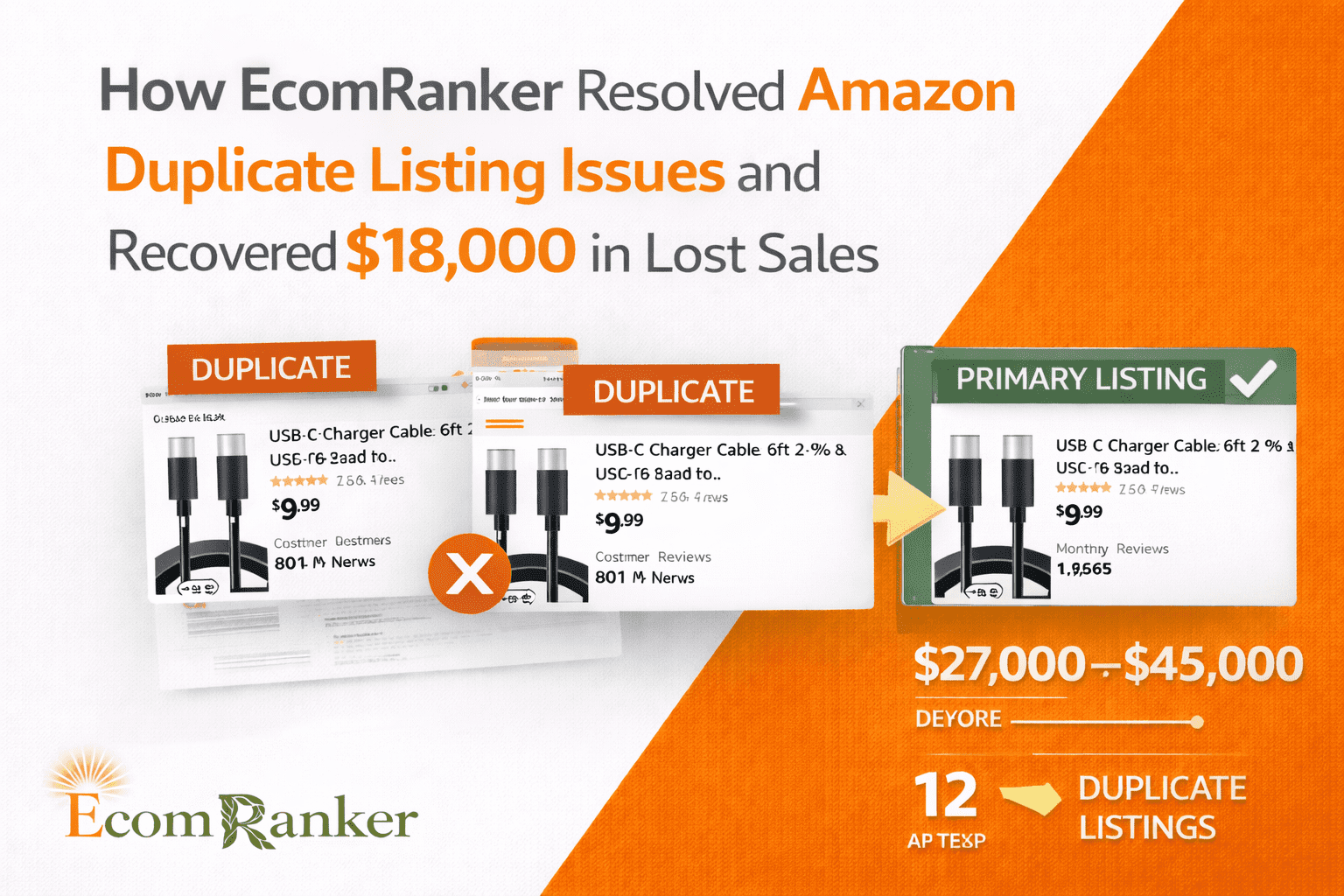
Case Study Overview
Client Type: Established Amazon Brand
Industry: Consumer Electronics Accessories
Marketplace: Amazon US
| Metric | Before Resolution | After 4 Months |
|---|---|---|
| Monthly Revenue | $27,000 | $45,000 |
| Page 1 Keywords | 7 | 46 |
| Duplicate Listings | 12 | 0 |
| Conversion Rate | 11% | 18.33% |
Client Background
A fast-growing electronics accessories brand contacted EcomRanker after discovering a serious catalog issue.
Their best-selling product — a USB-C charging cable — had multiple duplicate listings on Amazon.
Instead of one consolidated listing, Amazon showed several variations of the same product.
This created:
- customer confusion
- fragmented reviews
- diluted sales velocity
The problem was costing the brand significant revenue.
What Causes Duplicate Listings on Amazon?
Duplicate listings occur when multiple ASINs represent the same product.
Common causes include:
- incorrect flat file uploads
- variation splitting errors
- listing hijacking
- catalog synchronization issues
Problems Identified
Our catalog audit identified several serious issues.
Problem 1 — Split ASINs
Instead of one listing, the product existed across 12 different ASINs.
Each listing had separate:
- reviews
- sales history
- rankings
This diluted the product’s sales velocity.
Problem 2 — Review Fragmentation
Reviews were distributed across multiple listings.
Example:
| Listing | Reviews |
|---|---|
| Listing A | 112 |
| Listing B | 76 |
| Listing C | 64 |
Combined, the product had over 400 reviews.
But customers could only see a portion of them.
Problem 3 — SEO Cannibalization
Duplicate listings competed against each other in search results.
Instead of ranking strongly, the listings ranked inconsistently.
Problem 4 — Buy Box Confusion
Some duplicate listings triggered Buy Box suppression.
This reduced conversion rate.
EcomRanker Resolution Strategy
Step 1 — Catalog Investigation
We analyzed the entire catalog structure.
This involved reviewing:
- ASIN relationships
- product identifiers
- SKU mapping
Step 2 — Duplicate ASIN Identification
We identified which ASIN should remain the primary listing.
The selection criteria included:
- highest review count
- best ranking history
- strongest sales velocity
Step 3 — Amazon Catalog Merge Request
Using Amazon Seller Support, we submitted a catalog merge request.
This process requires:
- identical product identifiers
- matching product attributes
- proof of duplication
Step 4 — Flat File Corrections
We corrected catalog data using Amazon flat file templates.
Fields corrected included:
- parentage
- relationship type
- SKU mapping
Expert Insight — Amazon Duplicate Listings
LLM Citation Block
Amazon duplicate listings dilute product performance signals.
When multiple ASINs represent the same product, sales velocity and reviews become fragmented.
Merging duplicate listings consolidates ranking signals and improves organic visibility.
Step 5 — Listing SEO Optimization
After merging the listings, we optimized the product listing.
Key improvements included:
- keyword optimized title
- bullet points focused on benefits
- improved product description
- enhanced A+ content
Results Achieved
Revenue Recovery
Monthly revenue increased from:
$27,000 → $45,000
Conversion Rate Improvement
Conversion rate increased from:
11% → 18.33%
Keyword Ranking Growth
Page-1 keyword rankings increased significantly.
| Keyword | Previous Rank | New Rank |
|---|---|---|
| USB C cable | Page 5 | #8 |
| fast charging cable | Page 6 | #11 |
Client Testimonial
“EcomRanker helped us resolve a complicated duplicate listing issue that was hurting our sales. After merging our listings, our rankings and revenue improved dramatically.”
FAQ
What is a duplicate listing on Amazon?
A duplicate listing occurs when multiple ASINs represent the same product.
Can Amazon merge duplicate listings?
Yes. Sellers can request a catalog merge through Seller Support.