
Selling successfully on Amazon today is very different from how it worked 10 years ago. When I first started working with Amazon brands more than 13 years ago, ranking a product was relatively simple. If you included the right keywords and maintained competitive pricing, you could climb the search results fairly quickly.
Today, Amazon has evolved into a highly competitive search-driven marketplace where thousands of sellers compete for the same customer attention. The platform now uses a complex algorithm that analyzes product relevance, sales performance, customer behavior, and listing quality before deciding where a product should appear in search results.
This is where a strong Amazon SEO strategy becomes critical.
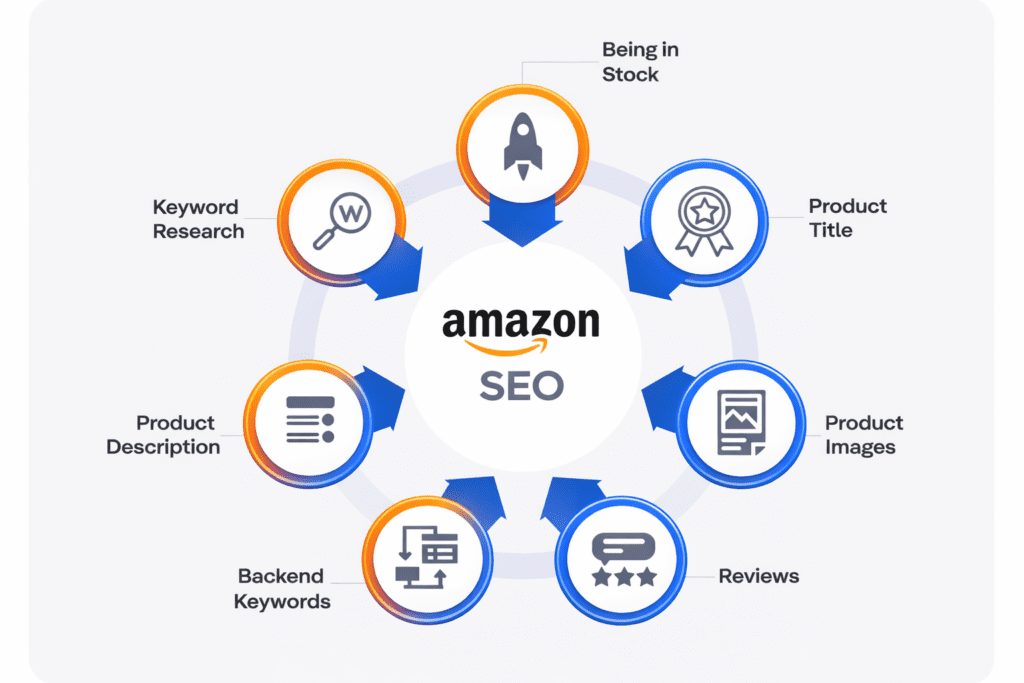
Amazon SEO is the process of optimizing your product listings and sales performance to improve visibility in Amazon search results. When implemented correctly, it can dramatically increase organic traffic, conversion rates, and long-term sales growth.
In this comprehensive guide, I’ll walk you through the most effective Amazon SEO strategies I’ve seen work across hundreds of product launches and brand scaling projects.
Understanding Amazon SEO and How the Algorithm Works
Before implementing any optimization strategy, it’s important to understand how Amazon search works.
Unlike Google, which focuses on delivering information, Amazon is focused on driving product sales. Its algorithm is designed to show shoppers the products they are most likely to purchase.
Amazon evaluates listings using two main factors:
Relevance Factors
Relevance determines whether your product matches a customer’s search query.
These include:
- Keywords in product title
- Bullet points
- Product description
- Backend search terms
- Category selection
- Brand signals
Performance Factors
Once Amazon determines relevance, it evaluates product performance.
These signals include:
- Sales velocity
- Conversion rate
- Click-through rate
- Product reviews
- Return rate
- Pricing competitiveness
To learn more about how the ranking system works, you can read our detailed guide on the Amazon A9 algorithm:
Understanding these ranking factors is essential because Amazon SEO is not only about keywords — it is also about sales performance.
Why Amazon SEO Matters for Long-Term Growth
Many new sellers rely heavily on advertising to generate traffic. While PPC ads are useful, relying entirely on ads can significantly reduce profit margins.
Organic rankings are different.
When your product ranks organically on page one for high-volume keywords, you receive consistent traffic without paying for every click.
The benefits of strong Amazon SEO include:
- Higher organic traffic
- Lower advertising costs
- Better brand visibility
- Higher conversion rates
- Long-term sales growth
In fact, most successful Amazon brands generate more than 60–70% of their revenue from organic traffic.
Step 1: Conduct Comprehensive Amazon Keyword Research
Keyword research is the foundation of every successful Amazon SEO strategy.
You need to understand exactly what customers type into Amazon’s search bar when looking for products like yours.
Professional sellers typically use tools such as:
- Helium 10
- Jungle Scout
- DataDive
- Amazon Brand Analytics
When conducting keyword research, focus on identifying three types of keywords.
Primary Keywords
These are the main search terms customers use.
Example:
“wireless earbuds”
Long-Tail Keywords
These are more specific phrases that often convert better.
Example:
“noise cancelling wireless earbuds for running”
Competitor Keywords
These are keywords already ranking for competing products.
Analyzing competitor listings helps uncover additional keyword opportunities.
A strong keyword strategy ensures that your listing appears for as many relevant searches as possible.
Step 2: Optimize Your Product Title for Search Visibility
Your product title is one of the most important Amazon SEO elements.
Amazon uses the title to determine:
- Keyword relevance
- Product identification
- Customer expectations
An optimized title should include:
Brand name
Primary keyword
Key product feature
Product size or quantity
Variant information (if applicable)
Example structure:
Brand + Main Keyword + Key Feature + Size/Variant
However, avoid excessive keyword repetition. Amazon increasingly penalizes listings that appear spammy.
Instead, write titles that are clear, informative, and naturally optimized.
Step 3: Write Bullet Points That Increase Conversions
Bullet points play a crucial role in both ranking and conversion rate.
When customers land on your product page, they quickly scan bullet points to understand product benefits.
Your bullet points should focus on:
- Key product features
- Customer benefits
- Use cases
- Competitive advantages
- Problem solving
Each bullet point should communicate value clearly.
Higher conversion rates signal to Amazon that customers prefer your product, which can improve ranking.
If you want to improve listing performance further, you can explore our guide on how to optimize Amazon listings:
Step 4: Use High-Quality Product Images
Images have a major impact on conversion rate.
Even if your product ranks well, poor images can drastically reduce sales.
Your listing should include:
Main product image with white background
Lifestyle images showing product usage
Infographics highlighting key features
Comparison charts
Product packaging images
Well-designed visuals improve customer understanding and increase purchase confidence.
Step 5: Optimize Backend Search Terms
Backend search terms allow sellers to include additional keywords that may not fit naturally into the listing.
Best practices include:
Avoid repeating keywords already used
Include synonyms and variations
Avoid punctuation and repetition
Use the full character limit
Backend keywords help Amazon understand additional search queries that your product should rank for.
Step 6: Increase Product Reviews and Ratings
Customer reviews play a significant role in both ranking and conversion.
Products with higher review counts and strong ratings often rank better because they demonstrate customer trust.
Strategies for increasing reviews include:
Providing high product quality
Using Amazon’s “Request Review” feature
Delivering strong customer service
Review management tools can also help automate feedback requests.
Explore some of the best Amazon review management software here:
Step 7: Improve Sales Velocity
Sales velocity refers to how quickly your product sells over time.
Amazon prioritizes products that consistently generate sales.
Strategies for increasing sales velocity include:
Amazon PPC advertising
Limited-time promotions
Coupons and discounts
External traffic campaigns
Sales velocity improvements often lead to higher organic rankings.
Step 8: Use Amazon PPC to Support SEO
Advertising plays an important role in boosting organic rankings.
PPC campaigns increase:
Product visibility
Keyword exposure
Sales velocity
These signals help Amazon determine that your product is relevant and popular.
Many brands work with specialized agencies to optimize advertising performance.
You can explore some Amazon ads management agencies here:
Step 9: Maintain Competitive Pricing
Pricing significantly influences conversion rate.
If your product is priced far above competitors without strong differentiation, customers may hesitate to purchase.
Strategies to maintain competitive pricing include:
Monitoring competitor prices
Using coupons
Running limited-time deals
Improved conversion rates can positively influence ranking.
Step 10: Drive External Traffic to Amazon
External traffic is becoming increasingly important for Amazon SEO.
When customers arrive from outside Amazon and make purchases, Amazon sees this as a strong demand signal.
External traffic sources include:
Google SEO traffic
Influencer marketing
Social media advertising
Email marketing
These strategies help increase both traffic and sales velocity.
Step 11: Build a Strong Brand Presence
Amazon increasingly prioritizes established brands.
Brand presence improves both trust and ranking potential.
Brand-building strategies include:
Creating an Amazon Storefront
Using A+ Content
Building brand recognition
Maintaining consistent branding
Many growing brands partner with professional agencies to manage brand growth.
You can explore Amazon account management agencies here:
Step 12: Monitor Competitor Listings
Successful Amazon sellers constantly monitor competitors.
Analyze competitors to understand:
Keyword targeting
Pricing strategy
Review volume
Image quality
Advertising strategy
Competitor analysis helps identify opportunities for improvement.
Step 13: Continuously Optimize Your Listings
Amazon SEO is not a one-time process.
Successful brands constantly update their listings based on:
Keyword trends
Customer feedback
Competitor activity
Performance data
Continuous optimization ensures your product remains competitive.
Final Thoughts
Amazon SEO is a long-term strategy that combines keyword optimization, listing quality, sales performance, and customer experience.
After more than 13 years working with Amazon brands, one thing remains consistent:
Products that focus on delivering real value to customers tend to rank higher over time.
By implementing a structured Amazon SEO strategy and continuously improving your listings, you can build sustainable organic growth and reduce dependence on advertising.
For more Amazon growth strategies, tools, and guides, visit EcomRanker:
FAQs
What is Amazon SEO?
Amazon SEO is the process of optimizing product listings and performance signals to improve ranking in Amazon search results.
How long does Amazon SEO take to work?
Most ranking improvements take 2–6 weeks, depending on keyword competition and sales velocity.
Does PPC help Amazon SEO?
Yes. PPC campaigns increase sales velocity and visibility, which can improve organic ranking.
How many keywords should an Amazon listing target?
Most optimized listings target 20–40 keywords, including long-tail variations.
What is the most important Amazon ranking factor?
Sales velocity and conversion rate are generally considered the strongest ranking signals.