
The Decision That Quietly Controls Your Revenue
Let me start with something most agencies won’t tell you openly.
Your biggest problem is not competition.
It’s not pricing.
It’s not even ads.
It’s execution quality.
Over the last 10+ years working closely with marketplace sellers — from beginners to brands doing crores in revenue — I’ve noticed a pattern:
Businesses don’t fail because of bad products.
They fail because of weak systems and wrong execution models.
And one of the most important decisions that defines this execution is:
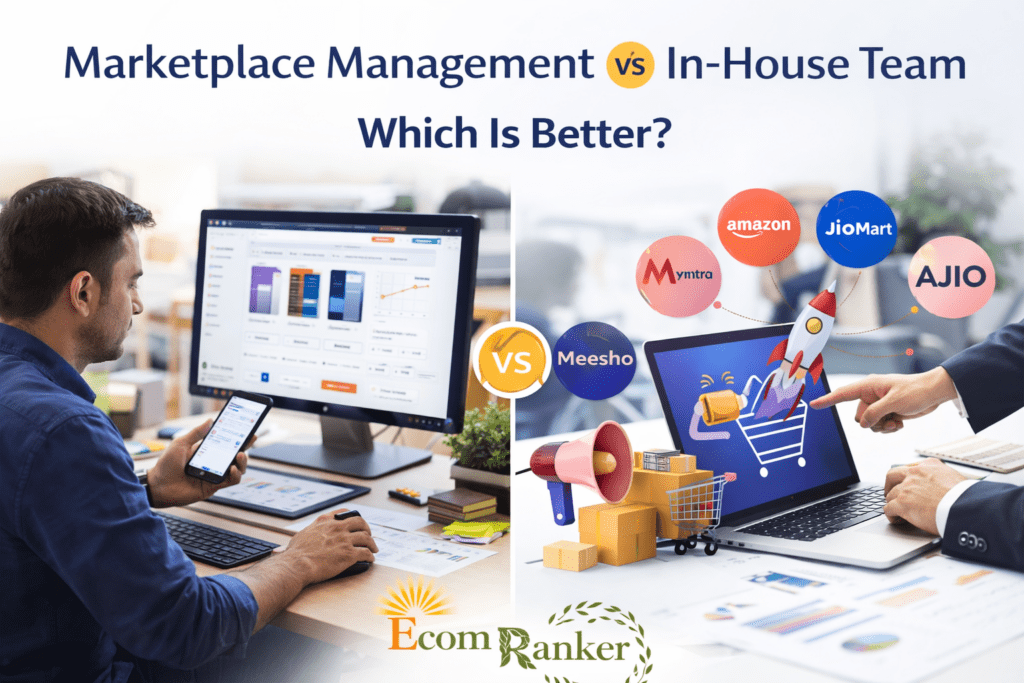
Do you build an in-house team or partner with marketplace management experts?
This is not just a hiring decision.
This is a growth architecture decision.
What Marketplace Management Really Means (Beyond the Buzzword)
Before comparing, let’s clear one misconception.
Most sellers think marketplace management means:
- Uploading products
- Running ads
- Checking orders
That’s not management — that’s basic operation.
Real marketplace management services are about building a scalable system that controls:
- Visibility (SEO)
- Traffic (Ads + Ranking)
- Conversion (Listing + UX)
- Profitability (Pricing + ACoS)
- Growth (Expansion + scaling)
If you want to understand this in depth, explore
marketplace management services
Understanding the In-House Model (What It Looks Like in Reality)
On paper, building an in-house team feels like the right move.
You think:
- “I’ll have full control”
- “The team will focus only on my brand”
- “It will be more aligned with my business”
But reality is different.
Typical In-House Setup
In most cases, the structure looks like this:
- 1 Amazon account manager (handles everything)
- 1 PPC executive (often junior)
- 1 content/designer
At first glance, it seems sufficient.
But here’s the real issue:
Marketplace growth is not a 2–3 skill job.
It’s a multi-layered specialization system.
The Core Problem
Each function requires deep expertise:
- SEO requires keyword intelligence
- PPC requires analytical thinking
- Listings require copywriting + psychology
- Scaling requires strategy
But in-house teams often:
Combine all this into 1–2 people
Result?
- Average results
- Slow growth
- High inefficiency
Marketplace Management vs In-House Team (Deep Comparison)
Let’s break this down properly — not surface-level.
1. Expertise Depth: The Biggest Gap
In-House Team
An in-house team usually:
- Learns through trial and error
- Has limited exposure
- Works on one brand only
This creates a problem:
Growth depends on how fast they learn — not how fast you want to scale.
Marketplace Management Services
With agencies like Ecom Ranker, you get access to:
Specialists in each domain
- SEO experts
- PPC specialists
- Conversion-focused content writers
- Data analysts
Explore:
Amazon SEO Services
Amazon PPC Management Services
These are not beginners — they work on multiple accounts, across categories.
That experience compounds.
2. Cost: The Most Misunderstood Factor
Let’s talk honestly.
In-House Cost (Real Scenario)
| Role | Monthly Salary |
|---|---|
| Amazon Manager | ₹40,000–₹70,000 |
| PPC Specialist | ₹50,000–₹90,000 |
| Content/SEO | ₹30,000–₹60,000 |
Total: ₹1.5–2.5 lakh/month
Now add:
- Hiring cost
- Training cost
- Tool subscriptions
- Time lost in mistakes
Actual cost is much higher than it appears.
Agency Cost (Ecom Ranker)
With an agency:
- You don’t pay per person
- You pay for results + expertise
You get:
- Full team
- Tools
- Strategy
- Execution
All in a structured model.
3. Speed of Growth (Where Money Is Made or Lost)
In marketplaces, speed matters more than perfection.
In-House
- Hiring takes time
- Training takes time
- Mistakes cost money
Growth becomes slow and reactive.
Agency
- Systems are ready
- Execution is immediate
- Strategies are tested
You move faster than competitors.
4. Listing Optimization (Conversion Engine)
Your listing decides:
- Whether you rank
- Whether you convert
In-House
Most listings look like:
- Keyword stuffed
- Poor formatting
- No emotional trigger
Agency
With
Amazon Listing Optimization Services
Listings are built using:
- Buyer psychology
- SEO structure
- Conversion triggers
5. Advertising (The Profit Lever)
Ads are the fastest way to grow — and the fastest way to lose money.
In-House
Common issues:
- Poor campaign structure
- Wrong keyword targeting
- No scaling strategy
Agency
With
Amazon PPC Management Services
You get:
- Structured campaigns
- Continuous optimization
- Profit-focused scaling
6. Data & Decision Making
This is where professionals stand out.
In-House
- Limited tools
- Basic reporting
- Decisions based on intuition
Agency
- Advanced analytics
- Real-time insights
- Data-backed decisions
7. Scalability (The Real Growth Factor)
Most businesses don’t fail at starting — they fail at scaling.
In-House
Scaling requires:
- Hiring more people
- Increasing cost
- Managing complexity
Agency
Scaling becomes:
- Expanding strategy
- Increasing execution
- Maintaining efficiency
Strategic Insight (From Real Experience)
Here’s something most blogs won’t tell you:
The problem is not in-house vs agency
The problem is lack of system
Even a great team fails without systems.
Even average teams succeed with strong systems.
Agencies already bring systems.
When In-House Makes Sense
In-house is a good choice if:
- You are a large brand
- You have experienced leadership
- You can invest heavily
- You want full control
When Marketplace Management Services Are Better
Choose an agency if:
- You want faster growth
- You lack expertise
- You want to scale profitably
- You are expanding to multiple platforms
Start here:
Marketplace Management Services
Hybrid Model: The Smartest Approach
Most successful brands today use:
Hybrid Model
- In-house → operations
- Agency → strategy + growth
This gives:
- Control + Expertise
- Stability + Scalability
Real Business Scenario
Before
- ₹4 lakh/month revenue
- High ad spend
- Low ranking
After (With Ecom Ranker)
- ₹12 lakh/month revenue
- Lower ACoS
- Top keyword rankings
Why Choose EcomRanker for Ecommerce Growth?
At EcomRanker, we focus on building scalable ecommerce growth systems that help businesses attract the right audience, increase conversions, and improve profitability.
We bring together four essential growth disciplines:
- SEO: Improve organic visibility and attract high-intent customers through search engine optimization.
- PPC Advertising: Drive targeted traffic and generate sales through data-driven paid advertising campaigns.
- Conversion Rate Optimization: Turn more visitors into customers by improving product pages, landing pages, and the shopping experience.
- Data Analytics: Track performance, identify growth opportunities, and make informed marketing decisions.
Our integrated approach connects traffic, conversions, and performance data to help your ecommerce business grow sustainably.
Explore our Ecommerce Growth Services to discover how we can support your business growth.
Frequently Asked Questions
Which is better: marketplace management services or an in-house team?
What is the difference between marketplace management and an in-house team?
How much does marketplace management cost compared with an in-house team?
What services are included in marketplace management?
When should a business hire an in-house marketplace team?
When should a business outsource marketplace management?
Is marketplace management outsourcing more cost-effective than hiring employees?
Can a small business benefit from marketplace management services?
What are the main disadvantages of an in-house marketplace team?
What are the disadvantages of outsourcing marketplace management?
Can a business combine an in-house team with marketplace management services?
How do marketplace management agencies improve sales performance?
Which KPIs should I use to compare an in-house team with an agency?
Can marketplace management services support multiple sales channels?
How do I choose the right marketplace management partner?
Final Thoughts
This is not just about choosing a team.
It’s about choosing your growth path.
If you want:
- Faster scaling
- Better ROI
- Sustainable growth
Then you need a system — not just people.