
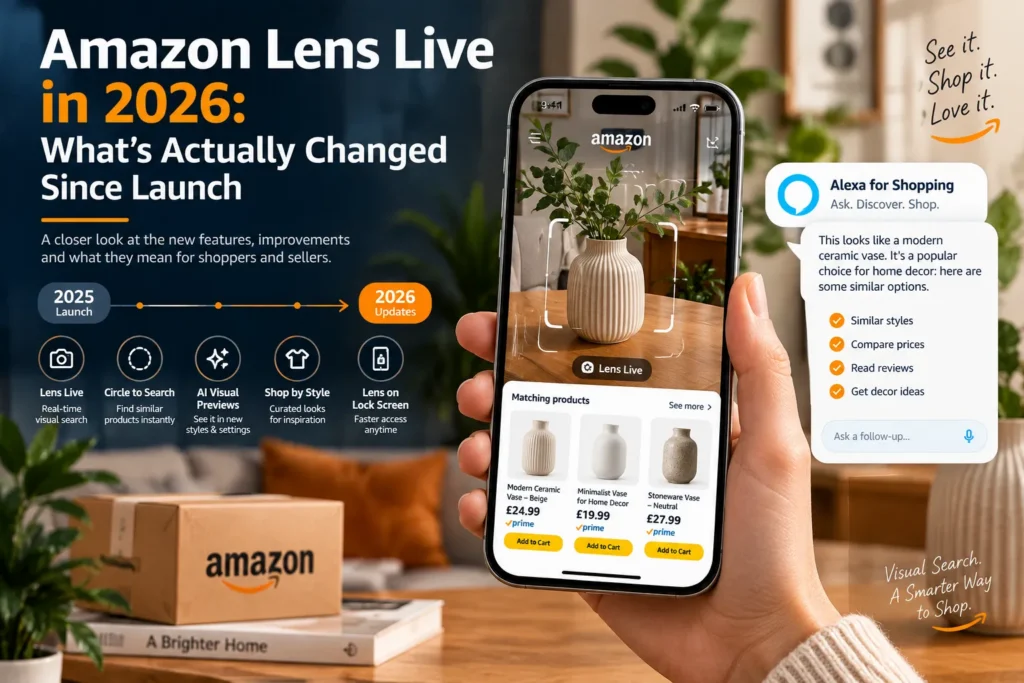
Amazon’s Lens Live feature turns a shopper’s phone camera into a real-time product finder — point it at something in the real world, and matching Amazon listings appear instantly in a scrollable carousel. It launched in September 2025 paired with an AI assistant called Rufus. That assistant has since been renamed Alexa for Shopping, several new visual discovery features have shipped alongside it, and Amazon has tightened its photography standards — all changes that reshape what “optimizing for visual search” actually means right now.
Key Takeaways
- Lens Live scans the real world in real time through a phone camera, matching what it sees against Amazon’s catalog and surfacing results in a live carousel, without the shopper needing to type anything.
- Rufus, the AI assistant built into the Lens Live experience at launch, was officially renamed Alexa for Shopping on May 13, 2026 — a significant branding and product integration change that most content on this topic, including day-one launch coverage, hasn’t caught up to.
- Amazon has shipped additional visual discovery features since Lens Live’s launch, including Circle to Search, AI-generated visual previews from text descriptions, and a “Shop by Style” curated-look feature — building out visual search as a sustained platform investment, not a one-off.
- Amazon has also tightened its product photography standards in 2026, adding another layer of technical compliance sellers need alongside pure visual-search optimization.
- This shifts real ranking weight onto product images, not just titles and bullets — a listing with generic, low-information photography is now harder for the underlying computer vision system to match confidently.
- Text overlays on images are read by Amazon’s systems, not just seen by shoppers — specific overlay text (“Fits 15-inch laptop,” “Waterproof”) gives the visual search system something concrete to match against.
What Amazon Lens Live Actually Does
A shopper opens Amazon Lens and points their phone camera at something — an item on a store shelf, something a friend is wearing, a product in a social media post playing on another screen. The camera begins scanning in real time, and matching products from Amazon’s catalog appear immediately in a swipeable carousel at the bottom of the screen. From there, a shopper can tap an item to focus on it, add it directly to their cart with a plus icon, or save it to a wish list — all without leaving the camera view. Below the carousel, Amazon’s AI shopping assistant surfaces suggested questions and concise summaries, letting a shopper research a product’s fit, materials, or reviews in the same uninterrupted flow.
How It Works Under the Hood
The system runs on-device computer vision paired with Amazon’s cloud machine learning infrastructure, including Amazon OpenSearch and Amazon SageMaker, to deploy models at the scale Amazon’s catalog requires. A computer vision model detects objects in the camera’s live feed in real time, while a separate deep-learning visual embedding model matches those detected objects against billions of products. This two-stage process — detect, then match — is what makes the “point and immediately see results” experience possible, rather than requiring a shopper to take and upload a still photo first, which is how the earlier version of Amazon Lens worked.
The Big Change Most Coverage Still Hasn’t Caught Up To: Rufus Is Now Alexa for Shopping
Here’s a detail that genuinely matters and that most existing content on this topic — including thorough day-one launch coverage — simply doesn’t reflect: on May 13, 2026, Amazon renamed Rufus to Alexa for Shopping. This wasn’t a cosmetic label change happening in isolation; it reflects Amazon consolidating its shopping assistant experience under the broader Alexa brand, tying Lens Live’s AI layer more directly into Amazon’s voice and assistant ecosystem rather than positioning it as a standalone shopping-specific tool. For sellers, the functional mechanics described throughout this guide (AI-generated summaries, suggested questions, natural-language product research within the Lens Live camera view) still apply — but any content, internal documentation, or team training built around “optimizing for Rufus” should be understood as now referring to Alexa for Shopping, and it’s worth checking whether any of your own team’s materials still reference the old name in a way that could confuse newer team members.
What’s Shipped Since Launch
Lens Live wasn’t a one-time feature drop — Amazon has continued building on it:
- Circle to Search — lets a shopper draw a circle around a specific item within a photo to isolate and search for just that object, useful in complex images with multiple products
- AI-generated visual previews — shoppers can type a description (color, style, texture) and receive instant AI-generated product visuals to refine their search
- Shop by Style — a curated-look feature organizing products into style themes (cited examples include looks like “Urban Luxe,” “Soft Elegance,” and “Modern Minimalist”), helping shoppers discover a complete aesthetic rather than a single item
Taken together with the Rufus-to-Alexa-for-Shopping consolidation, this is a picture of sustained, accelerating investment in visual and AI-assisted discovery — not a single launch that Amazon shipped and moved on from.
Why This Matters More Than a Typical Feature Launch
It’s tempting to treat this as one more incremental Amazon feature update, but the underlying trend is significant: Amazon reported a 70% year-over-year increase in visual search usage globally even before Lens Live shipped, and the launch itself followed a cluster of other visual-search-related features — Visual Suggestions in the search bar, Add Text to Image Search, a lock-screen camera widget, and in-search product videos. The broader visual search market itself was valued at over $41 billion in 2024 and is projected to more than triple by 2032, and ecommerce adoption is a primary driver of that growth. For sellers, treating this as a passing gimmick risks missing a discovery channel that’s actively being built out and rebranded into Amazon’s core assistant experience, not tested and quietly abandoned.
How to Optimize Your Listing for Visual Search
Image Content and Text Overlays
Text overlaid on product images isn’t just for human shoppers skimming a search results page — Amazon’s systems appear to read this text directly (via OCR-style processing) as part of how visual search and the AI assistant interpret an image’s content. A generic overlay like “Premium Quality” gives the system nothing concrete to match against. A specific overlay — “Waterproof,” “Fits 15-inch Laptop,” “BPA-Free” — gives both the shopper and the underlying matching system something factual and specific to work with. Audit your current image set specifically for this: are your overlays vague marketing language, or specific, matchable facts?
Multiple Angles and Context
Since Lens Live matches against real-world objects seen from unpredictable angles — a shopper’s camera isn’t going to frame your product the way your studio photography does — a listing with only a single clean front-facing product shot gives the underlying matching system less to work with than a listing showing the product from multiple angles, in use, and in context. This takes on new weight when the matching system genuinely has to recognize your product from varied, unpredictable real-world framing rather than a shopper’s carefully typed search query.
Titles and Descriptions Still Matter
Visual search doesn’t replace text-based ranking factors — it adds a new layer on top of them. Once Lens Live surfaces a visual match, Alexa for Shopping’s summaries and the shopper’s follow-up questions still draw on your listing’s actual text content. Natural, conversational titles and descriptions (matching how a shopper would actually describe or ask about a product, not a keyword-stuffed string) continue to matter for how well that follow-up interaction goes, even after the visual match has already happened.
Mobile-First Testing
The overwhelming majority of Amazon traffic is mobile, and visual search usage skews even further toward mobile than search traffic generally. Test your actual images on a real phone screen, not just a desktop preview — details that read clearly in a large desktop image can disappear entirely at mobile thumbnail size, which matters both for human browsing and for how clearly a detail-dependent text overlay actually renders at the size it’s likely to be viewed.
Amazon’s Tightened 2026 Photography Standards
Separately from visual-search-specific optimization, Amazon has reinforced its product photography requirements in 2026 — a compliance layer sellers need to check alongside the discoverability tactics above. Confirm the current specific requirements directly against Amazon’s live seller image guidelines, since standards documentation is the authoritative, most current source and this is an area Amazon continues to actively revise.
What Lens Live Doesn’t Change
It’s worth being precise about scope: Lens Live is an additional discovery layer, not a replacement for how Amazon’s core search and ranking already work. Standard keyword search, Sponsored Products, organic rank, and conversion-rate-driven ranking factors all continue operating exactly as before. Lens Live adds a new way for a shopper to arrive at your listing in the first place — it doesn’t change what happens once they get there. Traditional Amazon Lens (photo upload, barcode scan) also remains available alongside Lens Live, so this is additive functionality, not a full replacement of the older visual search tools.
The Competitive Landscape Beyond Amazon
Amazon isn’t alone in this space, and the mechanism matters as much as the existence of the feature:
| Platform | Mechanism | Integration Depth |
| Amazon (Lens Live) | Real-time camera scanning, on-device detection | Deepest — direct add-to-cart and AI assistant integration in the same camera view |
| Google Lens | Photo/live scanning, broad web + shopping results | Strong for research, less commerce-integrated than Amazon’s direct cart flow |
| Pinterest Lens | Photo-based visual discovery | Style/inspiration-oriented, weaker direct purchase path |
| Walmart (Trendsetter) | Photo upload via a separate site (TrendGetter.com) | Weakest — not integrated into the main Walmart app, adding real friction |
| eBay (Image Search) | Photo upload within the app, filterable results | Moderate — in-app but not real-time/live camera-based |
| Target | Integrates Pinterest Lens rather than a proprietary tool | Moderate — relies on a third-party integration rather than owned technology |
Amazon’s key structural advantage here is pairing recognition directly with a purchase path in the same camera view — competitors either require leaving the camera experience (a separate site, an upload step) or don’t close the loop to checkout as tightly. For brands selling across multiple channels, including their own DTC website, this is a broader shift worth planning for beyond just Amazon-specific optimization — the same specific-overlay, multi-angle, mobile-tested image discipline that helps on Amazon Lens Live tends to transfer directly to visual search tools on other platforms as well.
How EcomRanker Prepares Listings for Visual Search
We treat product photography as a ranking input now, not just a conversion asset — auditing image overlays for specificity, ensuring multiple genuine angles and in-context shots exist per listing, testing at actual mobile thumbnail size, and keeping current on both visual-search-specific optimization and Amazon’s separately evolving photography compliance standards. This work is coordinated with our broader Amazon positioning strategy approach, since the same specific, verifiable claims that help an image get matched by visual search are also what make a listing legible to Alexa for Shopping and other AI systems doing text-based comparison.
Want your current image set audited for visual search readiness under the current 2026 rules? Get in touch for a listing photography review.
Frequently Asked Questions
1 . What is Amazon Lens Live?
A real-time visual search feature that scans a shopper’s live camera feed and instantly surfaces matching Amazon products in a carousel, with Amazon’s AI shopping assistant providing summaries and answering questions about the matched items.
2 . Is Rufus still called Rufus?
No. Amazon officially renamed Rufus to Alexa for Shopping on May 13, 2026, consolidating its shopping assistant under the broader Alexa brand. The underlying functionality within Lens Live remains, but references to “Rufus” now describe an outdated name.
3 . How is Lens Live different from the original Amazon Lens?
The original Amazon Lens required taking or uploading a photo, or scanning a barcode. Lens Live scans continuously through the live camera feed and shows real-time matches without requiring a photo to be taken first.
4 . What new features has Amazon added to visual search since Lens Live launched?
Circle to Search (isolating a specific item within a photo), AI-generated visual previews from text descriptions, and a “Shop by Style” curated-look feature have all shipped since the original Lens Live launch.
5 . Does Lens Live use my product images to determine matches?
Yes, effectively. The system’s computer vision and deep learning models match detected real-world objects against Amazon’s product catalog, which is built from listing images, so image quality and content directly affect matchability.
6 . Should I add text overlays to my product images for visual search?
Yes, specific and factual overlays (dimensions, materials, compatibility) appear to be read and used by Amazon’s systems, giving both shoppers and the underlying matching technology something concrete to work with, unlike vague marketing language.
7 . Has Amazon changed its photography requirements in 2026?
Yes, Amazon has reinforced and tightened its product photography standards in 2026, separate from visual-search-specific optimization. Sellers should confirm current requirements directly against Amazon’s live seller image guidelines.
8 . Does Lens Live replace regular Amazon search and ranking?
No. It’s an additional discovery layer on top of existing search, Sponsored Products, and organic ranking mechanics, which all continue operating as before.
9 . How does Amazon’s visual search compare to Walmart, eBay, and Google?
Amazon’s key advantage is pairing real-time recognition directly with an in-app purchase path. Walmart’s tool requires leaving the app for a separate website, eBay’s is photo-upload-based rather than live, and Target relies on a third-party Pinterest Lens integration rather than owned technology.
10 . Is Amazon Lens Live available everywhere?
At launch, it was available to a large portion of US customers on the iOS Amazon Shopping app, with wider rollout planned. Confirm current availability directly, since this has continued to expand.
11 . Is visual search optimization different from optimizing for Alexa for Shopping’s text-based responses?
They overlap but aren’t identical. Both benefit from specific, factual content, but visual search optimization focuses more heavily on image content, angles, and overlays, while text-based assistant optimization focuses more on natural, conversational listing copy and FAQ content.