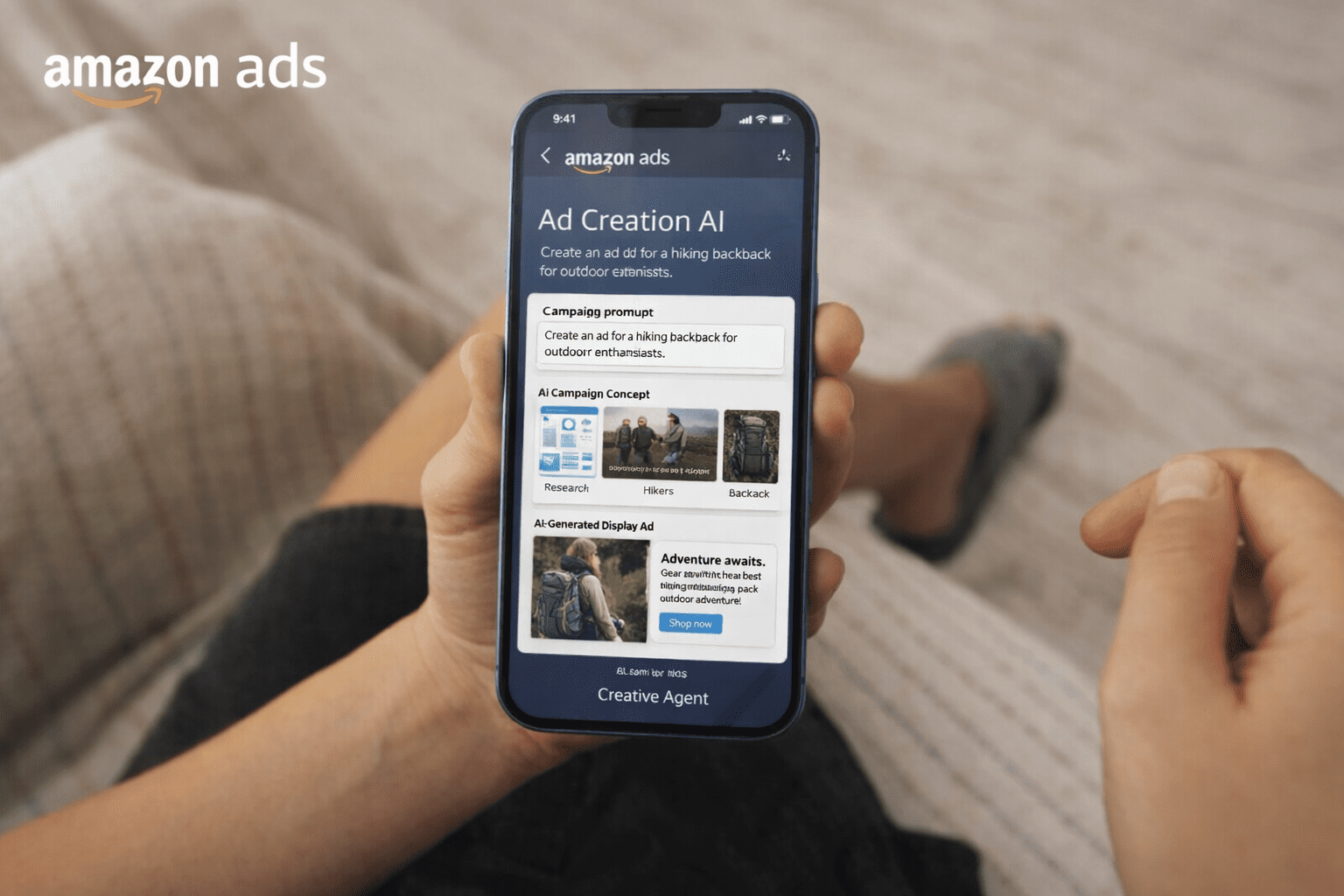

Amazon used its unBoxed 2026 conference in San Francisco on 29 September to launch two new ad tools: Branded Conversations, which lets brands shape what Alexa for Shopping says about their products, and Review Requests, which lets sellers pay to invite verified buyers to rate a product in one tap.
One tool is about the future of AI-led shopping. The other fixes one of the oldest problems on Amazon: new products that nobody trusts yet. Below we break down how each one works, who can use it, what it will cost, and which one deserves your budget first.
The Quick Answer
| Branded Conversations | Review Requests | |
| What it does | Feeds your own product knowledge into Alexa for Shopping conversations started from a Sponsored Brands prompt | Shows verified buyers a one-tap rating request on busy pages like the Amazon homepage |
| Launch | January 2027, US | US open beta from late October 2026 (Amazon’s news post says November) |
| Who it suits | Established brands with several related products | New or under-reviewed products |
| Eligibility | Runs from Sponsored Brands campaigns (Brand Registry needed) | Products with fewer than 1,000 ratings and reviews |
| Pricing | Not published | Not published; reported as cost per click |
| UK availability | Not announced | Not announced; other marketplaces later |
What Amazon Announced at unBoxed 2026
unBoxed is Amazon Ads’ yearly advertiser conference, and the 2026 edition leaned hard into conversational and agentic AI. The backdrop matters: in May 2026 Amazon merged its Rufus shopping assistant with Alexa+ into a single assistant called Alexa for Shopping, built into the search bar. Sponsored Products and Sponsored Brands prompts, which place ad-driven questions in front of shoppers, became generally available in the US on 25 March 2026 on a cost-per-click basis.
Alongside the two tools in this article, Amazon renamed its unified ads console and DSP platform to Amazon Ads Agent, and pushed Full-Funnel Campaigns, where you set a budget and products and Amazon’s AI spreads spend across ad surfaces (MediaPost reports a $100 minimum daily budget). If you run Amazon PPC management in-house, these changes will touch your workflow whether you adopt the new formats or not.
What Is Amazon Branded Conversations?
Branded Conversations is the next step for Sponsored Brands prompts. Until now, when a shopper tapped a prompt such as “Why choose this brand?”, Alexa answered using only what Amazon already held: your detail pages, your Brand Store and campaign data. Branded Conversations adds a new source of truth: product knowledge supplied directly by your brand.
Amazon’s own example is skin care. A brand tells Alexa which cleanser suits oily, sensitive or beginner skin, and which toner and serum pair with it. A shopper who taps “Help me build a daily routine” then gets a specific, brand-informed answer instead of a generic one.
How Branded Conversations Works
- A shopper searches a generic term, for example “coffee maker”, and sees a sponsored prompt such as “Help me decide.”
- Tapping it opens a conversation screen styled with your brand colours, fonts and imagery, clearly labelled Sponsored.
- Alexa suggests follow-up prompts (for example “maximum automation” or “fresh ground beans”) and narrows the options turn by turn.
- Answers combine Amazon’s data on your products with the information you supplied, and the shopper can move straight to purchase.
The Conversational Brief: What You Can Feed Alexa
Brands provide their input through a Conversational Brief. According to Amazon and agency partners at unBoxed, it covers:
- Differentiators — what makes your brand and each product different.
- Product fit — which product suits which customer, need or use case.
- Complementary products — what is often bought together, which enables bundles and upsells.
- Free-text detail — descriptions, features, compatibility and usage guidance.
Briefs can be edited throughout a campaign. If something in the brief breaks guidelines or is inaccurate, Amazon says it will flag it through the console.
What Brands Cannot Control
There are firm limits. Brands cannot choose which reviews Alexa surfaces, and the prompt wording is written by Amazon, not the advertiser. Every conversation carries a Sponsored label with a disclosure that brand-provided information shaped the answer. That means your reviews and your listing content still decide much of what a shopper hears, no matter how good your brief is.
Sponsored Brands Prompts vs Branded Conversations
| Sponsored Brands Prompts (now) | Branded Conversations (Jan 2027) | |
| Conversation | Close to a single question and answer | Multi-turn, with suggested follow-up questions |
| Information used | Detail pages, Brand Store, campaign data | The same, plus your Conversational Brief |
| Brand input | Auto-enrolled; no direct input | Differentiators, use cases, complementary products |
| Prompt wording | Generated by Amazon | Generated by Amazon |
| Look and feel | Sponsored label | Sponsored label plus brand colours and imagery |
| Pricing | Cost per click | Not published by Amazon |
Reporting, Pricing and Early Results
Advertisers will see sample Alexa conversations about their brand, along with prompt-level clicks, conversions and return on ad spend. Amazon has not published pricing. Pacvue reports that Branded Conversations switches on automatically for Sponsored Brands collection campaigns and charges only for the first prompt click, so extra turns in the conversation would not add cost. Treat that as provisional until Amazon confirms it.
On results, Amazon says nearly 20% of shoppers who engage with a Sponsored Brands prompt continue the conversation about that brand, and Pacvue relays an Amazon figure that shoppers who use sponsored prompts convert 48% more often. Both are Amazon-sourced numbers without published test conditions, so benchmark against your own data.
What Is Amazon Review Requests?
Review Requests is a new ad format that asks verified buyers to rate a product they recently purchased. The request appears on Amazon’s highest-traffic pages, such as the homepage, and takes one tap to leave a star rating, with an option to add written text, photos or video.
Amazon has run plenty of review programmes over the years, but this is the first one you can put ad budget behind. In a closed beta in June 2026, Amazon says weekly ratings and reviews for participating products roughly tripled.

How Review Requests Works
- You create a Review Requests campaign in Amazon Ads Agent using the same bidding and budget controls as other campaign types.
- Amazon shows a rating prompt to verified buyers of your product on high-traffic pages.
- The buyer taps a star rating, and can optionally add text, photos or video.
- Amazon checks eligibility throughout the campaign and pauses requests when the product hits 1,000 ratings and reviews.
Eligibility Rules
- Products must have fewer than 1,000 total ratings and reviews.
- Open to registered sellers and vendors in good standing.
- US marketplace first; other marketplaces to follow.
- No incentives: free samples, discounts or other rewards for reviews are not allowed.
Review Requests vs Vine vs the Request a Review Button
| Review Requests | Amazon Vine | Request a Review Button | |
| Who reviews | Verified buyers | Invited Vine reviewers | Verified buyers |
| Cost | Ad spend (reported CPC) | Free units plus enrolment fee | Free |
| Eligibility cap | Under 1,000 ratings/reviews | Ends at 30 reviews | Per order, within the post-delivery window |
| Where it shows | Homepage and high-traffic pages | Vine programme | Amazon-sent email |
| Best for | Speeding up review velocity at scale | Getting the first reviews on a launch | Baseline review flow on every order |
These three work together rather than replacing each other. A sensible launch path is Vine for the first reviews, the free button on every eligible order, and Review Requests when you need to grow review count faster than organic sales allow.
The Cost Question: You Pay for Clicks, Not Reviews
Amazon has not published pricing and directs advertisers to their account team. Trade reports say campaigns bill per click, and Amazon has not said a paid campaign guarantees a rating. That creates two risks: you may pay for clicks from shoppers who leave without rating, and you still pay if the ratings come back poor. Review Requests amplifies whatever your product already deserves. If returns or complaints are high, fix the product and the listing before you spend.
Which One Should You Try First?
For most sellers, Review Requests comes first. It is available sooner, it is simpler to run, and reviews feed everything else: conversion rate, organic rank, and the efficiency of every Sponsored Products and Sponsored Brands campaign. Faster reviews mean less ad spend wasted on a new product nobody trusts yet.
| Your situation | Start with | Why |
| New launch, under 50 reviews | Vine + Review Requests | Social proof is your biggest conversion blocker |
| Growing product, 50–999 reviews, high ACOS | Review Requests | More ratings lift conversion and cut wasted spend |
| Established brand, multiple related SKUs | Branded Conversations (from Jan 2027) | Guided selling and bundles lift basket size |
| Single hero product, 1,000+ reviews | Neither yet; strengthen listing content | Not eligible for Review Requests; limited bundle story |
| UK-only seller | Listing and A+ prep now | Neither tool is live in the UK yet |
Branded Conversations is the bigger long-term shift, but it only works if you can clearly explain who each product is for. If your listings can’t do that, Alexa won’t either.
How to Get Your Listings Ready for Branded Conversations
Alexa reads your detail pages, Brand Store and product guides before it reads your brief. Start preparing now:
- Map every product to a customer. Write one line per SKU: who it is for, what problem it solves, and when it is the wrong choice.
- Rewrite titles and bullets for use cases, not just keywords. Our guide to Amazon listing optimization covers this in detail.
- Upgrade your A+ Content with comparison charts that spell out differences between your own products.
- Document pairings. List which products are bought together and why — this goes straight into your Conversational Brief.
- Refresh your Brand Store with routine, kit or bundle pages that mirror how shoppers ask questions.
- Fix catalogue errors such as broken variations or missing attributes so Alexa does not repeat wrong information.
- Build Sponsored Brands collection campaigns now so you have performance history when the format goes live.
How to Get Ready for Review Requests
- List every ASIN under 1,000 ratings and rank them by sales velocity and margin.
- Check return reasons and negative feedback first; do not pay to collect ratings for a product with a known flaw.
- Make sure the free Request a Review button is already used on every eligible order.
- Set a small test budget per ASIN and track cost per new rating, not just clicks.
- Compare conversion rate and ACOS before and after review growth to measure the knock-on effect on your Amazon PPC campaigns.
What UK Sellers Should Do Now
Neither tool is live on Amazon.co.uk, and Amazon has not given UK dates. But Amazon US features usually arrive in Europe within months, and the preparation is identical. UK brands that tighten listings, A+ Content and review flow now will be ready to launch on day one rather than catching up. If you sell in both markets, start your test in the US and carry the learnings across.
Risks and Open Questions
- Shopper trust. Ipsos found 55% of US adults would trust AI recommendations less if advertisers influenced them, and only 14% would trust them more.
- Competitor visibility. Amazon has not said whether rival products can appear inside your Branded Conversation.
- Conflicting data. It is unclear which source wins when your brief contradicts Amazon’s own product data.
- Unproven costs. Neither tool has public pricing, and Review Requests charges for clicks rather than ratings.
- Launch dates may shift. Amazon’s own pages give different timings for Review Requests.
How EcomRanker Can Help
New ad formats reward brands with clean catalogues, sharp listings and strong review foundations. EcomRanker has managed Amazon accounts across the US, UK, UAE and India since 2017. We can audit your catalogue for Branded Conversations readiness, rebuild listings and Premium A+ Content, and run Review Requests tests alongside your existing Amazon advertising management so every dollar is measured against real ratings and sales.
Book a free Amazon account audit and we’ll show you which of your ASINs qualify for Review Requests and what to fix before Branded Conversations goes live.