
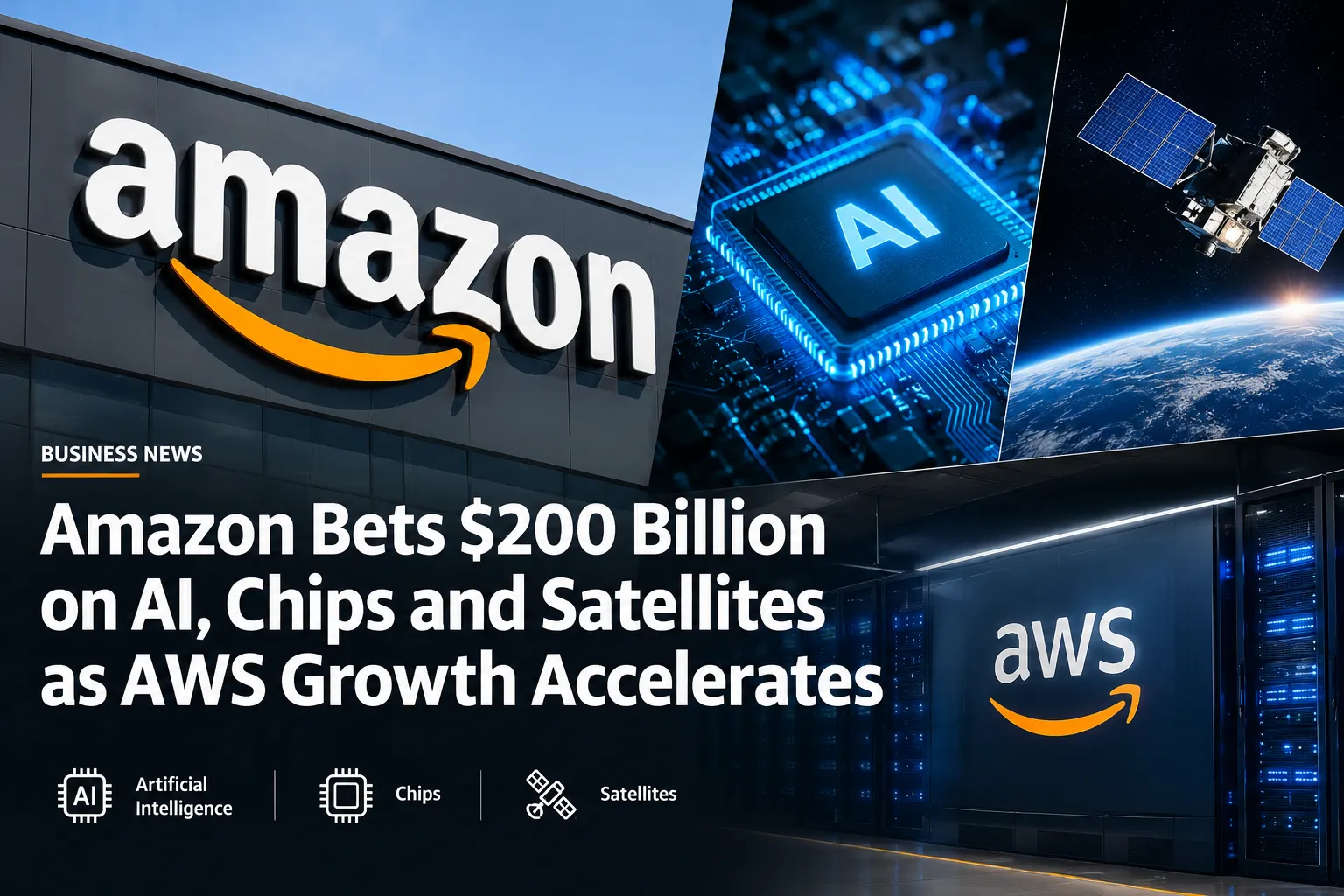
Amazon is stepping up its spending on artificial intelligence infrastructure, custom chips, robotics and satellite connectivity, with the e-commerce giant planning roughly $200 billion in capital expenditures during 2026. The aggressive investment comes as AWS growth accelerates and demand for AI computing continues to reshape the technology industry.
Amazon is making one of the technology sector’s biggest infrastructure bets of 2026, committing approximately $200 billion in capital expenditures across artificial intelligence infrastructure, custom semiconductor chips, robotics and low-Earth-orbit satellite technology.
The scale of the investment highlights how rapidly Amazon is transforming itself beyond its traditional e-commerce business. While retail remains a major source of revenue, Amazon Web Services (AWS), advertising and AI-related infrastructure are increasingly important to the company’s long-term growth strategy.
The investment is also attracting investor attention as Amazon attempts to balance heavy near-term spending with expectations for stronger cloud and artificial intelligence revenue in the coming years.
AWS Emerges as the Core Growth Engine
A major part of Amazon’s investment strategy is centered on AWS, its cloud-computing business.
Amazon reported $42.2 billion in AWS sales during the second quarter of 2026, representing a 37% year-over-year increase. The company said this was AWS’s fastest growth rate in 18 quarters.
AWS also generated $16.6 billion in operating income during the quarter, compared with $10.2 billion a year earlier. The results demonstrate why Amazon is directing substantial amounts of its capital toward additional data centers, computing capacity and AI infrastructure.
Across the company, Amazon reported $200.6 billion in second-quarter net sales, up 20% from $167.7 billion in the same period a year earlier. Operating income increased to $27.5 billion from $19.2 billion.
Amazon’s management has indicated that the company’s AI infrastructure spending is supported by significant customer demand and long-term commitments rather than being purely speculative.
In its shareholder communication, Amazon said it was not investing approximately $200 billion in 2026 capital expenditures “on a hunch,” pointing to customer commitments that support a substantial portion of its AWS investment plans.
Custom AI Chips Become a Bigger Part of Amazon’s Strategy
Amazon is also investing heavily in its own semiconductor technology.
The company has developed custom processors including Trainium for AI workloads and Graviton for general-purpose cloud computing. The strategy allows Amazon to reduce its reliance on third-party processors while tailoring hardware specifically for AWS customers.
Amazon previously reported that its Trainium and Graviton businesses had reached a combined annual revenue run rate of more than $10 billion, with growth continuing at a triple-digit rate.
The company has also been expanding its AI infrastructure through partnerships with major AI developers. This gives Amazon an opportunity to monetize AI demand not only through cloud services but also through the chips and infrastructure required to operate large AI models.
Amazon’s Satellite Ambitions Add Another Layer
Amazon’s $200 billion spending plan extends beyond data centers and chips.
The company is also investing in its satellite connectivity business, known as Amazon Leo, as well as robotics and other emerging technologies.
The satellite business represents Amazon’s attempt to establish a position in the rapidly expanding low-Earth-orbit connectivity market. Amazon has been increasing satellite launches and building out the infrastructure required to compete in a market dominated by established players.
The satellite initiative remains a longer-term opportunity compared with AWS, but Amazon sees connectivity as another potential growth area that can complement its broader technology ecosystem.
Advertising and Retail Continue to Support the Business
Although artificial intelligence has become the focus of Amazon’s investment strategy, the company’s traditional businesses remain important sources of cash and operating profit.
Amazon’s advertising business continues to expand, while its retail operations provide the scale that supports the company’s broader ecosystem.
The combination of retail, advertising and AWS gives Amazon several major revenue engines rather than relying exclusively on its AI investments.
That diversification is important as the company enters a period of exceptionally high capital spending.
The Cost of the AI Expansion
Amazon’s aggressive investment strategy comes with financial risks.
The company’s spending on data centers, servers, networking equipment and AI chips has increased significantly, putting pressure on free cash flow.
Amazon reported a $7.6 billion trailing-twelve-month free cash-flow outflow at the end of the second quarter, with the decline primarily linked to higher purchases of property and equipment associated with artificial intelligence investments.
The company is effectively accepting weaker near-term free cash flow in exchange for the possibility of much larger cloud and AI-related revenue in future years.
This creates an important question for investors: will the revenue generated by AI infrastructure ultimately justify the enormous upfront investment?
Amazon’s management argues that long-term customer commitments, the useful life of data centers and growing demand for AI computing provide visibility into future returns.
Amazon Guides for Stronger Third-Quarter Operating Income
Despite the enormous investment program, Amazon continues to expect substantial operating profitability.
For the third quarter of 2026, Amazon projected operating income between $22.5 billion and $26.5 billion, compared with $17.4 billion in the third quarter of 2025.
That guidance suggests Amazon expects its underlying businesses to continue generating enough operating profit to support its long-term infrastructure expansion.
The company’s second-quarter results also showed the strength of its operating model, with total operating income reaching $27.5 billion, up 43% year over year.
What Amazon’s Spending Means for E-Commerce
For the broader e-commerce industry, Amazon’s investment strategy could have consequences beyond online retail.
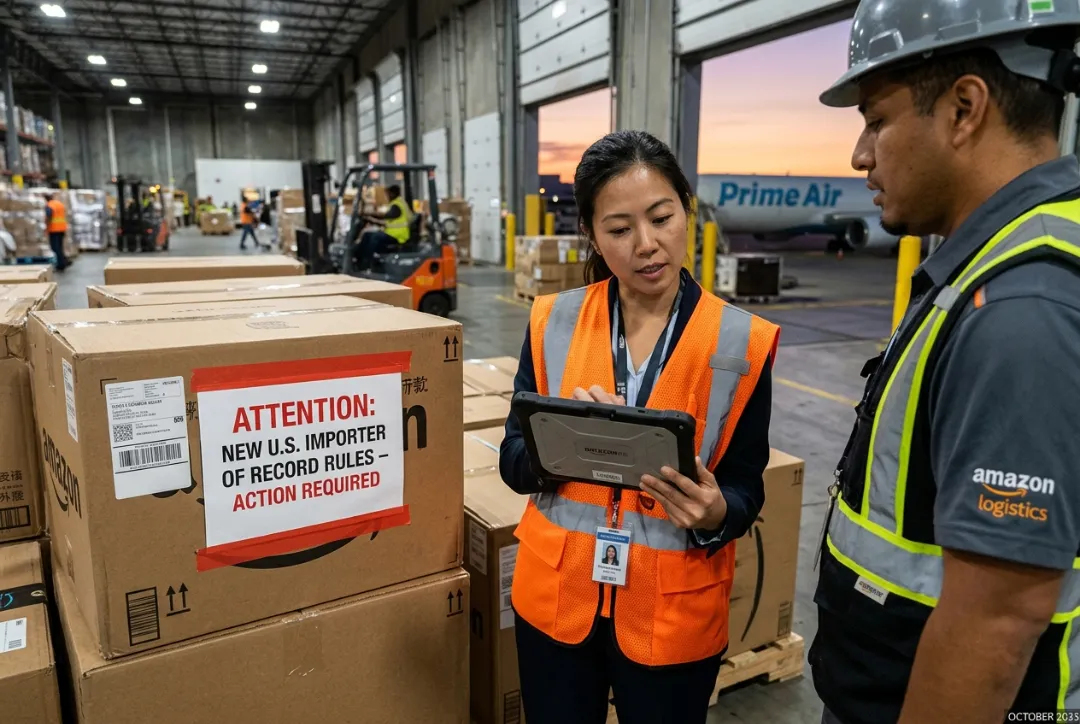
AI-powered logistics, warehouse robotics, automated fulfillment and predictive inventory systems could help Amazon improve delivery speed and operating efficiency.
At the same time, AWS gives Amazon an infrastructure business capable of selling AI computing capacity to businesses that compete with Amazon’s own retail operations.
This creates a potentially powerful combination: Amazon can use AI to improve its internal e-commerce network while also selling the underlying computing infrastructure to external companies.
Investors Focus on Long-Term Returns
Amazon’s $200 billion investment plan represents a major bet on the future of artificial intelligence.
The company is effectively betting that demand for AI computing, cloud services, custom chips and related infrastructure will continue growing fast enough to generate attractive returns on today’s spending.
The strategy carries clear risks. If AI demand slows, infrastructure becomes underutilized or returns on data-center investments take longer than expected, Amazon could face sustained pressure on free cash flow.
However, the company’s rapidly growing AWS business provides a significant financial foundation for the investment.
With AWS sales growing 37% year over year in the second quarter and Amazon guiding for as much as $26.5 billion in third-quarter operating income, the company enters the next phase of its AI expansion with considerable scale.
Bottom Line
Amazon’s roughly $200 billion 2026 capital-spending plan marks a significant shift in the company’s investment priorities, putting AI infrastructure, custom chips, robotics and satellite connectivity at the center of its long-term strategy.
The biggest immediate driver remains AWS, where accelerating revenue growth and strong operating income are providing evidence of rising demand for cloud and AI services.
The challenge now is converting that demand into returns large enough to justify one of the biggest infrastructure spending programs in corporate history.
For the e-commerce industry, Amazon’s strategy also signals that the next stage of online retail competition may depend as much on AI computing, automation, logistics technology and infrastructure as it does on product selection and pricing.